
On the surface, the change of command ceremony that took place July 31 in a hangar at Creech Air Force Base, Nev., didn’t look that much different from scores of others that have taken place across the Air Force this summer.
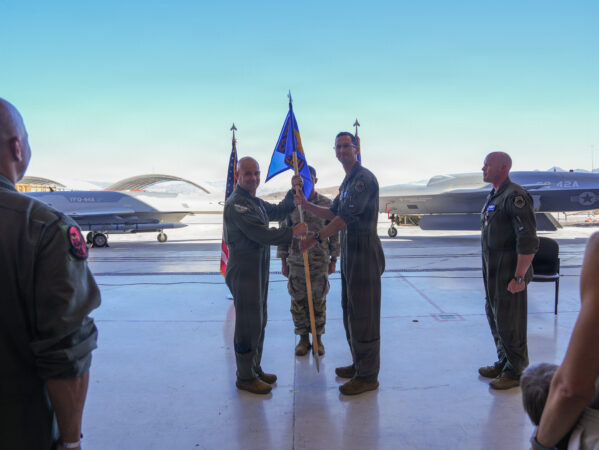
A small flag called a guidon was ceremonially passed from the unit’s outgoing commander to a group commander, who then passed it on to the new unit commander.
But this time, flanking the officers in the background were two of the Air Force’s newest and most cutting-edge aircraft—semi-autonomous Collaborative Combat Aircraft. And the unit in question, the Experimental Operations Unit that is figuring out how best to use CCAs in combat, had just undergone its first change of command since its June 2025 standup.
The change in command is just another sign of how the CCA concept is maturing and becoming entrenched in the Air Force’s structure, to the point where exercises have generated multiple sorties in a single day to simulate high-tempo combat operations. As this happens, officials are moving beyond the novelty of the new type of aircraft and starting to shift its focus to everyday nuts-and-bolts questions such as how best to maintain CCAs while deployed—and which Airmen it wants to have controlling them.
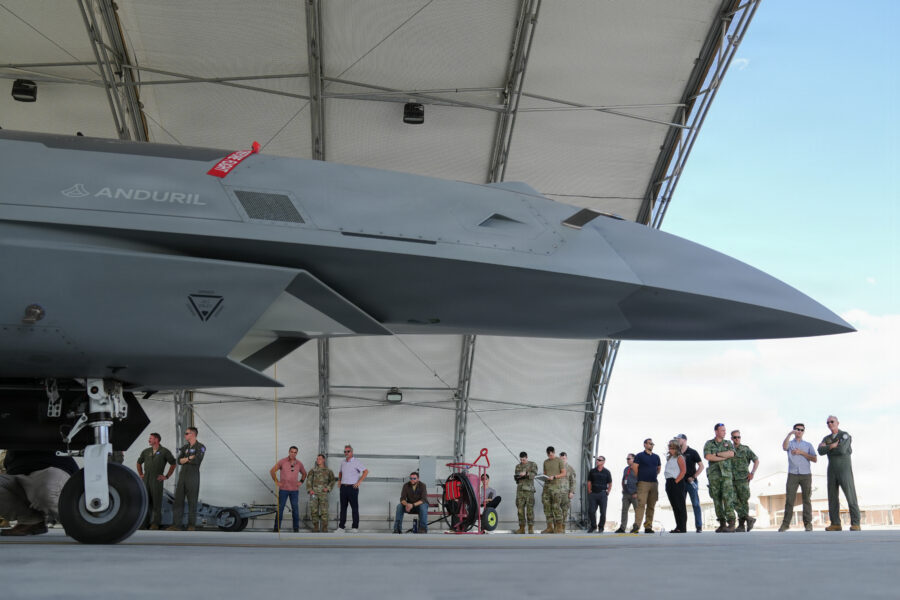
The ceremony in which Lt. Col. Lyndon Bartlett assumed command of the EOU came a little more than a week after a groundbreaking exercise at Creech, in which the Air Force’s first CCAs—General Atomics’ YFQ-42A and Anduril Industries’ YFQ-44A—practiced operating in simulated operational environments.
It marked the EOU’s second exercise with CCAs, following the first in April. In an Aug. 18 blog post, Anduril said the weeklong July exercise included more complex tasks than in the past and expanded the responsibilities of Air Force personnel directing CCAs.
Anduril said EOU operators assigned tasks to CCAs from multiple locations, showing how disaggregated control of the drones could cut manpower requirements and allow Airmen to fly CCAs from austere bases.
Anduril also said operational users oversaw daily mission autonomy flights of the prototype YFQ-44A for the first time, some days generating multiple sorties.
“The latest EOU exercise is tangible evidence that the operational procedures and trust required to field FQ-44 [the production version of Anduril’s CCA] at scale are taking shape,” Anduril said. “Regular testing and experimentation with operational end users is central to how the CCA program will deliver a combat credible capability quickly.”
But having actual CCAs in the hands of Airmen means the Air Force has to figure out how it wants to carry out critical missions such as maintenance—and who should do those jobs.
Col. John Cummings, autonomous collaborative platforms division chief at Air Combat Command, said in a Mitchell Institute for Aerospace Studies podcast released Aug. 15 that coming up with new ways to conduct maintenance for CCAs is “a tough cultural paradigm to break.”
For years, Cummings said, the Air Force has used highly trained, specialized maintainers to work on its most complex jets. But if the Air Force wants small teams to operate CCAs from remote locations, he said, “we really just need that generalist maintainer, so we need everybody to be able to do everything.”
Col. Scott Gunn, commander of the 53rd Wing that oversees the EOU, also said on the podcast that a wide variety of Airmen make up the new experimental ops unit. The Air Force wants to figure out what a future CCA unit might need to be, without any preconceived notions from the past.
“We weren’t exatly sure what a CCA unit would have to look like, and so we cast a wide net of operators,” Gunn said. “So pilots, [weapons system officers], both fighter pilots and [remotely piloted aircraft] pilots. We’ve got engineers, maintainers, security folks, analysts and … intel and cyber folks. … If we model this after a fighter squadron, or a maintenance squadron, or an RPA squadron, we’d probably be missing the mark. Because we would probably try to fit this square peg into a round hole that it doesn’t need to fit into.”
The autonomous capabilities of CCAs continue to grow, Gunn said, and in the near future, controllers will be able to direct multiple CCAs at once.
Cummings said that could mean using navigators or WSOs to control CCAs—but noted that the CCA program faces “cultural headwinds” as it tries to change some of these mindsets.
But eventually, Gunn said, CCA controllers must come to terms with the fact that they won’t truly be the pilots.
“We’re going to get to a point—how soon remains to be seen—where we all need to get comfortable with the fact that it is semi-autonomous, and so there is a human-machine interaction, but humans are not the pilots,” Gunn said. “We are not the ones flying the aircraft. It’s the algorithms that humans have been a part of designing and developing [that are] actually piloting.”