
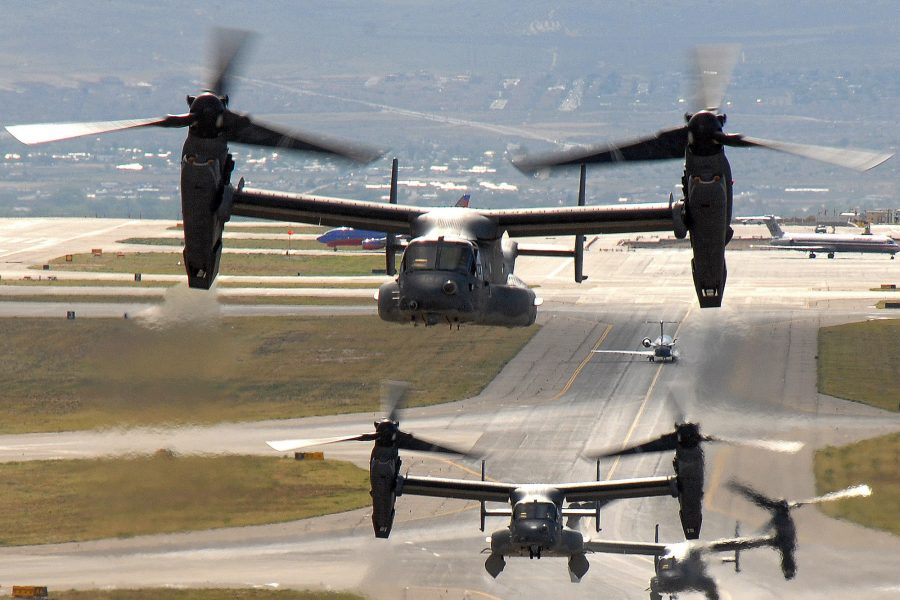
The CV-22 is a medium-lift, vertical takeoff and landing (VTOL) tilt-rotor, primarily used for clandestine long-range, all-weather penetration to insert, recover, and support SOF teams in hostile, denied, and politically sensitive areas.
Derived from the V-22, which flew in prototype form on March 19, 1989, USAF CV-22Bs are equipped with a fully integrated precision TF/TA radar navigation, digital cockpit management system, FLIR, integrated NVG/HUD, digital map system, robust self-defense systems, and secure antijam comms. The CV-22 can conduct shipboard and austere forward operations and is USAF’s sole high-speed vertical lift asset. It is also fully capable of operating in nuclear, biological, and chemical (NBC) warfare conditions.
CV-22s first deployed to Africa in November 2008 and debuted in combat in Iraq in 2009. The Department of the Navy leads joint-service sustainment with USAF funds, while SOCOM manages special operations specific mods. Primary efforts include upgrading the fleet to Block 20 standards, replacing the legacy TF/TA radar with the Silent Knight (in common with the MC-130J), as well as critical safety and maintainability improvements. Block 20 brings the baseline airframe in line with USMC’s MV-22 configuration including new cabin lighting, Color Helmet Mounted Displays, IR searchlight, lightweight ballistic armor, EW upgrades, modernized avionics and mission computers, self-defensive improvements, weapons integration, and ISR and situational awareness enhancements.
AFSOC completed developmental flight-testing the stealthier, low-altitude, night/all-weather navigation radar in 2025 and it is currently in operational testing prior to fielding. Development includes improving the Osprey’s rapid, long-distance self-deployment capabilities, modifying its nacelles to improve safety and maintainability, improving engine IR suppression, and reducing dust/debris ingestion. The nacelles improved availability by more than 20 percent and modifications are anticipated fleetwide in 2026.
Airborne Mission Networking (AbMN) will eventually give the aircrew a common air/ground picture and manage complex workloads (in common with the AC/MC-130 fleet), while TacNet will add lightweight Link-16. The CV-22 fleet was grounded in 2022 and 2023 following a fatal accident linked to engine-gearbox failure. The fleet resumed restricted operation in March 2024, though AFSOC placed 15 aircraft in storage to enable nacelle, gearbox, clutch, and prop-rotor safety improvements. Gearbox replacement began in January 2026, and fleetwide installation is planned by the end of next year, followed by reengineered clutch units. AFSOC postponed full operational capability (FOC) by at least two years and a return to unrestricted flight by a year for safety modifications. Bell Textron delivered the 56th and final CV-22 on April 18, 2025, replacing two unserviceable aircraft withdrawn from service.
CV-22 Osprey Technical Data
Contractors: Boeing; Bell Helicopter Textron.
First Flight: February 2000 (CV-22).
Delivered: Sept. 19, 2005-April 18, 2025.
IOC: 2009.
Production: 56.
Inventory: 53.
Operator: AETC, AFSOC, ANG (associate).
Aircraft Location: Cannon AFB, N.M.; Hurlburt Field, Fla.; Kirtland AFB, N.M.; RAF Mildenhall, U.K.; Yokota AB, Japan. Planned: Davis-Monthan AFB, Ariz.
Active Variant: • CV-22B. Air Force special operations variant of the V-22 Osprey.
Dimensions: Span 84.6 ft, length 57.3 ft, height 22.1 ft, rotor diameter 38 ft.
Weight: Max vertical T-O 52,870 lb; max rolling T-O 60,500 lb.
Power Plant: Two Rolls-Royce-Allison AE1107C turboshafts, each 6,200 shp.
Performance: Cruise speed 277 mph, combat radius 575 miles with one internal auxiliary fuel tank, self-deploys 2,100 miles with one in-flight refueling.
Ceiling: 25,000 ft.
Armament: One ramp-mounted .50-caliber machine gun.
Accommodation: Two pilots, two flight engineers.
Load: 24 troops seated, 32 troops on floor, or 10,000 lb cargo.