
The Air Force wants to pump more than $12 billion over the next five years into its new affordable long-range missiles program and recently asked industry to push the flights of some of those munitions beyond 1,200 miles.
In budget documents released earlier this month, the service outlined plans to spend $12.6 billion on multiyear contracts to procure nearly 28,000 units under its Family of Affordable Mass Munitions program.
The funding request is part of a broader effort across the Pentagon to acquire both expensive projectiles and low-cost options to replenish stockpiles and prepare for a potential large-scale conflict with the likes of China, which could require the U.S. military to strike 100,000 or more targets.
Procurement is set to start relatively slowly for FAMM, with Air Force planners requesting $355 million for 1,000 missiles in the 2027 budget.
But the Future Years Defense Program, which projects five years out, shows dramatic increases coming:
- 2028: $1.85 billion for 5,300 missiles
- 2029: $2.3 billion for 5,920 missiles
- 2030: $4.03 billion for 7,700 missiles
- 2031: $4.13 billion for 7,990 missiles
The FAMM program is split into two efforts: one for lugged munitions, carried by fighter and bomber aircraft, and another for palletized munitions, dropped in batches from cargo aircraft. Budget documents did not specify the quantities of lugged or palletized munitions the Air Force is seeking, but they did indicate the palletized version is the service’s first priority.
For now, USAF is seeking munitions capable of striking targets within a range of 250 to 500 miles.
But those documents also note that “future increments” of FAMM program funding could be spent on extended-range capabilities, beyond line-of-sight, and long-range kill-chain communications.
Longer Ranges
An April 20 notice from the the Air Force Life Cycle Management Center seeks information from industry on an affordable cruise missile capable of traveling more than 1,200 miles to hit slow-moving ships, dubbed FAMM-Beyond Adversary Reach.
The center is interested in a weapon that can fly at least 537 mph and receive midcourse navigation updates, according to the notice. Contractors would need to produce 1,000 to 2,000 missiles annually.
The project aims to “streamline the battlespace by developing a single, common, air-to-surface munition that is affordable, adaptable, and possesses significant standoff range.”
For that, the center wants more flexibility on which platforms can launch the potential weapon.
They’re seeking “a weapon that must be both internally/externally lug-mounted by fighters/bombers and deployed from a cargo pallet or for maritime operations on [U.S. Navy] ships,” according to the notice, though the initial use case will be from a pallet.
Beyond the aircraft and ship needs, the missile must also be able to strike land-based targets using Army ground launchers.
Palletized Efforts
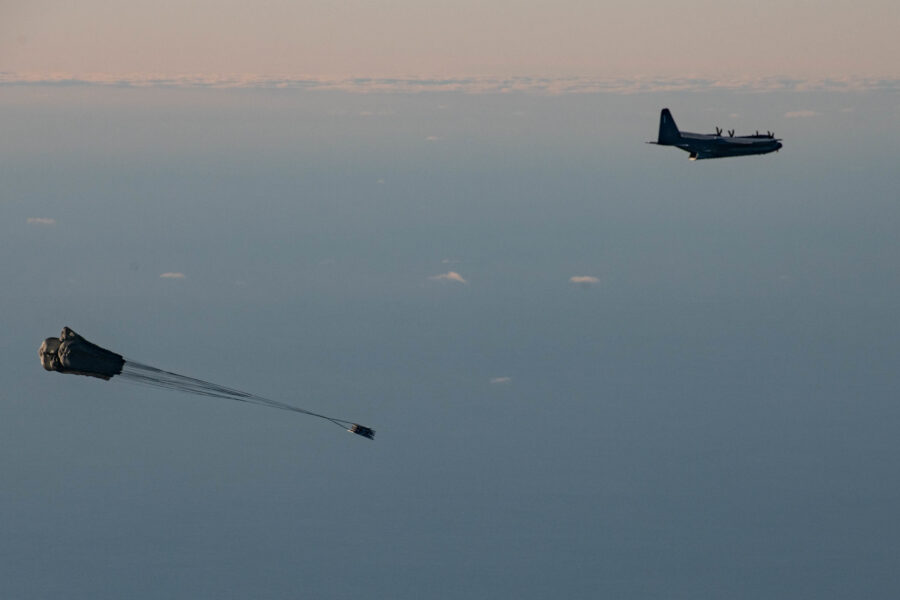
The palletized aspect of the missile’s capabilities closely follows a Air Force experimental program called Rapid Dragon that dates back to 2019, seeking to turn the Air Force’s cargo aircraft into weapon delivery systems.
As part of Rapid Dragon, the Air Force Research Lab conducted multiple tests from both the C-130 and C-17, including a live-fire test from Eglin Air Force Base in December 2021,
In that test, the crew of an Air Force Special Operations Command MC-130J Commando II dropped pallets of nine AGM-158B Joint Air-to-Surface Standoff Missiles-Extended Range.
The JASSM-ERs were put in pallet crates, dropped from the aircraft, and then extracted from the pallet by a parachute, according to the AFRL release. The missiles’ engines then ignited and the weapons sought their targets.
The JASSM-ER is built by Lockheed Martin, along with its maritime target option, the Long-Range Air-to-Surface Missile, and is considered an “exquisite” or high-technology, high-cost round at $1.5 million apiece.
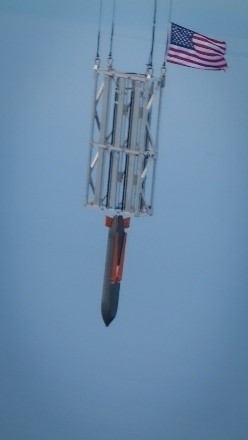
The Rapid Dragon palletized experiment transitioned to a program run by the Defense Innovation Unit, dubbed “Franklin,” which aimed to develop long-range weapons at $100,000 per round, Air & Space Forces Magazine reported.
Lt. Gen. Michael G. Koscheski, then-deputy commander of Air Combat Command, said at the 2024 Air Force Futures conference hosted by the Mitchell Institute for Aerospace Studies that the Franklin program would produce a “$100,000 weapon that can go about 500 miles and can punch a hole in a ship.”
Since then, many companies have unveiled their own low-cost missiles: Anduril’s Barracuda, Lockheed’s Common Multi-Mission Truck, L3Harris’ Red Wolf, Leidos’ Black Arrow, and Zone 5 Technologies’ Rusty Dagger.
Yet another, CoAspire, recently unveiled its entrant into the low-cost cruise missile market at the annual Navy League Sea-Air-Space trade show, calling the munition the Rapidly Adaptable Affordable Cruise Missile-Extended Range, according to the company’s website.
The RAACM-ER can fly 1,200 miles and is built to launch from sea, air, and ground platforms.
