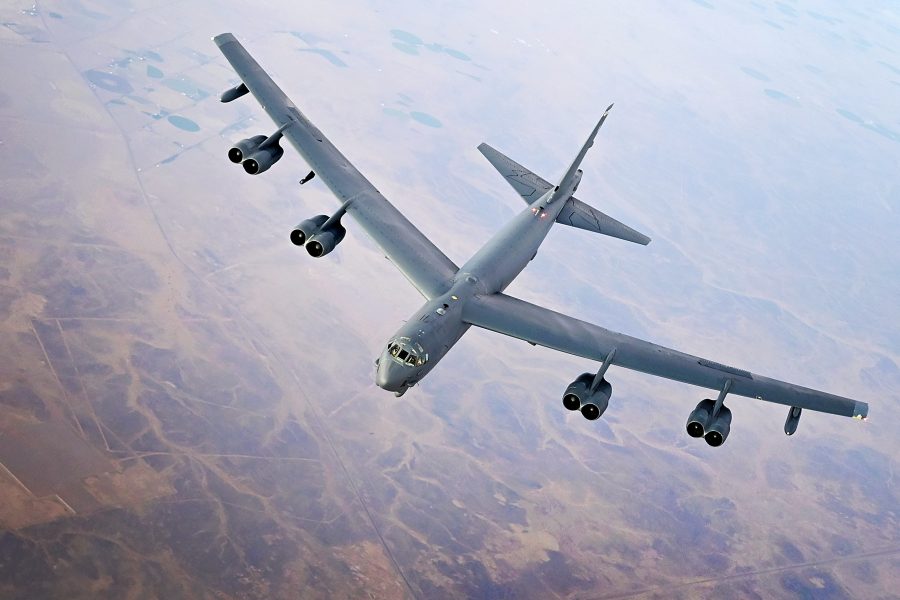
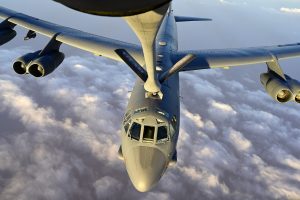
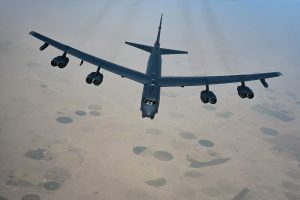
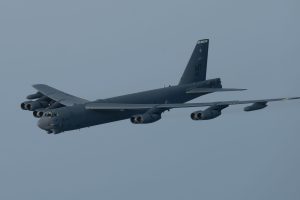
A U.S. Air Force B-52 Stratofortress, assigned to the 5th Bomb Wing, conducts a presence patrol mission over the U.S. Central Command area of responsibility June 12, 2024. The U.S. remains committed to regional security and is prepared to respond to any state or non-state actor seeking to broaden or escalate conflict across the region. (U.S. Air Force photo by Master Sgt. Matthew Plew)
Audio of this article is brought to you by the Air & Space Forces Association, honoring and supporting our Airmen, Guardians, and their families. Find out more at afa.org
Air Force B-52 bombers roared over the Arabian Peninsula twice last week, flying alongside an American MC-130J and allied fighters during bomber task force missions.
The Stratofortresses, originally from Minot Air Force Base, N.D., came from RAF Fairford, U.K., where they are currently deployed for a bomber task force.
The June 12 and June 14 flights “incorporated fighter escorts from several coalition nations,” Air Forces Central said in a release, though they did not disclose what nations flew alongside the B-52. The release noted that the flights included passes over the Red Sea and Arabian Gulf.
“Bomber Task Force missions highlight the U.S.’s ability to rapidly field combat airpower while enhancing training opportunities and interoperability for regional allies and partners operating alongside U.S. forces,” the release stated.
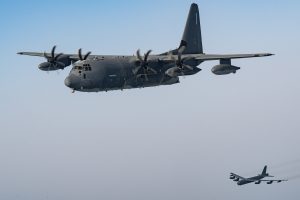
On at least one flight, the B-52 was joined by a U.S. Special Operations Command-operated MC-130J. AFCENT noted in its release that the MC-130J took part in familiarization training this spring, with Airmen in the Middle East orienting themselves on “palletized effects”—cruise missiles on a pallet dropped out the back of cargo aircraft.
The B-52s’ tour over the Middle East comes as the region remains on edge. Israel’s war against Hamas in Gaza continues, and Houthi rebels in Yemen have intensified their attacks on shipping in the Red Sea. Over the past several days, U.S. Central Command said it struck several Houthi missile launchers, sensors and drones, though it did not disclose what assets it used to conduct the strikes.
In April, B-1 bombers on a rotation in Spain deployed to Turkey for exercises, bringing them close to the Middle East. In February, B-1s flew from the continental U.S. to take part in dozens of airstrikes in Iraq, Syria, and Yemen. And last November, B-1s flew three missions in CENTCOM over the course of eight days.
It’s been a little while longer since a B-52 flew over the region—in March 2023, a B-52 from Minot was escorted by fighters from seven different countries during a bomber task force mission.
Audio of this article is brought to you by the Air & Space Forces Association, honoring and supporting our Airmen, Guardians, and their families. Find out more at afa.org
The Pentagon and Lockheed Martin on Oct. 22 announced a framework agreement to buy F-35 Joint Strike Fighters for the next 10 years. But the deal, touted by the Pentagon as “landmark” and a first of its kind, depends on Congress granting the military authority to enter into such a…
At least two KC-135 Stratotankers that were seriously damaged during Operation Epic Fury are still undergoing extensive maintenance depot repairs, the head of Air Force Materiel Command said Oct. 21.
As the Air Force wrestles to solve the logistics of dispersed operations in the vast Indo-Pacific, it’s investing $3.5 million to help develop a new kind of aircraft: a blended-wing body freighter that’s smaller than a C-130 but larger than a Cessna for “sub-tactical” lift.
Roughly two of every five fighters in the Air Force fleet could be F-35As by 2035, according to a new fighter force structure report the service submitted to Congress on Oct. 16. Lt. Gen. David Tabor, deputy chief of staff for plans and programs, revealed the new estimate during an…
The Air Force Life Cycle Management Center is moving forward with a program to upgrade a quarter-century-old computing system for some F-16 fighter jets.
The U.S. Navy on Oct. 15 accepted a C-130J-30 Super Hercules plane that it will modify to become the first of its new nuclear command, control, and communications aircraft—a route the Air Force is considering for a similar NC3 mission under congressional direction.
More than 40 years after the original YF-117 operational prototype flew test runs from a Lockheed Martin Skunk Works facility, an F-117 returned for a $1 million refurbishment to look its best when it assumes its place in history alongside other iconic aircraft on permanent exhibit at the National Air…
A U.S. Air Force F-22 pilot controlled a YFQ-44A Fury Collaborative Combat Aircraft this month while both aircraft were in flight, according to an Oct. 16 release, another milestone in the service’s ambitious CCA efforts.
The Marine Corps recently conducted its first-ever “ripple” release of eight Small Diameter Bomb IIs from an F-35B, a key early step in proving out the capability for all F-35 variants.
✓
Thank You!
Check your inbox to verify your email address and finish setting up your AFA account.
★
Welcome Back!
An account with this email already exists. Please log in to continue.
Subscribe to the Air & Space Forces Daily Report
The latest news from Air & Space Forces Magazine, as well as news from other leading publications, delivered right to your inbox every morning!
We’re sorry, there has been an error. Please review your input or try again later.