
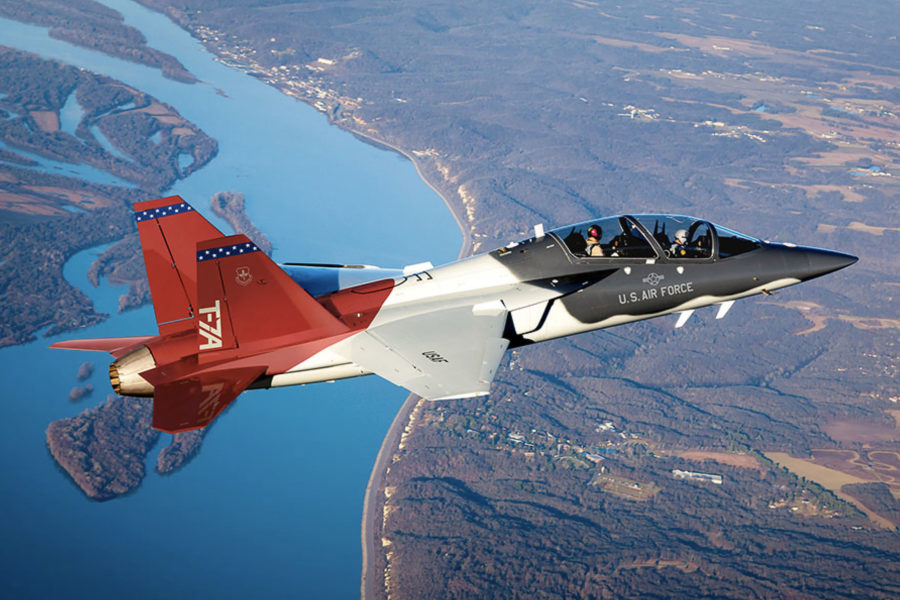
The T-7A Red Hawk is the Air Force’s developmental next-generation, supersonic advanced jet trainer. The service selected the joint-venture Boeing-SAAB aircraft as the winner of its $9.2 billion “T-X” competition to replace the T-38 on Sept. 20, 2018. The Air Force dubbed the type “Red Hawk” in honor of the WWII Tuskegee Airmen.
The T-7A was developed in fewer than three years using digital design techniques to quickly field new, low-cost designs. The aircraft was designed from the outset to replicate the systems and performance of advanced fourth- and fifth-generation aircraft, including high-G/high angle of attack performance and a blend of synthetic and onboard systems such as simulated radar, defensive systems, data links, and smart weapons. It incorporates fly-by-wire controls, a fully digital glass cockpit, “stadium seating” to improve backseat visibility, next-gen ACES 5 ejection seats, modular systems architecture, and maintainer-friendly design to cut downtime and life-cycle cost.
T-7A is being developed in tandem with the Ground-Based Training System simulator and courseware to provide AETC with a seamless, comprehensive flight training program. The first of two “production ready” airframes flew from Boeing’s facility at St. Louis on Dec. 21, 2016, launching initial flight-testing with the manufacturer.
Boeing delivered the first of five production-representative aircraft to Edwards on Nov. 9, 2023, launching USAF and Boeing developmental flight-testing. Boeing flight tests over the last year focused on correcting deficiencies for type certification, including instability at high angles of attack, and concerns with ejection seats, as well as fine turning flight control software, engines, and flight dynamics. USAF developmental testing is focused on evaluating wing flutter, flight dynamics, structural loading, and systems including the on-board oxygen generation system (OBOGS).
Deficiencies uncovered in early testing and supply chain problems delayed the low-rate production decision two years to 2026, and USAF now plans to complete developmental tests and reach initial operational capability in 2028. AETC received the first operational T-7A at JBSA-Randolph, Dec. 5, 2025, starting initial operational testing and prior to instructor pilot qualification in 2027. JBSA-Randolph expects delivery of the second of 14 T-7As this spring.
T-7A Red Hawk Technical Data
Contractors: Boeing-SAAB, General Electric (engine), Collins Aerospace (cockpit/ejection seats).
First Flight: Dec. 20, 2016 (T-X).
Delivered: 2023 onward (planned).
IOC: 2024 (planned).
Production: 351 (planned).
Inventory: Three (not including contractor-owned test airframes).
Operator: AETC; Planned: AFMC.
Aircraft Location: Edwards AFB, Calif.; JBSA-Randolph, Texas. Planned: Columbus AFB, Miss.; Laughlin AFB, Sheppard AFB, Texas; Vance AFB, Okla.
Active Variant: •T-7A. Developmental next-generation advanced trainer.
Dimensions: Span 30.6 ft, length 46.9 ft, height 13.5 ft.
Weight: Max T-O 12,125 lb.
Power Plant: General Electric F404-GE-103 augmented turbofan, 17,200 lb thrust.
Performance: Speed Mach 1.05+, range approx. 1,140 miles.
Ceiling: 50,000 ft+.
Accommodation: Two pilots on ACES 5 zero/zero ejection seats.