


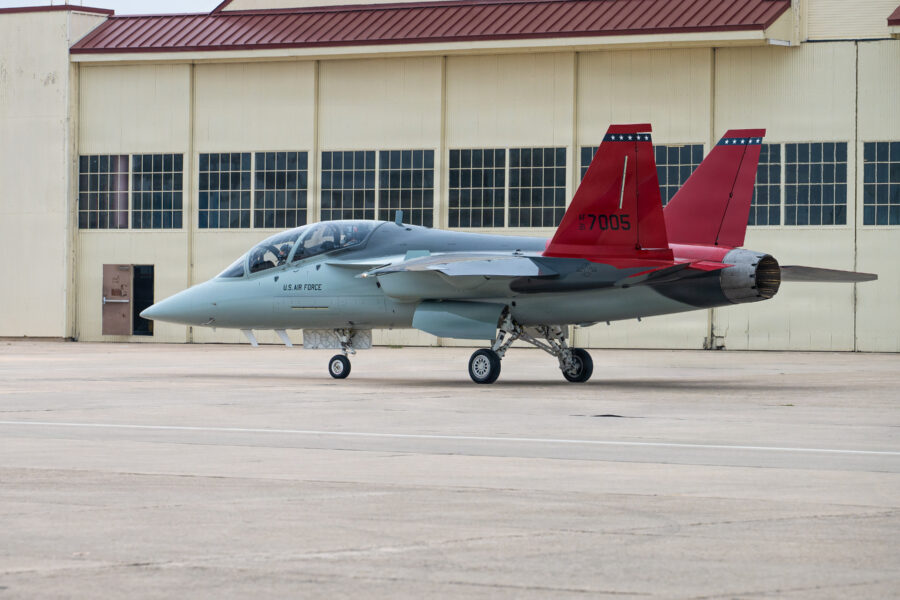
The Air Force plans to buy the engines for its new T-7A trainer directly instead of having Boeing, the plane’s maker, provide engines as part of its contract.
The change could carry costs, but gives the service more control over a critical component of the jets.
The Air Force Life Cycle Management Center released two “sources sought” notices for F404-103 engines in early July—one for the engines themselves, and a second for the engine’s technical data package, which is necessary for supporting acquisition and sustainment.
The F404-103 is a derivative of GE Aerospace’s F404 engine, which powers the F/A-18 Hornet. The variant was developed for the T-7 and to date, “engines have been included with Boeing’s T-7A aircraft orders,” a spokesperson for the Life Cycle Management Center told Air & Space Forces Magazine.
Now the Air Force is working on a deal with Boeing to provide the engines to Boeing as government-furnished equipment, the spokesperson confirmed. “The Air Force is actively preparing for this direct procurement strategy, pending an agreement between the Air Force and Boeing,” the spokesperson said.
A Boeing spokesperson said the two sides “began exploring this approach to allow the Air Force to own the engine procurement while we focus on the remainder of production. Our goal is to deliver the game-changing T-7A training system to the U.S. Air Force, and all of our negotiations are focused on how we can do that most efficiently and effectively.”
Breaking Defense first reported on the the potential arrangement in a series on the T-7 last month. The notice is the first public confirmation from the Air Force that it is taking steps to do so.
A formal request for proposals is expected late this year, the AFLCMC spokesperson said.
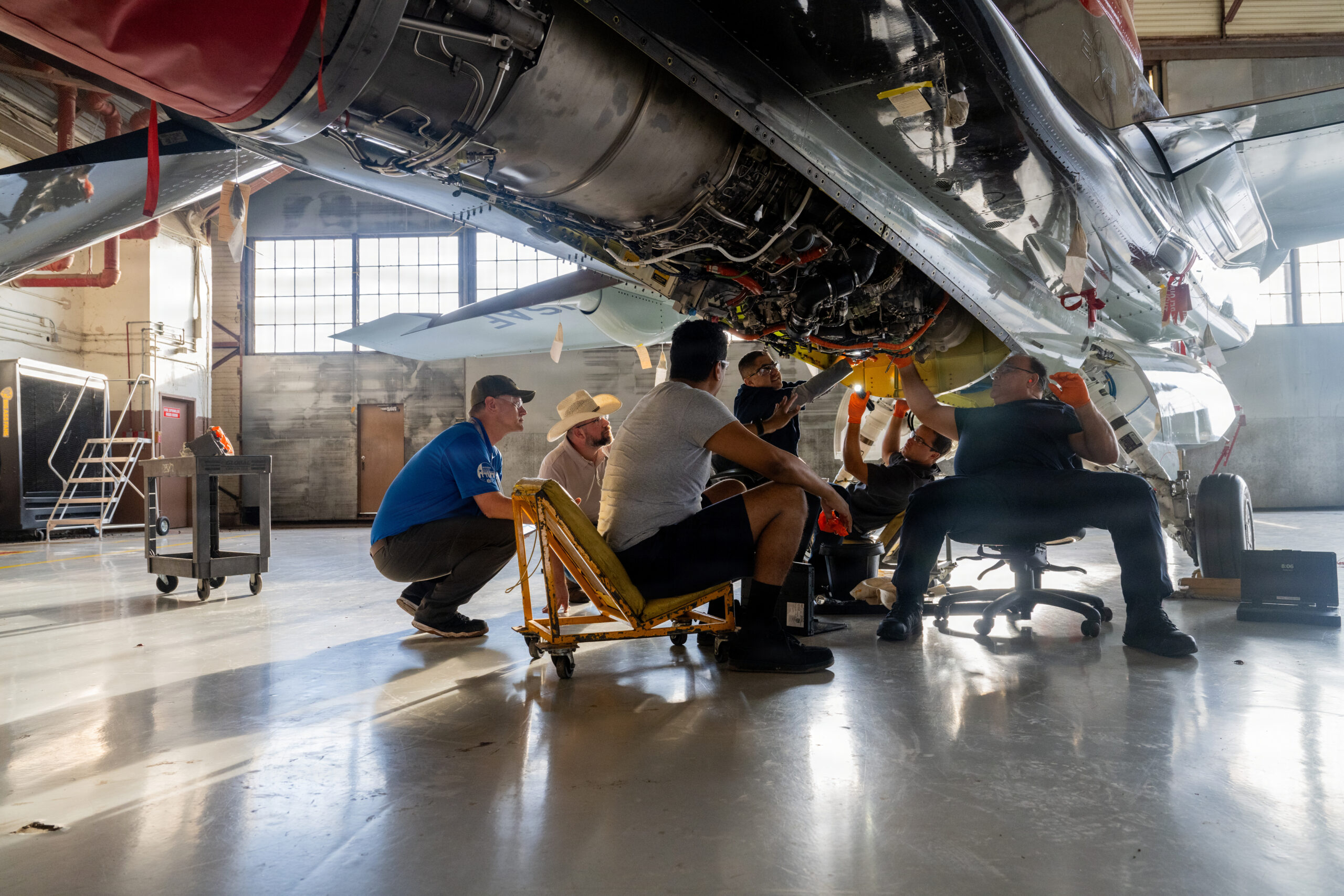
The notice for the technical data package is distinct from engine procurement, the Air Force spokesperson said, explaining that the data package is needed “to stand up organic depot-level repair capabilities for long-term sustainment.”
But the fact that the service needs the data package would seem to confirm one of the issues that may have led to officials deciding to purchase the engines separately, longtime defense analyst J.J. Gertler told Air & Space Forces Magazine: ensuring that USAF gets all the needed technical data for the T-7.
“Boeing had apparently, at least according to the government, not included proper pass-through clauses in their deals with some suppliers to get the technical data the government believes it needs,” said Gertler, director of The Defense Concepts Organization and senior advisor at AeroDynamic Advisory. “I don’t know if one of those suppliers was General Electric, but if the government believed that they were having trouble getting the documents they needed from General Electric on this deal, [there is a solution.] Contracting directly with GE, the government can put that into contract.”
Breaking Defense reported in June that the Air Force concluded that T-7 sustainment was “high risk” because of questions about technical data rights.
Gertler said the Pentagon’s past experience with the F404 powerplant through the F/A-18 program—the Marine Corps still flies F/A-18s with the F404—could also be a factor.
“The U.S. government has been buying F-404s in large numbers for decades. … The original contract on that engine came with data—not the manufacturing data, but because the government had funded the development of the engine, they got the rights to operational-level and intermediate-level maintenance data for those engines,” Gertler said. “And the government may believe that they already have that paperwork in hand and can leverage that by making a deal direct with GE.”
Costs
It’s not unusual for the Pentagon to buy jet engines separately from the aircraft. It does just that with the F-35, built by Lockheed Martin, and its F135 engine, made by Pratt & Whitney. It does the same with the Boeing-built F-15EX and GE-built F110-129 engines.
What’s different here is that the Air Force is changing approaches midway through the program.
In negotiations, the Air Force could try to push for lower costs. Neither the government nor Boeing commented on how the change could affect T-7 pricing. But Gertler said the issue is a key question.
“If the engine is government-supplied equipment,” Gertler said, “what’s the … the new price per T-7?”
He added that renegotiating now is fraught. Boeing has already lost several billion dollars on the fixed-price T-7 deal and will want to recoup some of those losses in negotiations. Another risk is potential disruptions to production at the very time the Air Force is trying to ramp it up. The engine procurement notice states production would begin in 2032. Budget documents indicate plans to buy 60 T-7s per year by then, when full-rate production gets going.
The government notice states a requirement for 200-300 engines and up to 105 spares. The cost of such a deal is unclear, but for comparison:
- The U.S. Air Force and GE agreed to a $1.58 billion deal in 2021 for up to 329 F110-129 engines for the F-15EX.
- GE also agreed in 2021 to sell 99 F404-GE-IN20 engines—another F404 variant to support the Indian Air Force’s Tejas fighteR.