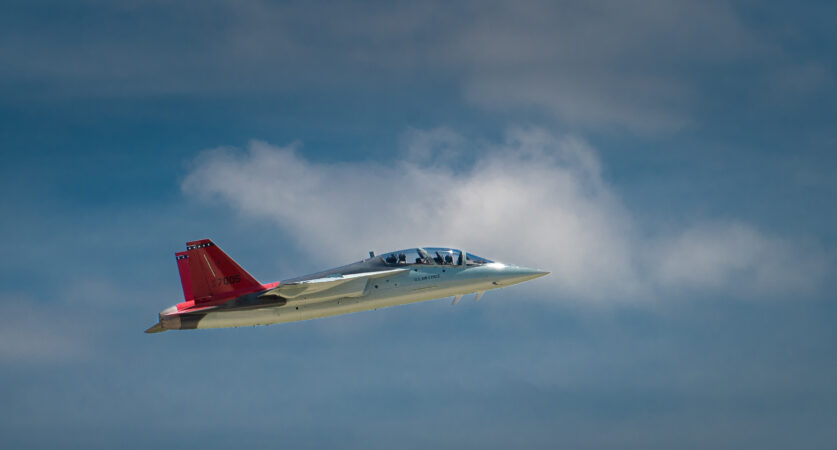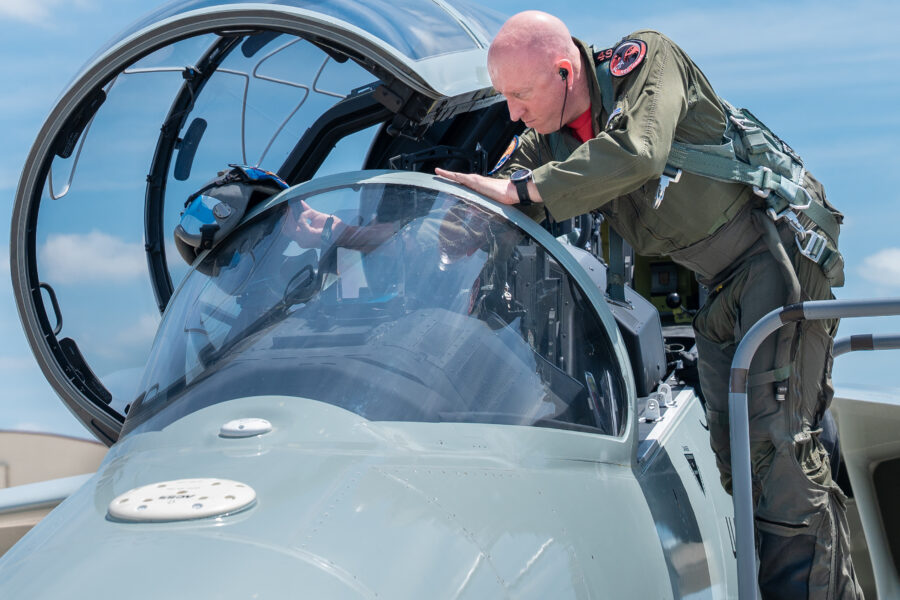
Air Education and Training Command has ticked off another box on the long checklist it must complete to start training student pilots on the new T-7A Red Hawk: qualifying its first instructor pilots.
The command announced the milestone June 3. Lt. Col. Michael Trott and Lt. Col. Phillip Bourquin are the command and director of operations, respectively, for the 99th Flying Training Squadron and have been familiarizing themselves with the T-7 since the unit accepted its first jet in December.
The 99th is the first operational unit in the Air Force to get the T-7. It will serve as the schoolhouse for future T-7 instructor pilots, training the Airmen who will then go on to train new pilots.
To get there, members of the 99th have to qualify on the jet themselves, learning from Boeing and Air Force test pilots.
The qualification process began in earnest when Trott and Bourquin helped fly the first two T-7 production jet from Boeing’s St. Louis facilities down to Joint Base San Antonio-Randolph, Texas.
But both Airmen have plenty else on their plate too—all 16 members of the 99th are working with Boeing contractors to set up and test the first T-7 simulators, reviewing flying guides and technical orders from Boeing, sharing feedback, and developing a training syllabus for future instructors to use to teach the T-7.
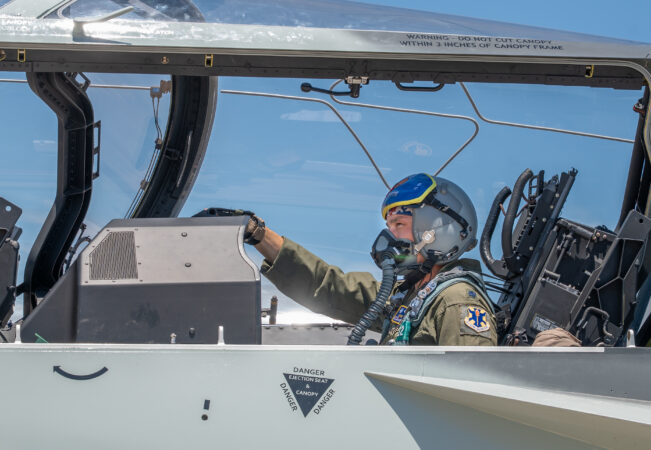
The qualification process has also taken time because the squadron only has two jets to start, and one is being kept largely in reserve so maintainers can train on it.
Now that Trott and Bourquin are qualified, AETC says the squadron has “operational independence,” meaning the new instructor pilots will be able to teach their squadron-mates instead of relying on outside help.
That process won’t start right away, as Trott and Bourquin said they intend to gain more experience through “seasoning” sorties before flying as IPs with the other members of the squadron.
Eventually, though, all of this initial cadre will be qualified on the T-7, a process that will likely pick up steam as more Red Hawks are delivered. The next is expected in August.
As everyone is qualified, the squadron will work on initial operational test and evaluation for the T-7 and finishing the syllabus for Pilot Instructor Training, leading up to the declaration of initial operational capability, targeted for summer 2027.
At that point, the 99th will start teaching new instructor pilots from outside the initial cadre. From there, those new instructor pilots will scatter across AETC’s bases to start teaching students. Columbus Air Force Base, Miss., is first after JBSA-Randolph to get the T-7, with first delivery planned for fiscal 2027.
The T-7 is intended to replace the T-38 Talon as the Air Force’s advanced training jet for future fighter and bomber pilots. The T-38 dates back to the 1960s and has become increasingly hard to maintain. On top of that, officials say the Talon was designed to train pilots to fly third-generation aircraft and is not equipped to prepare Airmen for fifth-gen platforms—to say nothing of coming sixth-generation aircraft like the B-21 and F-47.
Officials have described the T-7 to Air & Space Forces Magazine as a modern, flexible platform: high-performance enough to pull up to 8 Gs, yet more forgiving than the T-38.
“It flies like a fighter, maneuvers like a fighter,” Trott said in January. Boeing drew on existing designs, employing landing gear based on the F-16’s and the same engine as that powering the F/A-18. The control stick is on the side, just like in the F-35 and F-22.
The aircraft’s Large Area Display can also be customized to show new pilots a simple layout of basic data or more advanced students a dizzying array of complex data. That flexibility has led AETC leaders to begin exploring whether to shift some undergraduate pilot training duties from the T-6 to the T-7, in addition to taking on the higher-end training done with the T-38.