


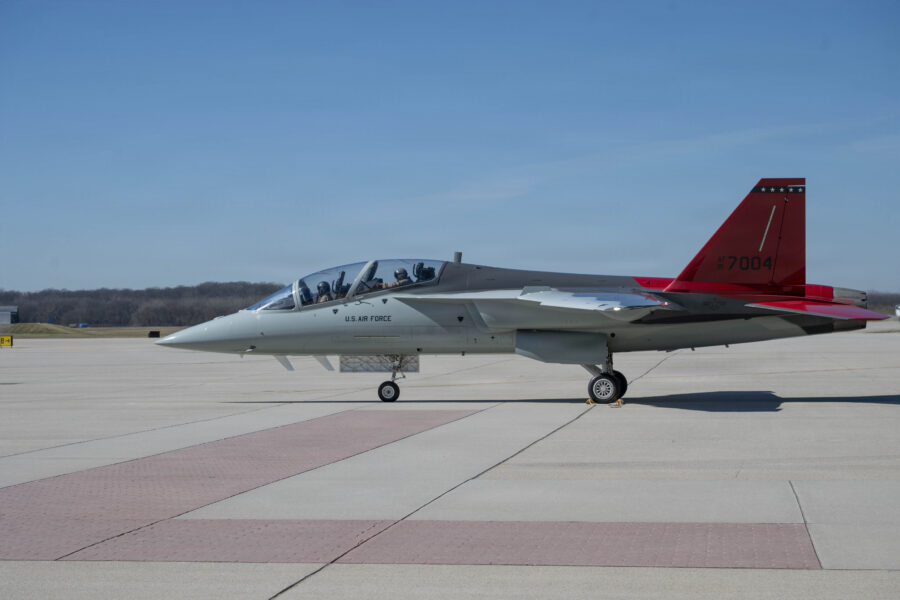
The Air Force just got its hands on its first operational T-7A trainer jet, and officials are already thinking about adding a slew of upgrades—including some that could help the service use the Red Hawk to train less experienced pilots.
The T-7A program office released a sources sought notice June 16 for “modernization and sustainment of the T-7 family of systems” that specifies five areas where officials are looking to add capabilities, though the list is not meant to be exhaustive:
- Terrain and air collision avoidance
- Barrier capability
- Selectable G-limits
- Pilot vehicle interface
- Embedded GPS and Inertial Navigation System
Work on such upgrades and other sustainment activities could begin as early as fiscal 2029, the notice states.
The Air Force tapped a contractor team of Boeing and Saab in 2018 to develop a new platform for advanced pilot training to replace the aging T-38C Talon. That became the T-7, which Air Education and Training Command officials say will offer a generational leap in capability over the 1960s-era T-38.
The T-7 has faced delays that stretched what was once envisioned as an extremely fast development timeline by several years. But the program just recently transitioned to low-rate initial production, the first two operational jets are at Joint Base San Antonio-Randolph, Texas, and AETC leaders are exploring the idea of expanding the T-7 beyond advanced training to include some undergraduate pilot training for brand new pilots.
Some of the modernization upgrades specified in the sources sought notice would boost T-7 safety, especially for less experienced pilots.
On G-limits, for example, the program office says it is interested in a “Dial-a-G” capability that lets pilots set a maximum number of G-forces they can reach below the T-7’s max limit of 8.
“A pilot-selectable G-limiter is desired with the ability to restrict inexperienced students to a lower G-capable aircraft,” the notice states. “This feature will allow a selectable function so increased G-load can be presented to the student as experience is gained.”
Ideally, the notice adds, the pilot would be able to override the system with a switch, but the jet would respond to such an input slowly to limit the likelihood of G-induced loss of consciousness, or G-LOC.
G-LOC is also one of the dangers that the collision systems would address. Ground collisions can occur due to “inattention or G-induced loss of consciousness,” the T-7 notice states, while the risk of air collisions increases during “dynamic air-to-air maneuvers, especially critical for solo students or dual crews.”
Instances of G-LOC are most common among aircrew in training, particularly those with the least experience. A 2006 study of Royal Air Force aviators found that 77.4 percent of reported G-LOC incidents occurred on training aircraft, and 64 percent occurred with crew who had fewer than 100 hours of flight time—less than the number of flying hours U.S. Air Force students get in undergraduate pilot training.
Collision avoidance systems alert pilots if they are about to hit the ground or something in the air, and automatic systems can even maneuver the jet themselves to avoid the danger. The Air Force Research Laboratory has worked with Lockheed Martin and NASA to develop both automatic ground and air systems.
Another safety feature the notice addresses are barriers—the nets and cables used to slow down and stop aircraft threatening to leave the runway. The Air Force wants to better understand how the T-7 interacts with these barriers.
“Evaluation of T-7 aircraft with these systems will provide data needed to inform T-7 compatibility during high-speed engagements and development of appropriate procedures for the use or avoidance of such arresting systems,” the notice states.
The upgraded inertial navigation system would also let pilots fly in situations where GPS signals are degraded or jammed.
Cockpit Aids
Not all the modernization upgrades the Air Force is suggesting are about safety. The service is also looking for ways to improve the displays and controls in the cockpit “that allow for fourth- and fifth-generation fighter/bomber skills to be trained.”
Those could include new features for situational awareness and navigation features, like more touch selections on the T-7’s main Large Area Display screen, and the ability to cue sensors from a tactical situation display, plus the ability to reprogram the throttle and stick buttons for different commands.
All told, the sources sought notice lists nine different ways the pilot vehicle interface could be improved.