
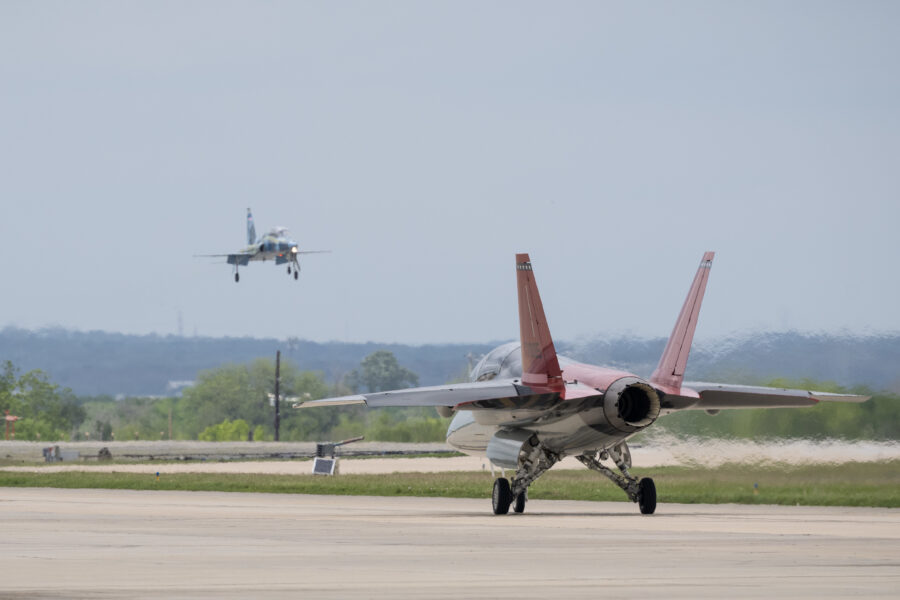
Multiple delays have pushed the full-rate production decision on the T-7A Red Hawk back two years to 2029, the Government Accountability Office said in a new report. The assessment is another setback for the Air Force’s next-generation trainer aircraft, which has been plagued by issues throughout its development.
The Air Force had previously expected to reach a full-rate production decision on the Boeing-made T-7, intended to replace the aging T-38C Talon, in January 2027, according to GAO’s previous Weapon Systems Annual Assessment released last June. But the office’s latest assessment, released July 2, said a decision is now likely to come in January 2029. And officials warned that the program’s significant overlap between its testing and production phases could lead to bigger problems down the road.
“Since our last assessment, the T-7A program reported that it is experiencing significant delays in the completion of developmental testing,” the GAO wrote in the report.
Those delays were largely caused by the need to complete additional engineering analysis, fewer aircraft available on a day-to-day basis than expected due to a shortage of maintenance personnel and spare parts, and the T-7’s software taking longer to finalize than originally anticipated, the report states.
In a statement to Air & Space Forces Magazine, the Air Force said it concurred with GAO’s assessment on the T-7. Delays in completing the developmental testing on the T-7 led the service to revamp its plan, the Air Force said, which resulted in a new date for expected full-rate production.
“The Air Force is executing a phased production start strategy to optimize the programmatic risk of the T-7 against the operational risks of continuing to fly and sustain a 60-year old T-38C,” an Air Force spokesperson said. “This approach presents explicit decision points against verified criteria, which illustrates readiness for future lot buys and manages concurrency risk.”
The Air Force said the T-7 remains on track for its initial operational test and evaluation phase this year.
Boeing deferred comment to the Air Force.
The Air Force plans to buy about 351 T-7s, which are expected to cost about $28 million per tail, to replace the fleet of roughly 476 1960s-era T-38s. The T-38 is outdated and increasingly difficult to sustain, and officials say they cannot use it to fully prepare new pilots for modern fighters such as the F-22 and F-35.
In 2018, the Air Force awarded Boeing a $9.2 billion contract for the T-7. Officials have touted the digital design tools used in its development, the advanced simulator that will go with it, and the modern cockpit and avionics that more closely mimic fifth-generation jets.
But the program has faced challenges including supply chain snarls and design flaws that had to be fixed.
In May, the Air Force officially made the decision to move the T-7 into low-rate production and awarded Boeing a $219 million contract to start building the first 14 production T-7s. And in June, Air Education and Training Command qualified its first instructor pilots in the T-7.
But the program’s delays, GAO said, have had consequences to the program’s overall timeline and led to the replan.
Most of the T-7’s developmental testing will now be done by April 2028, GAO said, and lower-priority requirements will be done by May 2029—years after the T-7 entered low-rate production. GAO noted that overlap between testing and production, referred to as concurrency, “often results in cost overruns and schedule delays.”
And another key system-level test, which includes linking the T-7’s ground-based training system with the jet in flight, is now not likely to happen until July 2027, GAO said—more than a year after the low-rate production decision was announced, and almost three years later than originally planned.