


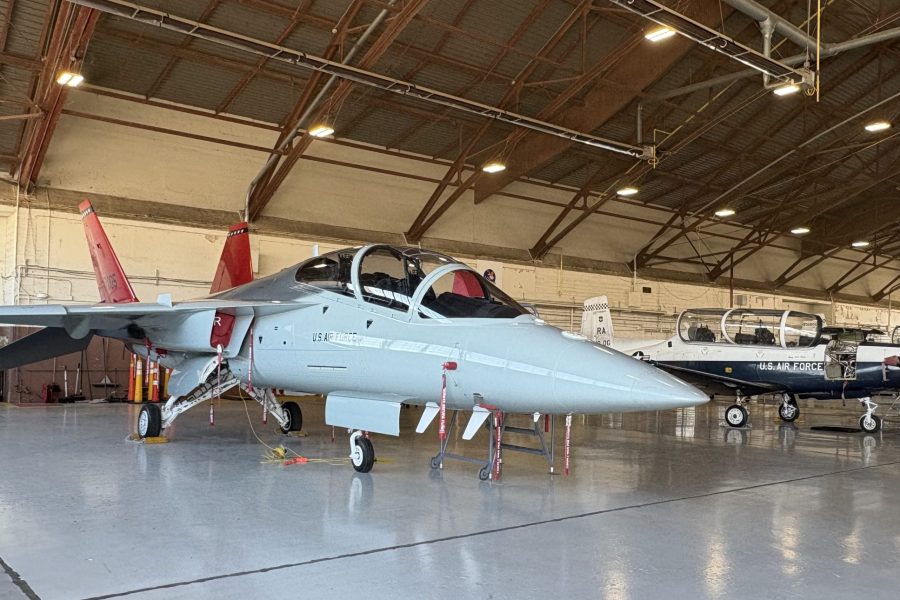
The Air Force said May 4 it has approved the T-7A Red Hawk trainer aircraft to move into low-rate production and awarded Boeing a $219 million contract to start building the first 14 production jets.
The “Milestone C” decision, in acquisition-speak, came April 23, clearing one of the last major hurdles for the long-awaited advanced jet trainer. The contract with Boeing’s Defense, Space and Security division will also provide spare parts, support equipment, and training for the T-7.
“Reaching Milestone C is a testament to the dedicated government and industry teams who have worked diligently to overcome complex technical hurdles,” William Bailey, who is performing the duties of the Air Force’s assistant secretary for acquisition, technology and logistics, said in the May 4 statement. “The T-7A is a pivotal program for the future of our combat air forces, and entering production brings us one step closer to putting this essential capability into the hands of our instructor pilots and students.”
The T-7 is designed to teach new pilots how to fly advanced fourth- and fifth-generation jets and bombers including the F-15EX Eagle II, F-35A Joint Strike Fighter, F-22 Raptor, and eventually the sixth-generation B-21 Raider and F-47. The Air Force plans to buy 351 T-7s in all, as well as 46 ground-based training simulators, which will be delivered to five Air Education and Training Command bases over the next decade.
It will replace the Air Force’s aging fleet of T-38 Talons, which are more than six decades old and were originally designed for pilots to learn how to fly third-generation, Vietnam-era jets like the F-100 Super Sabre, F-105 Thunderchief, and F-4 Phantom—all of which retired decades ago. Today, aspiring F-35 and F-22 pilots have to learn many of the intricacies of flying advanced fighters in the actual jets, which limits the training pipeline.
Getting the T-7 to this point has been a long and difficult road. The Air Force awarded Boeing a $9.2 billion contract in 2018 for the T-7, and the company and service touted the use of digital design techniques as a groundbreaking step that would streamline the Red Hawk’s development, production, and sustainment.
But design, testing, and production problems emerged that caused the T-7’s schedule to repeatedly slip. The Air Force’s original plan called for buying the first operational T-7s in 2023, before ejection seat and flight control software problems caused that deadline to slide, first to 2024, then 2025.
In February 2024, Boeing said quality problems with some parts and supply chain issues were causing monthslong delays in the delivery of a test T-7 and the start of low-rate initial production. And in January 2025, the Air Force announced yet another delay to the production contract—this time to 2026—and decided to expand the test fleet to nine aircraft as part of a major reorganization of the program’s acquisition strategy.
That revised “active management” strategy of collaboration between the Air Force and Boeing yielded results and allowed the service to better balance operational risk and programmatic risk, the service said May 4.
The Air Force said it will take a phased approach in moving forward with the T-7’s production, and its program office will have to get approval before moving forward with each of the first three low-rate initial production lots. The service said this will allow the program to manage the risks of concurrency—when a system enters production while testing is still going on—by folding developmental testing insights and other observations into subsequent production lots.
Recent Air Force budget documents lay out a plan to buy a low-rate production lot of 23 T-7s in fiscal 2027, followed by 36 in 2028 and 42 in 2029.
The Air Force intends for the Red Hawk to reach initial operational capability by 2027 and said its program office will stay focused on finishing the program’s engineering and manufacturing development phase while supporting the first instructors and maintainers on the T-7 program.
“Our mission is to train the next generation of combat aviators, and the T-7A Red Hawk is the tool we need to do it,” Brig. Gen. Matthew Leard, AETC’s director of plans, programs, requirements, and international affairs, said in the statement. “Replacing our 60-plus-year-old T-38s is a top priority. The T-7A’s advanced systems will give our students a far more realistic training environment, ensuring they are prepared for the cockpits of the future.”
“Boeing is honored to work with our U.S. Air Force partner in achieving this historic milestone in the T-7A Red Hawk’s journey,” Andy Adams, Boeing vice president and T-7 program manager, said in a statement. “Getting this pathfinding digitally designed, built and tested advanced trainer into the hands of Air Force instructors and students remains our focus, and Milestone C positions us to start low-rate initial production this year.”