
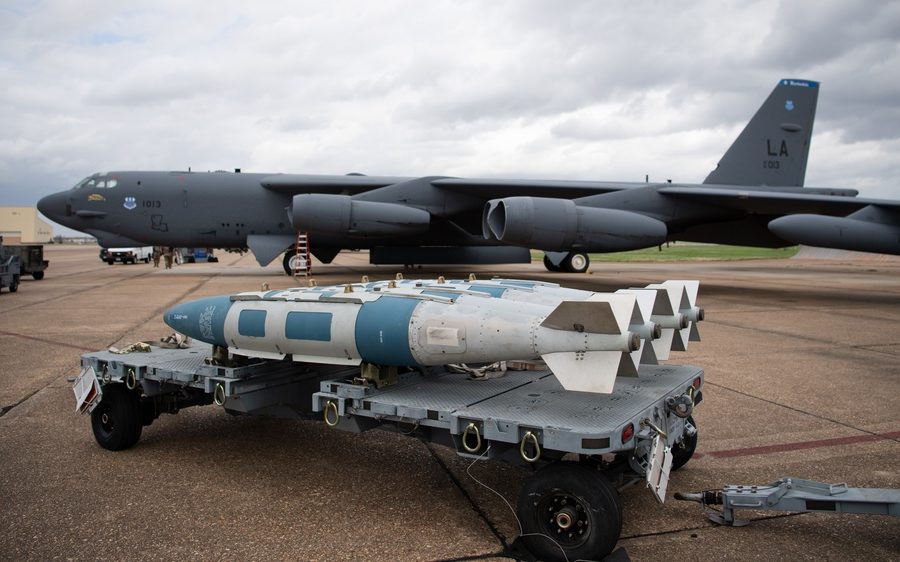
JDAM is a GPS/INS-guided, autonomous, all-weather surface attack weapon. The joint USAF-Navy program upgrades the existing inventory of general-purpose bombs by adding a GPS/INS guidance kit for accurate all-weather attack from medium/high altitudes.
The weapons acquire targeting information from the aircraft’s avionics. After release, an inertial guidance kit directs the weapon aided by periodic GPS updates. JDAM seeker/tail kits can be mounted on general-purpose or penetrating warheads in each weight class. JDAM can also utilize the 500-lb carbon fiber-cased Very Low Collateral Damage Weapon (VLCDW) for sensitive targets.
A JDAM kit is under development for the 5,000-lb BLU-113 penetrating weapon slated for integration and flight-testing on the F-15E. The Advanced 2,000-lb (A2K) BLU-137/B weapon is also being developed for integration onto the F-15E and B-2A. A2K will improve both precision and penetration to strike a wider variety of targets, eventually replacing the BLU-109 bunker buster.
JDAM-class weapons are the most frequent air-to-ground munition expended in combat. USAF is acquiring Strategic Anti-Jam Beamforming Receiver Y-Code (SABR-Y) tail kits and developing an advanced Military Code anti-jam GPS guidance for use in signal-degraded environments. The service is also working to field a lighter-weight successor class of weapons incorporating IR/GPS guidance, maneuver wings, stealth, and EW capabilities.
The U.S. supplied winged JDAM-ER as part of weapons shipments to Ukraine, which extend the weapons standoff delivery to beyond 40 miles. USAF drastically reduced combat stockpile replenishment in FY22 before slightly increasing procurement to 4,200 tail kits in FY23. FY26 request procures 1,500 guidance kits.
B-2s conducted a follow-on low-cost “QUICKSINK” demo using modified 500-lb and 2,000-lb JDAMs in a bilateral maritime strike scenario with Norwegian F-35s over the Norwegian Sea in September 2025. USAF staged a similar demonstration with the 2,000-lb JDAM last year.
GBU-31/32/38 JDAM Technical Data
Contractors: Boeing, Textron, Honeywell.
First Flight: Oct. 22, 1996.
IOC: 1998.
Active Variants: •GBU-31. GPS/INS-guided 2,000-lb GP, or BLU-109 penetrating weapon. •GBU-32. GPS/INS-guided 1,000-lb GP, or BLU-110 penetrating weapon. •GBU-38. GPS/INS-guided 500-lb GP, or BLU-140 (prev. BLU-111) penetrating weapon.
Dimensions: Span 25 in (GBU-31), 19.6 in (GBU-32), 14 in (GBU-38); length (with JDAM and warhead) approx. 12 ft (GBU-31), 10 ft (GBU-32), 7.8 ft (GBU-38).
Performance: Range up to 15 miles, CEP with GPS 16.4 ft, CEP with INS only 98 ft.
Guidance: GPS/INS.
Warhead: 2,000-lb Mk 84/BLU-109 (GBU-31); 1,000-lb Mk 83/BLU-110 (GBU- 32); 500-lb Mk 82/BLU-111 (GBU-38).
Integration: A-10C, B-52H, B-2A, B-1B, F-15E, F-16, F-22A, F-35A (GBU- 31/32), and MQ-9.