


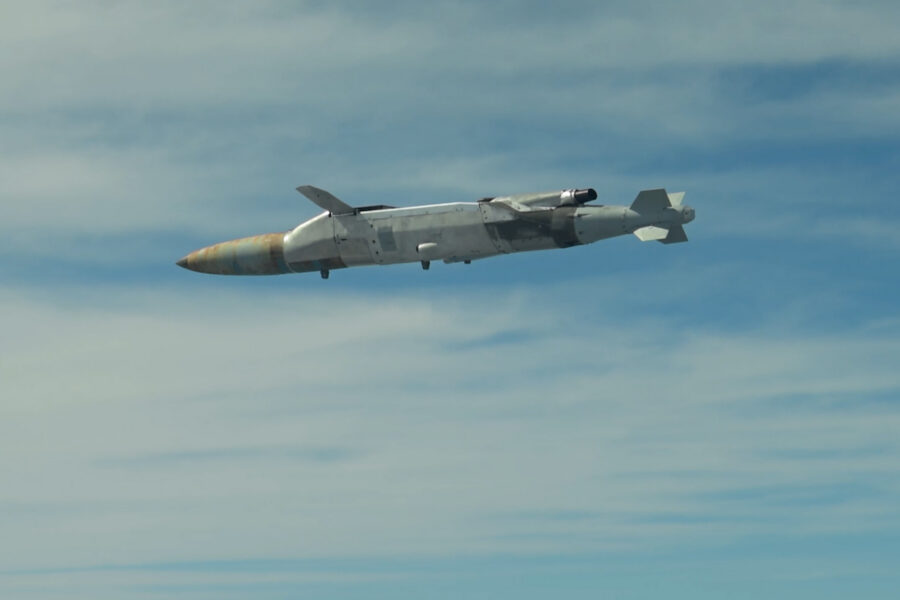
The Air Force awarded Boeing a $75 million production contract to begin supplying long-range JDAMs as the service seeks to expand its arsenal and extend the range of its key munitions.
The BSU-111 Payload Delivery Unit creates a new JDAM variant, the GBU-75 JDAM-LR, with a stand-off range of more than 300 nautical miles for a 500-pound payload, Boeing said in a release.
That’s a significant increase from the standard GBU-38 JDAM, at 15 nm, and the extended-range JDAM-ER, at 45 nm.
The long-range variant adds a Kratos TDI-J85 turbojet providing 200 pounds of thrust to enable jets to attack from a much safer distance. Improvements in adversaries’ air defenses have made penetrating strikes by non-stealthy aircraft increasingly risky.
“This is a good decision, though long overdue,” said retired Air Force Col. Mark Gunzinger, Director of Future Concepts and Capability Assessments at the Mitchell Institute for Aerospace Studies. “This will give the Air Force new options to conduct strikes from medium-range standoff distances.”
The 2027 National Defense Authorization Act includes about $277 million for 1,150 upgraded JDAM guidance tail kits with M-Code GPS for the legacy munitions.
Gunzinger said the new version will cost “far less than more exquisite stand-off munitions, so they should be considered as an affordable mass capability.”
The JDAM-LR was developed through the Navy, and only completed flight testing in April, marking rapid development by typical standards—recognition that fourth-generation aircraft need this capability soon, and that the Air Force and Navy need less costly alternatives to missiles for stand-off attack.
Separately, the Air Force is developing its so-called Family of Affordable Mass Missiles, to produce lower-cost missiles under a series of multiyear framework agreements signed in July with three defense newcomers – Anduril, CoAspire and Zone 5 Technologies. The three companies are slated to produce a total of 8,000 missiles a year once production ramps up.
Munitions stocks were depleted during Operation Epic Fury, with U.S. forces expending an estimated 10,000 JDAMs, according to a June report from the Center for Strategic and International Studies.
The new munitions “will help the Air Force accelerate rebuilding its munitions inventories,” Gunzinger said.
While the Navy-led JDAM-LR program focused on delivery by fighters, Gunzinger said the weapon also has utility for bombers. “The Air Force should buy JDAM-LR at scale and integrate them on its bombers as well as fighters,” he said.
The Boeing contract letter authorizes initial production of the PDU with the Navy, according to the Aug. 5 Boeing release. JDAMs are a joint Air Force/Navy program.
“This first production contract is a major milestone for the JDAM LR program, demonstrating our ability to deliver long-range precision-strike capability at a significantly lower cost,” Bob Ciesla, vice president of Boeing Precision Engagement Systems said in the release. “Scaling production of the GBU-75 will provide the fleet with an affordable, sustainable solution designed to eliminate long-range land and sea-based threats to U.S. and international forces and enable them to safely and effectively operate in a contested battlespace.”
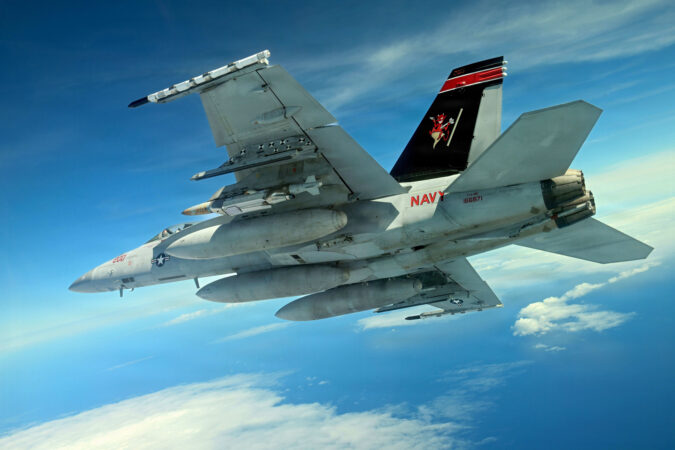
The JDAM-LR system completed its first test flight off the coast of California on April 1 and a second test flight on April 3. During those flights, it sustained powered flight on a predefined test profile using M-code GPS, according to the release.
Both demos flew an estimated 200 nautical miles, according to a Navy release at the time.
“As Naval Air Forces in theater continue to rely heavily on JDAM systems, the program recognizes a critical need to provide the fleet with greater standoff range,” said Capt. Sarah Abbott, Precision Strike Weapons (PMA-201) program manager, in an April Navy release. “This new capability allows pilots to engage targets from significantly safer distances, maintaining a tactical advantage in contested environments.”
Navy teams are also doing testing for shipboard integration of the JDAM-LR.