
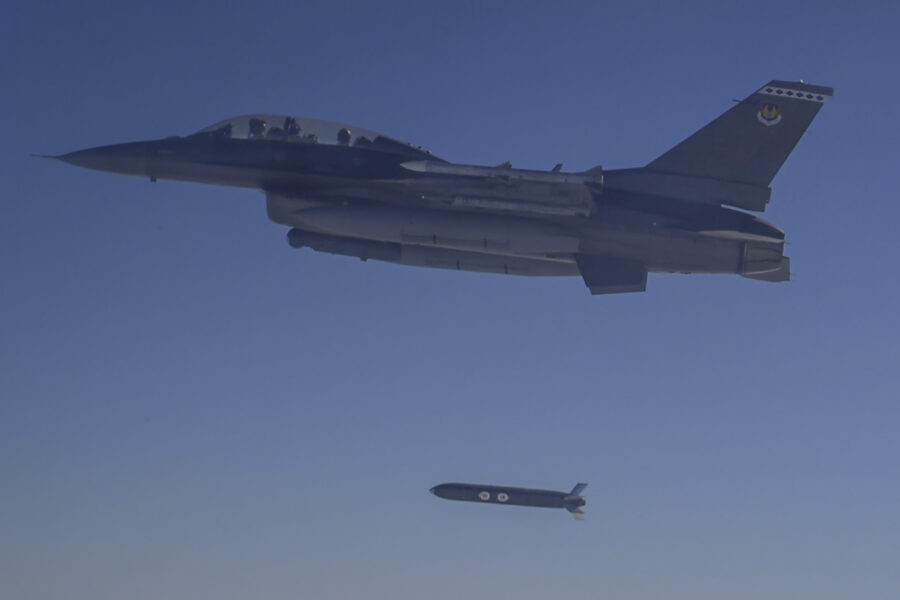
The Air Force and Navy each demonstrated new munitions designed to enable greater stand-off range at lower cost.
The Air Force integrated and tested the Rusty Dagger Extended Range Attack Munition, an air-launched cruise missile, while the Navy tested a long-range variant of the standard Joint Direct Attack Munition, dubbed JDAM-LR, that can fly more than six times farther than the extended-range JDAM variant.
The Air Force ERAM is “a next-generation … precision-guided, stand-off” weapon, the Air Force said in a release reporting the test, which included functionality checks, validated load procedures, and proved the weapon is compatible with the F-16.
“This was a perfect demonstration of test readiness to meet warfighter needs,” said Lt. Col. Brett Tillman, 780th Test Squadron commander, in the release. “Integrating the entire test team allowed us to safely test and deliver a critical capability at incredible speed.”
The release does not identify the missile by name, referring to it as part of the Family of Affordable Mass Munitions-Lugged, or FAMM-L. But markings on the weapon in images released by the Air Force identified the munition as an ERAM.
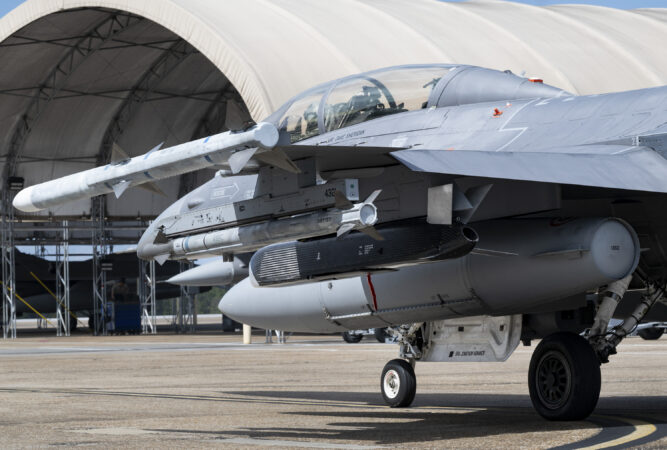
Zone 5 Technologies, the maker of the weapon, posted about the test on social media: “Zone 5 is proud to have supported #TeamEglin’s rapid Rusty Dagger integration on the F-16,” the company said in its LinkedIn post. “Together, we’re making ‘Affordable Mass’ a reality with precision strike capabilities at scale!”
The Rusty Dagger previously completed tests in palletized and pylon-launched configurations and long-duration missions, Air & Space Forces Magazine has reported.
The 96th Test Wing was the lead development test provider, and the 53rd Wing led operational testing.
“The combined test team is laser focused on accelerating experimentation to deliver capability into the hands of warfighters, faster,” Lt. Col. Taylor Wilson, 40th Flight Test Squadron commander, said in the release. “The team was able to rapidly generate and execute sorties to deliver crucial data for evaluating new, innovative warfighter capabilities.”
The Air Force’s top weapons acquisition boss, Brig. Gen. Robert P. Lyons III highlighted the ERAM in his March 24 testimony before the Senate Armed Services Committee, when he called it part of a “new class of affordable, low-cost munitions.”
“These cruise missiles represent a new speed of acquisition,” Lyons said, noting that ERAM moved from contract to prototypes in four to seven months, and into production just 14 months after the first contract award.
The integration work in March follows a successful ERAM live-fire test on Jan. 21, according to a January Air Force release.
The January ERAM test, which included a full warhead detonation, collected data for a new, “cost-effective, long-range strike capability,” according to the release. The release noted that the live fire test was conducted less than 16 months after the initial contract award.
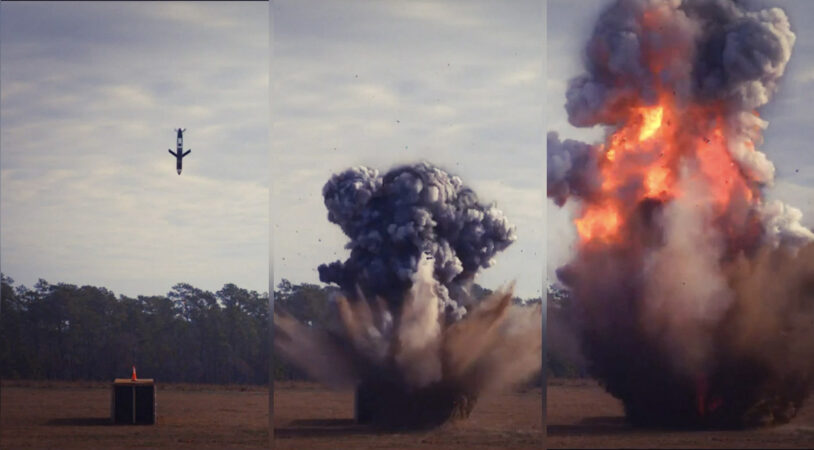
“Moving from a contract to a live-fire demonstration in under two years proves we can deliver lethal, cost-effective capability at the speed of relevance,” Lyons said in the release.
FAMM launched in the fiscal 2026 budget, seeking prototypes that included “integration and flight demonstrations of affordable and highly manufacturable small turbine engines, seekers/sensors, networked datalinks, collaborative autonomy behaviors, and ordnance [warhead/fuse].”
The combination of rapid development and affordability aligns with expert views of the potential for high-volume, high-mass strike warfare in a peer conflict with China.
Over the first five weeks of Operation Epic Fury, the United States struck more than 13,000 targets, Gen. Dan Caine, chairman of the Joint Chiefs of Staff, said in an April 8 press briefing. Experts anticipate that the United States will need the capacity to strike 100,000 or more targets in such a conflict.
“The future fight demands we create an asymmetric advantage by developing cost-effective, attritable systems like ERAM that give commanders the ability to generate mass,” Brig. Gen. Mark Massaro, 96th TW commander, said in the January release. “This test is a critical milestone on that path.”
The ERAM program predates the public disclosure of the FAMM program. Two Air Force requests to industry in 2024 outlined what the service is seeking with the new weapon.
The notices sought modular, open-architecture systems to deliver affordable long-range effects. The service wanted a 500-pound-class weapon with limited penetration, fragmentation, and blast, with variable fuze options. The missile needed to reach speeds of at least Mach 0.6, hit a minimum range of 287 miles, and operate in a GPS-degraded environment.
The notices also required that the manufacturer be able to scale up production to produce 1,000 missiles annually within two years of contract award.
In August 2025, the Trump administration approved the sale of 3,350 ERAMs to Ukraine as part of a larger aid package.
Other Low-Cost Cruise Missile Efforts
In addition to the Zone 5 Technologies Rusty Dagger project, the Air Force awarded an ERAM contract to CoAspire in late 2024.
The company has conducted long-range test flights of its 3D-printed Rapidly Adaptable Affordable Cruise Missile, or RAACM, as recently as mid-2025, according to the company’s website.
Those tests used an A-4 Skyhawk jet fighter for weapon integration.
The Navy is also developing a low-cost cruise missile using existing missile stockpiles, a development that recently made news.
In a separate announcement, U.S. Naval Air Systems Command, or NAVAIR, demonstrated the JDAM-LR, a variant of the standard JDAM that can fly about as far as an ERAM.
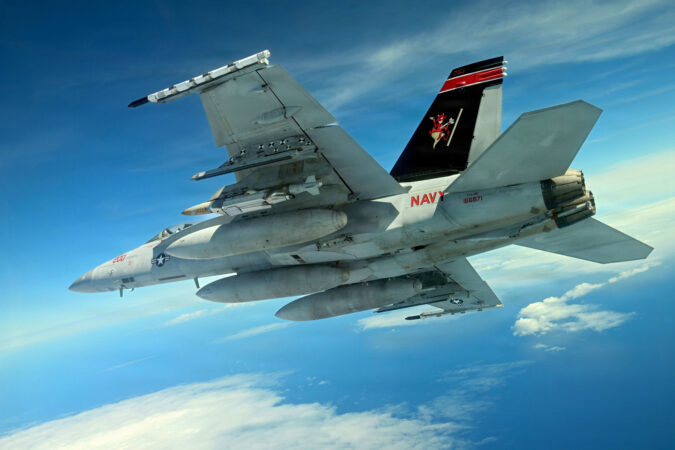
The command conducted two tests at the Navy’s Point Mugu Sea Range off the California coast, according to a NAVAIR release. The tests evaluated the weapon’s interface with the F/A-18 Super Hornet and performances in controlled and powered free-flight. Both test fires traveled more than 230 miles.
The JDAM-LR is made by Boeing, which says it can strike targets as far as 345 miles away—far above the 15-mile range of a conventional JDAM and the 50-mile range of the JDAM-Extended Range variant.
“As Naval Air Forces in theater continue to rely heavily on JDAM systems, the program recognizes a critical need to provide the fleet with greater standoff range,” Navy Capt. Sarah Abbott, Precision Strike Weapons program manager, said in the release. “This new capability allows pilots to engage targets from significantly safer distances, maintaining a tactical advantage in contested environments.”
Next steps for the JDAM-LR include shipboard integration.