


The Air Force’s fiscal 2027 budget request would invest $15 billion in its munitions portfolio, with $10.8 billion earmarked for weapons purchases and another $4.3 billion for research, development, test, and evaluation of new arms.
Leading the investments are sizable plus-ups to procure more of certain key munitions, an extra $1.1 billion for the secretive Joint Advanced Tactical Missile, and an extra $1.4 billion for Advanced Medium Range Air to Air Missiles, or AMRAAMs.
“We are modernizing our munitions portfolio to deliver combat power against any pacing challenge,” said Maj. Gen. Frank R. Verdugo, deputy assistant secretary of the Air Force for budget, in an April 21 budget briefing at the Pentagon.
Restoring weapons stockpiles is a major concern. U.S. aircraft and ships struck more than 13,000 targets in just five weeks in fighting against Iran during Operation Epic Fury. If the U.S. went to war against China, the target list could be 10 times as large, and planners worry about having enough weapons on hand.
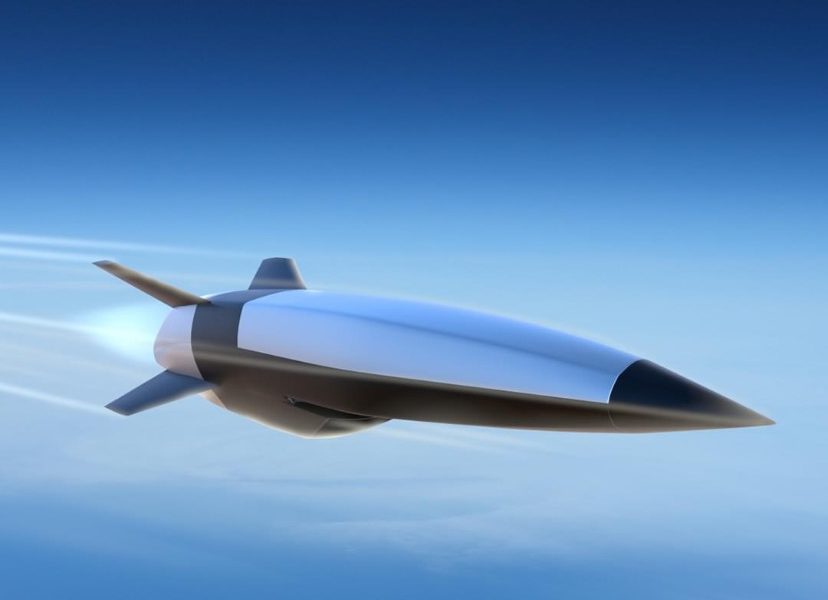
The budget plan would also add some more specialized weapons to the stockpile, Verdugo said: “We are pushing the boundaries of speed and survivability by investing $1.2 billion to mature the Hypersonic Attack Cruise Missile, which will provide a swift, penetrating strike capability to bypass the most advanced enemy defenses.”
HACM test flights are expected to begin this year, and the fiscal 2027 investment would rise by $200 million, or 20 percent over the current fiscal year. Defense contractor RTX is leading development of the air-launched, scramjet-powered weapon, which is projected to exceed Mach 5.
2027 Munitions Procurement (quantities)
| Munition | Fiscal 2026 Enacted | Fiscal 2027 Request |
| Advanced Medium-Range Air-to-Air Missile | 423 | 1,317 |
| Joint Direct Attack Munition | 1,500 | 1,150 |
| Family of Affordable Mass Munitions | 1,000 | 1,000 |
| Joint Air-to-Surface Standoff Missile | 381 | 821 |
| AIM-9 Sidewinder Missile | 173 | 648 |
| Small Diameter Bomb Increment II | 806 | 373 |
| Small Diameter Bomb Increment I | 511 | 220 |
| Long Range Anti-Ship Missile | 114 | 156 |
| Advanced Anti-Radiation Guided Missile-Extended Range | 75 | 105 |
| Joint Strike Missile | 100 | 100 |
| Stand-in Attack Weapon | 0 | 50 |
Source: Department of the Air Force Fiscal 2027 budget request
Existing Missiles
The administration is “aggressively accelerating production of the most vital munitions … [to] build deep magazines for the Indo-Pacific and other contested theaters,” budget documents say. Verdugo added that the budget represents “a clear commitment to enhancing our readiness and deterrence, particularly in the Indo-Pacific.”
The fiscal 2027 budget would more than double JASSM purchases from 381 to 821, and triple AMRAAM purchases from 423 to 1,317.
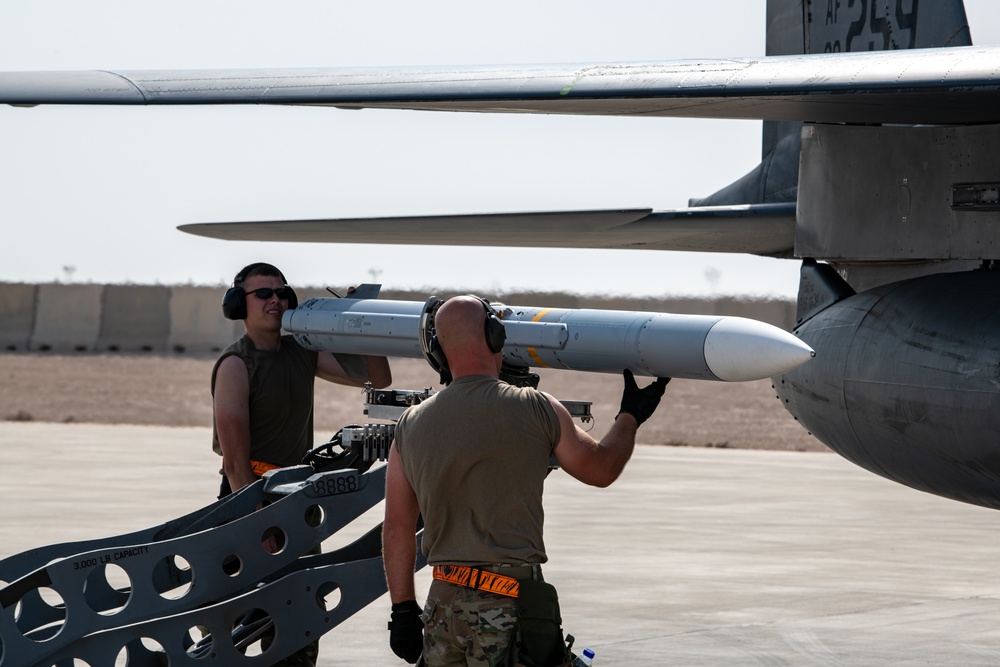
The AGM-158 JASSM is a long-range standoff precision cruise missile that is used by the B-1B, B-52, F-16, and F-15E to attack fixed, relocatable, and moderately hardened or buried targets. Summary documents presented at the briefing did not include exact dollar amounts for JASSM procurement.
The AMRAAM is a radar-guided, medium-range, supersonic air-to-air missile. Designated the AIM-120, it can be carried by both the F-22 Raptor and F-35 Lightning II fighters. The Air Force would spend $2.2 billion on AMRAAMs alone.
To combat seaborne targets at range, the Air Force is asking for $738 million to acquire more Long-Range Anti-Ship Missiles. The Air Force plans to acquire 114 LRASMs this year, and is seeking to purchase 156 in 2027.
Outwardly, LRASM and JASSM are nearly identical, but the anti-ship missile is adapted for maritime targets. Both can carry a 1,000-pound warhead.
In 2024, Lockheed Martin received two Air Force contracts totaling $3.56 billion to produce the two complex missiles.
Affordable Munitions
To build lower-cost weapons, the Air Force is seeking to double investment in developing lower-end munitions options. “We are investing $600 million to develop a Family of Affordable Mass Munitions,” Verdugo said. FAMM represents a shift “away from small numbers of exquisite weapons toward a future where we can overwhelm an adversary with sheer volume.”
The FAMM program builds on concepts like palletized, air-to-surface munitions developed under the Enterprise Test Vehicle program, which funds integration and flight demonstrations this year for “small turbine engines, seekers/sensors, networked datalinks, collaborative autonomy behaviors, and ordnance” products.
One example of an affordable munition under development is Northrop Grumman’s Stand-in Attack Weapon, or SiAW. The new, modular air-to-ground missile is built to strike advanced, time-sensitive targets such as anti-ship missiles, jammers, and missile launchers.
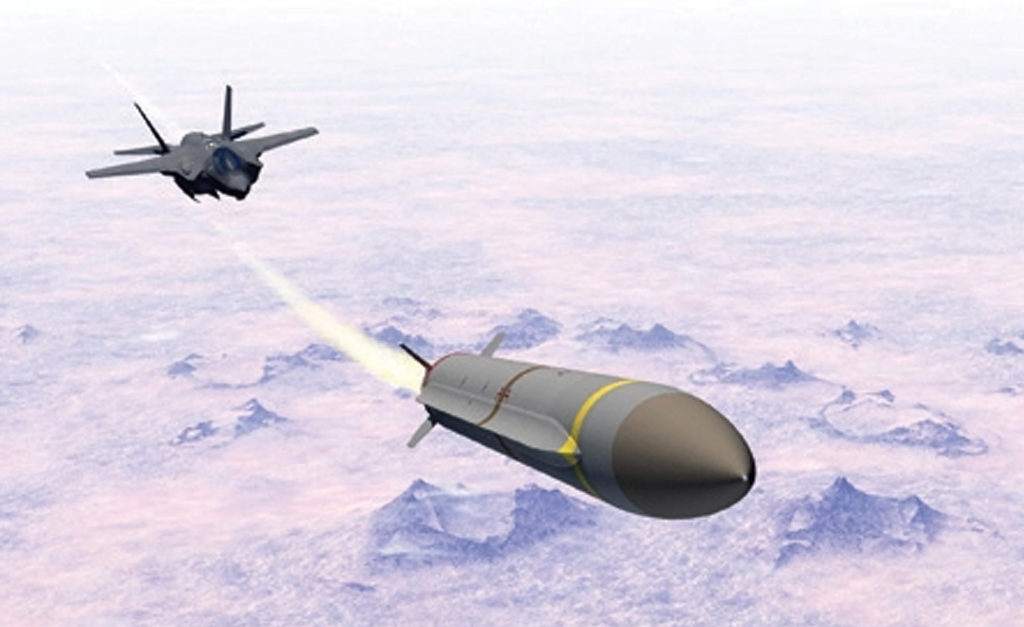
The Air Force posted a notice in early March seeking additional manufacturers to produce the SiAW, which is intended to improve upon the Anti-Radiation Missile-Extended Range (AARGM-ER) now carried by the F-35, F-16, F-47, and B-21.
The service is buying 72 SiAWs in fiscal 2026 and is seeking funds to purchase 155 in fiscal 2027.
Production Improvement
Verdugo stressed that the increased funds earmarked for munitions also include money to bolster the industrial base by projecting a steadier workflow.
“We are sending an unmistakable demand signal to industry and expanding multiyear contracts for next-generation technology,” Verdugo said. “This provides our industry partners the stable demand needed to invest capital and expand production lines in the name of national security. To that end, we are aggressively accelerating production of our most vital munitions.”
In March, Trump met with executives from defense companies RTX, Northrop Grumman, Lockheed Martin, L3Harris, Honeywell Aerospace, Boeing, and BAE Systems at the White House and subsequently announced expansion deals to increase U.S. stockpiles of medium- and upper-medium-grade munitions.