
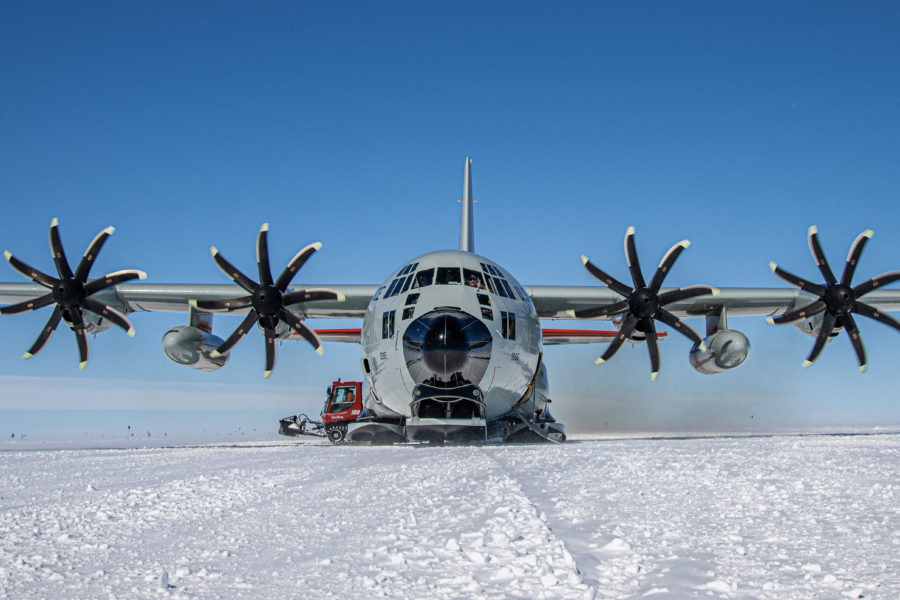
The LC-130H is a ski-equipped, Arctic-support derivative of the C-130H. It is capable of direct resupply of Antarctic research stations and high-Arctic radar sites using ice and snowpack runways.
The LC- 130H fleet supports the National Science Foundation’s (NSF) Antarctic research, ferrying much of the materials, provisions, and personnel between Christchurch, New Zealand, and McMurdo Station, Antarctica. The aircraft also provide onward support to the remote Amundsen-Scott South Pole Station.
USAF began augmenting the Navy’s “Operation Deep Freeze” with the C-124 in 1956. C-130s began Antarctic support in 1959, operating without skis until the initial ski-borne deployment of the C-130D in January 1960. By 1975, the New York ANG’s 109th AW operated USAF’s only ski-equipped LC-130 supporting Distant Early Warning sites in the high Arctic.
The unit began augmenting Navy LC-130s during Deep Freeze in 1988, before taking over primary responsibility in 1999. Three aircraft were converted from ex-Navy LC-130Rs, and the NSF funded an additional three new-build aircraft in 1995-96. LC-130s have been upgraded with eight-bladed NP-2000 propellers to increase takeoff performance, digital cockpit displays and flight management systems, multifunction radar, modernized comms, and a single air data computer. LC-130s are upgraded along with the baseline C-130H fleet, including Avionics Modernization Program Increment 2 launched in 2022 and center wing box replacement. Required upgrades include NVG-compatible flight deck, secure BLOS data link, increased reliability commercial SATCOM, and self-defensive/missile warning capability.
The ANG test-flew an LC-130 with upgraded T56 3.5 engine enhancements for the first time in October 2022. Paired with the NP2000 propellers, the upgrade improves payload, range, high-altitude performance, and reliability. A total of four LC-130s flew 63 Operation Deep Freeze missions supporting NSF research during the 2025-2026 season. Aircraft carried a total of 1,086 passengers, 1,350 tons of cargo and fuel. LC-130s also completed nine medical evacuations from Antarctica to Christchurch, New Zealand, and cooperated with Canadian Forces landing on a freshwater ice runway for the first time in decades during Operation Nanook-Nunalivut.
Increased Russian and Chinese activity in the Arctic and a current mission capable rate below 50 percent prompted USAF to shift funds to begin developing a next-generation LC-130J for arctic support. Congress approved funding the first aircraft in FY26.
LC-130H Skibird Technical Data
Contractor: Lockheed Martin.
First Flight: 1957 (ski-equipped C-130D).
Delivered: 1974-96.
IOC: Circa October 1984.
Production: 10.
Inventory: 10.
Operator: ANG.
Aircraft Location: Stratton ANGB, N.Y.
Active Variant: •LC-130H Skibird. Arctic support variant with wheel-ski gear and eightbladed propellers.
Dimensions: Span 132.6 ft, length 97.8 ft, height 38.8 ft; nose ski 10 ft by 6 ft wide, main gear skis 12 ft by 6 ft wide.
Weight: Max T-O 155,000 lb; max payload 45,000 lb.
Power Plant: Four Rolls-Royce T56 3.5 turboprops, each 4,591 shp.
Performance: Speed 366 mph; range with 35,000-lb payload 1,636 miles (with engine upgrades).
Ceiling: With max payload, 23,000 ft.
Accommodation: Two pilots, navigator, flight engineer, loadmaster.
Load: Up to 92 passengers or 74 litters; six cargo pallets, 16 Container Delivery System (CDS) bundles, or any combination up to max weight.