


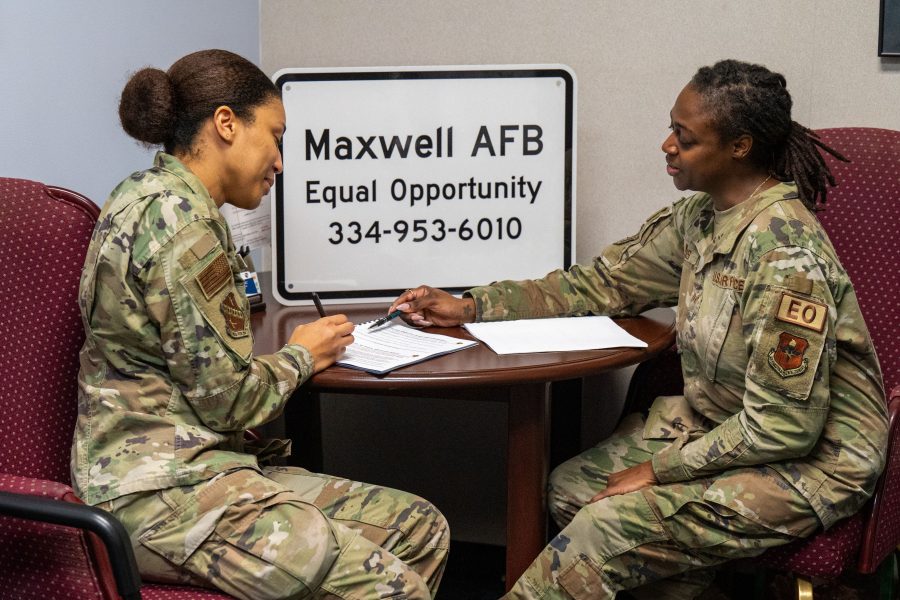
The Department of the Air Force’s new equal opportunity and harassment policy, rolled out to comply with Defense Secretary Pete Hegseth’s directives, redefines key terms and empowers commanders to dismiss complaints they deem not actionable. The new rules also bar investigations based on anonymous complaints.
Unveiled 11 months after Hegseth directed changes to the Pentagon’s Equal Opportunity and Military Equal Opportunity programs, the new rules are dated July 28, but weren’t announced until late August. Hegseth called for the overhaul nearly a year ago, saying the programs had been “weaponized” by poor performers against leaders and commanders.
“No more frivolous complaints, no more anonymous complaints, no more repeat complaints, no more smearing reputations, no more endless waiting, no more legal limbo, no more side-tracking careers, no more walking on eggshells,” Hegseth said last Sept. 30 at an all-call with hundreds of generals and admirals.
The Department of the Air Force policy follows on similar updates from the Army and Navy, also announced in August.
New Definitions
Each military department’s policy includes the same new definitions of three key terms: “bullying,” “hazing,” and “harassment.”
The new definition of harassment represents the biggest change, said retired Lt. Col. Colby Volkey, a former Marine Corps Judge Advocate General. The new definition explicitly exempts standard training programs, stating “official military or governmental activities conducted in a professional manner, such as basic military training, professional military education, physical training programs, disciplinary or corrective actions, or combat readiness exercises, do not constitute harassment.”
It also states that “behavior that is rude, ignorant, abrasive, or unkind, is not necessarily indicative of harassment, but may constitute harassment depending on the totality of the circumstances.”
The revisions appear to be “an attempt to limit the types of activities that are considered harassment, Volkey said in an email.
The new definition of hazing no longer includes the phrase “any form or initiations or congratulatory acts that involves physically striking another person in any manner or threatening to do the same,” language that was included in the past in an effort to stop the practice of pounding on newly earned rank or other insignia, such as aviators’ wings.
Equal Opportunity Definition Changes
Bullying
Bullying: As described in DoDI 1020.03, while not a form of prohibited harassment under equal opportunity (EO) law but is a prohibited form of conduct, bullying is a form of harassment that includes acts of aggression by service members or DoD civilian employees, with a nexus to military service, with the intent of harming a service member either physically or psychologically, without a proper military or other governmental purpose. Bullying may involve the singling out of an individual from his or her coworkers, or unit, for ridicule because he or she is considered different or weak. It often involves an imbalance of power between the aggressor and the victim. Bullying can be conducted through the use of electronic devices or communications, and by other means including social media, as well as in person.
Bullying is evaluated by a reasonable person standard and includes, but is not limited to, the following when performed without a proper military or other governmental purpose:
- Physically striking another person in any manner or threatening to do the same.
- Intimidating, teasing, or taunting another person.
- Oral or written berating of another person with the purpose of belittling or humiliating.
- Encouraging another person to engage in illegal, harmful, demeaning, or dangerous acts.
- Playing abusive or malicious tricks.
- Branding, handcuffing, duct taping, tattooing, shaving, greasing, or painting another person.
- Subjecting another person to excessive or abusive use of water.
- Forcing another person to consume food, alcohol, drugs, or any other substance.
- Degrading or damaging another’s property or reputation.
- Soliciting, coercing, or knowingly permitting another person to solicit or coerce acts of bullying.
Bullying does not include properly directed command or organizational activities that serve a proper military or other governmental purpose, or the requisite training activities required to prepare for such activities (e.g., command-authorized physical training). Service members may be responsible for an act of bullying even if there was actual or implied consent from the victim, and regardless of the grade or rank, status, or service of the victim. Bullying is prohibited in all circumstances and environments, including off-duty or “unofficial” unit functions and settings.
Bullying (Military): A form of harassment, as described below, that involves repetitive, intentional hurtful conduct by an individual or a group, which intimidates, humiliates, torments, isolates, degrades, exploits, controls, or creates a risk of mental, physical, or emotional distress or harm.
- Inflicting or threatening to inflict physical pain or injury.
- Berating or belittling a Service member’s duty performance, professional abilities, or personal attributes.
- Threatening, teasing, or taunting a Service member.
- Destroying or confiscating a Service member’s personal property or work equipment or deliverable.
- Excluding a Service member from work-related opportunities, information, or social activities.
- Posting malicious gossip, rumors, and lies on social media, sharing humiliating photos, or sending vicious text messages
Harassment
Harassment (Military): As described in DoDI 1020.03, conduct that is unwelcome or offensive to a reasonable person, whether verbal or nonverbal, written, electronic, or physical, that creates an intimidating, hostile, or offensive environment. Harassment may include offensive jokes, epithets, ridicule or mockery, insults or put-downs, displays of offensive objects or imagery, stereotyping, intimidating acts, veiled threats of violence, threatening or provoking remarks, racial or other slurs, derogatory remarks about a person’s accent, or displays of racially offensive symbols.
Types of harassment include, but are not limited to, discriminatory harassment, sexual harassment, hazing, bullying, stalking, revenge porn, and other sexual misconduct. Stalking, Revenge Porn, Other Sexual Misconduct. Formal complaints involving conduct that may be punishable under Articles 130 (stalking); 117a (wrongful broadcast or distribution of intimate visual images); and 120c (other sexual misconduct) of the UCMJ will be referred to the appropriate military criminal investigative organization or other law enforcement organization with criminal investigators who are specially trained to conduct such investigations. Harassment can be oral, written, or physical. Harassment can occur in person, through electronic communications, including social media, and other forms of communication. Activities or actions undertaken for a proper military or governmental purpose, such as combat survival training, making work assignments, or conducting performance counseling are generally not considered harassment. For the purpose of this publication, the DAF MEO program is limited to processing complaints alleging bullying and hazing as “other forms of harassment.”
Harassment (Military): Conduct by a Service member or civilian employee, without a legitimate military or governmental purpose, that would be unwelcome or offensive to a reasonable person in the military environment, whether delivered verbally or nonverbally, including by written or electronic means, or in-person, that creates an intimidating, humiliating, or abusive environment.
Hazing
Hazing—As described in DoDI 1020.03, hazing is a form of harassment that includes conduct through which service members or DoD employees, without a proper military or other governmental purpose, but with a nexus to military service, physically or psychologically injure or create a risk of physical or psychological injury to service members for the purpose of: initiation into, admission into, affiliation with, change in status or position within, or continued membership in any military or DoD civilian organization. Hazing can be conducted through the use of electronic devices or communications, and by other means including social media, as well as in person.
Hazing is evaluated by a reasonable person standard and includes, but is not limited to, the following when performed without a proper military or other governmental purpose:
- Any form of initiation or congratulatory act that involves physically striking another person in any manner or threatening to do the same.
- Pressing any object into another person’s skin, regardless of whether it pierces the skin, such as “pinning” or “tacking on” of rank insignia, aviator wings, jump wings, diver insignia, badges, medals, or any other object.
- Oral or written berating of another person with the purpose of belittling or humiliating.
- Encouraging another person to engage in illegal, harmful, demeaning or dangerous acts.
- Playing abusive or malicious tricks.
- Branding, handcuffing, duct taping, tattooing, shaving, greasing, or painting another person.
- Subjecting another person to excessive or abusive use of water.
- Forcing another person to consume food, alcohol, drugs, or any other substance.
- Soliciting, coercing, or knowingly permitting another person to solicit or coerce acts of hazing.
Hazing does not include properly directed command or organizational activities that serve a proper military or other governmental purpose, or the requisite training activities required to prepare for such activities (e.g., administrative corrective measures, extra military instruction, or command-authorized physical training). Service members or DoD civilian employees may be responsible for an act of hazing, even if there was actual or implied consent from the victim, and regardless of the grade or rank, status, or service of the victim. Hazing is prohibited in all circumstances and environments including off-duty or “unofficial” unit functions and settings.
Hazing (Military): A form of harassment, as described below, that involves intentional or reckless conduct by an individual or group, which humiliates, degrades, or creates mental, physical, or psychological injury or harm, or reasonably perceived as such, directly related to the affected Service member’s affiliation, entry, advancement, reinstatement, change in status or position, or continued standing within a military unit, command, or DoW or military affiliated organizations regardless of whether the affected Service member consented to the activity.
- Inflicting or threatening to inflict physical violence, including striking, restraining, branding, causing body modifications, tattooing, shaving, greasing, duct taping, or engaging in any form of unwanted physical contact that causes pain or injury.
- Subjecting a Service member to abusive physical discomfort or fatigue.
- Destroying or confiscating a Service member’s personal property or work equipment or deliverables.
- Requiring financial contributions.
Dismissing Complaints
The new policy instructs installation commanders to dismiss formal equal opportunity complaints in certain circumstances, such as if:
- The complaint “does not contain sufficient or actionable information to investigate.”
- “A complainant does not respond to request for information.”
- “A complainant files duplicative or related complaints”
- If a commander or supervisor to the service member making the complaint determines “through an adverse action or UCMJ action” that the complaint was a false official statement
Under the new policy, equal opportunity directors have five days to review a formal complaint before forwarding it to an installation commander, who in turn has 30 days to consult with the “servicing legal officer’ and determine if the complaint should be dismissed. The commander then has seven days to inform the complainant, who in turn has five days to appeal.
Giving commanders the power to dismiss complaints is a radical change, said David Sheldon, a former Navy JAG who now represents military clients from every service branch as a civilian attorney. The policy leaves it up to commanders to make a legal determination over whether the complaint is “sufficient or actionable.” Indeed, Congress only recently determined that commanders were not well suited to prosecute certain serious crimes, including murder, sexual assault, and domestic violence.
“It’s kind of a step in the wrong direction in my thinking, for the very reason that you have a conflict of interest,” Sheldon said. Commanders have a built-in incentive not to be seen as having EO problems within their commands, he said.
Dismissing or resolving a case removes the holds that have sometimes delayed promotions, held key jobs opened, or resulted in foreshortened careers. Once closed, the policy states, “all favorable administrative personnel actions (e.g., awards, promotion, retirements) for an alleged offender of an [Military Equal Opportunity] complaint will be resumed or completed.”
Similarly, an individual being under investigation for an EO complaint is no longer sufficient grounds to withhold awards, promotions, retirement and other favorable actions. In the past, EO complaints have resulted in holds that could remain in place for months.
Anonymous Complaints vs. Confidential Reports
The new policy eliminates military equal opportunity complaints based on anonymous allegations, with some exceptions. Instead of filing anonymously, service members may submit “confidential reports,” revealing their identities only to equal opportunity directors and staff. But confidential reports do not constitute either informal or formal complaints, and therefore cannot trigger an investigation. Rather, they are merely a means for service members “to disclose allegations, receive information regarding available resources and reporting options, and obtain referrals to appropriate support services,” the policy states.
Commanders may choose to “look into the matter and take appropriate action in response to a referred anonymous report of prohibited discrimination or discriminatory harassment,” and a service member can choose, within time limits, to upgrade a confidential report into a complaint.
Allegations regarding sexual harassment and those concerning bullying or hazing are not covered by that limitation, however. Anonymous allegations regarding sexual harassment must be referred to the Sexual Assault Prevention and Response office. Allegations of bullying and harassment can be anonymous, but must include “sufficient information,” such as the offender’s name and rank, date of the incident, and units involved.
Shorter Timeline
The timeline for service members to file complaints is now shorter, just 60 days versus 90 days previously. But there are exceptions:
- Multiple incidents: In cases involving an alleged series of incidents or pattern of behavior, only one instance needs to have taken place within the past 60 days.
- Deployments: Service members who are deployed when an incident occurs and who lack resources at their deployed locations have 60 days to file once they return.
- Delays: Those who waited too long can submit a memo to their installation commander explaining the circumstances and seek an extension.
- Sexual harassment: By law, these complaints are exempt from the 60-day requirement.
A service member who makes a confidential complaint and then wants to formalize it, must do so within 60 days of the incident—not the report.
Sheldon suggested this makes it harder for complainants. Whether it is 45, 60, or 90 days, he said, “obviously “I would like a longer window just to give the aggrieved party an opportunity to be heard.”
Mediation
The new policy opens the door for “facilitation,” a form of mediation in which a neutral third party meets with the accused and the complainant to try to resolve the conflict. Facilitation is “a method for resolving problematic situations before they rise to the level of misconduct,” the policy states.
The confidential process can be offered for both informal and formal complaints, so long as both parties agree; commanders are instructed to consult with their legal offices before determining if it is a suitable solution for a given complaint. Commanders may also forgo facilitation if they determine it would “negatively impact good order and discipline.”