


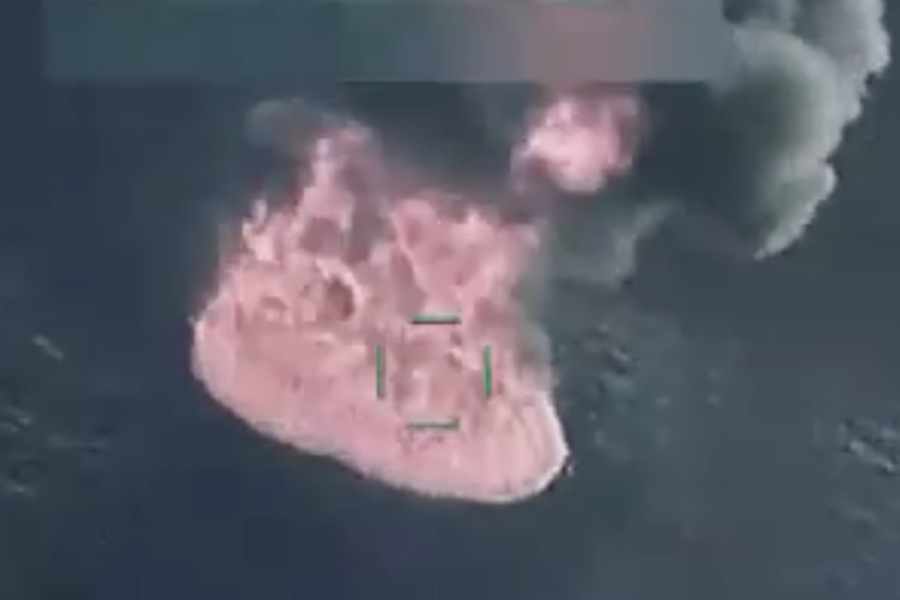
U.S. Southern Command recently announced its first lethal strike on a suspected narco-trafficking vessel in two months, and the first under a newly formed permanent counter-cartel task force. The U.S. is also reportedly planning to transfer MQ-9 drones to Colombia to bolster its counter-cartel efforts.
On Aug. 23, Joint Task Force-Western Hemisphere “executed a lethal kinetic strike on a low-profile vessel operating along established narco-trafficking routes in the Eastern Pacific,” according to a SOUTHCOM social media post. The strike happened in the Eastern Pacific and killed two alleged narco-terrorists.
“When I ordered the establishment of Joint Task Force-Western Hemisphere, it was precisely for this purpose: to accelerate, synchronize, and execute lethal actions against these destabilizing narco-terrorist networks,” Marine Corps Gen. Francis L. Donovan, SOUTHCOM commander, said in a statement. “We are committed to imposing total systemic friction on narco-terrorists—disrupting their operations, dismantling their leadership, and eliminating cartel terror across the region.”
A SOUTHCOM spokesperson declined to comment on the strike, citing operational security reasons. An Air Forces Southern spokesperson did not immediately respond to a query.
As of this most recent attack, there have been 67 strikes since Sept. 2, 2025, killing 223 people. Many of the videos released by SOUTHCOM appear to be from drones, and MQ-9s are known to be stationed in the region. SOUTHCOM has declined to say what assets it has used in the strikes.
This first strike under the new task force comes just a few days after the Colombian newspaper El Colombiano reported Aug. 18 that the U.S. will transfer three MQ-9 Reaper drones to Colombia for use in its escalating war on cartels in the country.
“This transfer will also most likely require significant U.S. assistance on the training and doctrine side to allow Colombia to effectively integrate these platforms into their joint operations,” Henry Ziemer, a fellow with the Americas Program at the Center for Strategic and International Studies, told Air & Space Forces Magazine
The benefit of Colombia operating its own MQ-9s would be freeing up more assets for SOUTHCOM, Special Operations Command-South, and the 12th Air Force to conduct the backbone of the combatant command’s work in the region—intelligence, surveillance, and reconnaissance, retired Air Force Lt. Gen. Norm Seip, former Air Forces Southern commander, told Air & Space Forces Magazine.
Having the drones under Colombian control also widens the U.S. intelligence network in the region, as they’ll likely be coordinating their flights with AFSOUTH’s 612th Air Operations Center, which recently hosted Ecuadorian Air Force intelligence officers for the first time during the region’s largest military exercise, PANAMAX, Air & Space Forces Magazine reported.
SOUTHCOM still has other strike assets for the region, such as the AC-130J gunships located at Comapala, El Salvador, which has been reported as a hub for the Eastern Pacific air campaign against cartels, Ziemer said.
Larger Moves
The drone transfer news came shortly after Colombia, a previous holdout, agreed to join the Americas Counter Cartel Coalition—a 19-member group aligned with U.S. objectives in the region to combat cartels.
This marks the first known time that a Latin American nation has been armed with the MQ-9. Colombia did begin arming its military’s smaller, tactical drones in response to criminal gangs conducting more than 200 drone attacks on military personnel since 2024.
The move to put SOUTHCOM on a more aggressive footing under JTF-WH follows President Donald Trump’s shifting of the National Security Strategy and National Defense Strategy last year to prioritize Western Hemisphere operations.
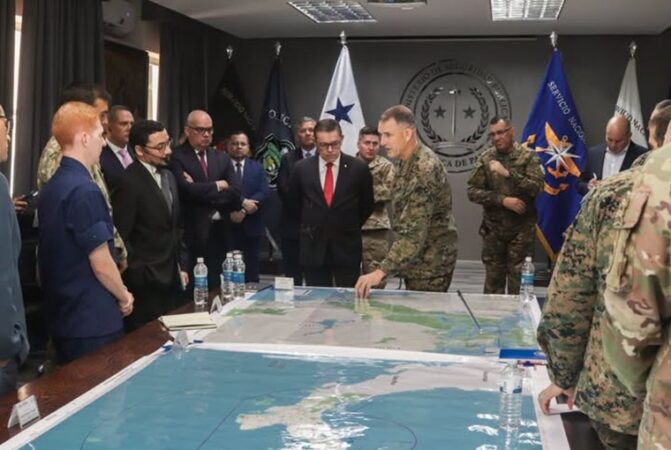
On Aug. 12, during PANAMAX in Panama, students from the U.S. Naval War College’s Maritime Advanced Warfighting School presented an update to a report requested by Donovan to the commander and Panamanian Minister of Public Security Frank Alexis Ábrego on developing “a joint, combined and interagency defense of identified strategic terrain in the region,” according to a NWC release.
Siep said the report itself wasn’t unusual and likely also stood as another “optic” for the region.
“It sends a couple of messages,” Seip said. “One, to those that are thinking that it’s business as usual with regard to what they may be doing, that is not in line with how SOUTHCOM wants to do business. We’re out there looking at the strategic level of various things that are of our interest to the command there, as well as certainly advertises to the United States taxpayers that, ‘hey SOUTHCOM is growing their game with capability, and here’s one way that we’re doing that’ from a standpoint of intellectual capital that’s being expended for this particular project.”
Though the “strategic terrain” was not identified in the release, Ziemer believes that since it was presented in Panama during the major exercise, it likely relates to the Panama Canal and other critical infrastructure.
“It does reflect a growing interest in SOUTHCOM’s area of responsibility from a U.S. defense planning perspective,” Ziemer said.
Effective Strikes
Donovan testified to Congress in March that while the drug boat strikes will be a part of the overall strategy to counter cartels, they might not be the most effective.
“Putting total systemic friction from point of production to point of delivery … I believe that actually kinetic strikes will be one of the many tools, and probably not the most effective tool, when we actually look at it as more of a campaign approach,” Donovan said at the time.
Seip said he agreed strikes are not the most effective tool, but they have a place in the overall mission to create the systemic friction that Donovan is seeking.
“It may be that these types of strikes, whether you have a positive or negative opinion of them, but these types of strikes may fit into what he’s trying to accomplish,” Seip said.
Part of that is not only hitting those specific boats but also sending a message: “You will not be allowed to operate and roam freely in the waters of South and Central America without consequences,” said Seip, president of the D.C. think tank American Security Project.
While experts say the strikes have not made a large impact on drugs flowing to the United States, the strikes are likely to continue.
“Neither the White House nor SOUTHCOM wants to foreclose the option to carry out future strikes against trafficking targets at sea, even as they recognize this strategy has not had the desired effect on drug trafficking flows,” Ziemer said. “Going forward, I would expect to see these kinds of strikes continue, albeit more sporadically.”