


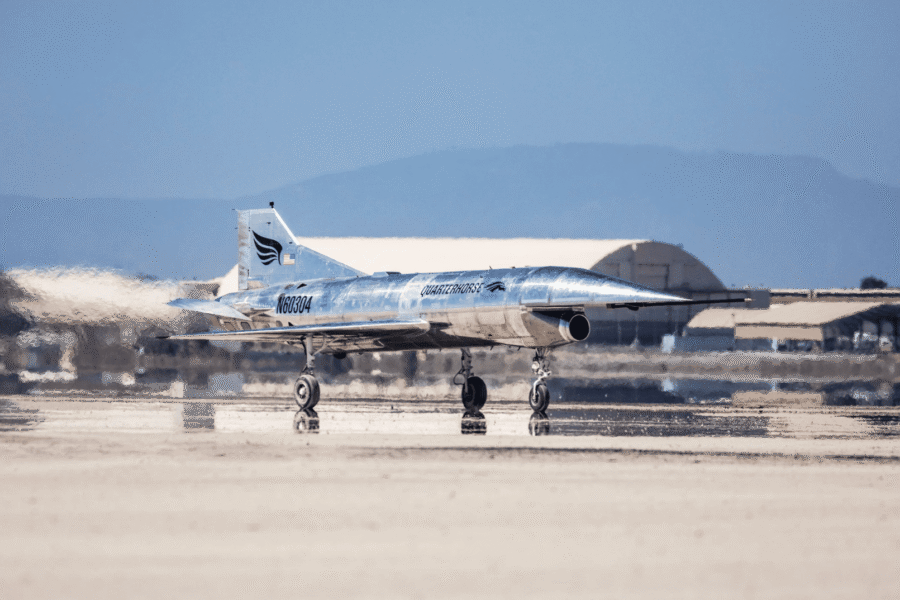
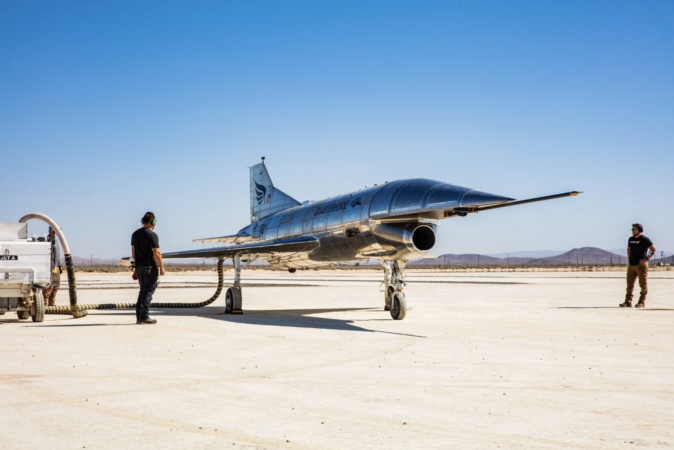
Startups Anduril Industries and Heremus have agreed to integrate Anduril’s autonomy software onto Hermeus’ hypersonic demonstrator aircraft “Quarterhorse”—uniting two technologies that have drawn keen interest and investment from the Air Force.
The firms announced the deal Sept. 3 and said they plan to fly the Quarterhorse Mk 2 aircraft using the Lattice autonomy system in 2027.
Hermeus is attempting to build a reusable aircraft that can reach hypersonic speeds, defined as Mach 5 and above, and has received funding and support from the Air Force. Quarterhorse has yet to go that fast—company officials say they’re targeting supersonic speeds, or Mach 1-plus, as the next step in their test campaign—but adding autonomy software could enable faster control of the aircraft as it flies around a mile per second.
At the same time, preparing the software for the platform will take time.
“We will spend the rest of this year on a build-up from software in the loop to integration testing to hardware in the loop and validation testing, then we’ll go toward flight,” Brett Darcey, vice president for mission autonomy at Anduril, told Air & Space Forces Magazine.
Anduril is already refining its autonomy software, dubbed Lattice, for the Air Force’s Collaborative Combat Aircraft program. The firm is competing with Shield AI and Collins Aerospace on that front. Anduril is also building its FQ-44A Fury drone as one of the CCA airframes, along with General Atomics’ FQ-42A Dark Merlin.
But while Anduril has experience with the CCA program, CCAs aren’t meant to be supersonic nor hypersonic like Quarterhorse. The speeds at which that aircraft will operate will require beyond human-like decision-making speeds. The Autonomy Government Reference Architecture that serves as the baseline for most contractor’s autonomy software requires that Quarterhorse be able to fly itself “through all regimes of flight, which would include the jump to supersonic,” Darcey said.
That means human operators will tell the software to fly at a certain velocity, and the software will be responsible for taking the steps to execute the command.
“That probably means we’re going to do a lot of software and hardware in the loop testing, and a lot of independent validation of what we are doing on the route generation side, and appropriately, I think the monitoring of execution of those routes when we’re at those high speeds on the build-up phase all the way to flight,” Darcey said.
That step-by-step approach is necessary as companies work to build trust in the software’s ability to control the aircraft’s flight and other taskings for its human operators.
Tactics, techniques, and procedures are still developing and evolving to build that trust between human and machine, but Darcey was quick to note that in the development stage there can be too little trust; at times, there can also be too much.
He likens it to using an actual horse in warfare. Horses are independent, thinking creatures that can also be trained to do certain things. Cavalrymen would build their trust in the “human-horse system” over time, instead of just jumping on a horse and going to war.
A key difference between autonomy software and an actual horse, though, is that the software has built-in debrief functions that will tell the user what it did and why. And as developers of the software, sharing that data with their company partners and the Air Force provides transparency for the process, Darcey said.
CCA and Mission Autonomy
In February, Anduril’s developmental YFQ-44A flew with two different mission autonomy software suites on the same aircraft during the same flight, using both Lattice and Shield AI’s Hivemind suite.
“We do have an advantage with Fury,” Darcey said. “That kind of deep platform knowledge definitely is useful.”
But Darcey was quick to point out that the company isn’t tying all its software thinking to its own platform, or even to a single platform. The software used in the CCA program must also be viable for a wide range of aircraft types, based on USAF requirements.
“One of the big challenges with mission autonomy is it has to be generally built so it can do the mission requirements of multiple platforms at once,” Darcey said.
Quarterhorse
Hermeus conducted its first flight with the Mk1 model in May 2025 and then flew its Mk 2.1 demonstration vehicle in another flight in March.
That flight ran from Spaceport America past White Sands Missile Range, N.M., with operators piloting the aircraft from a ground-based flight deck, Air & Space Forces Magazine reported.
The Mk 2 aircraft is roughly the size of an F-16 fighter.
The company won a $1.5 million contract in 2020 for a future hypersonic Presidential and Executive Airlift fleet via AFWERX, an Air Force innovation arm within the Air Force Research Laboratory.
In 2021, Hermeus won a $60 million Strategic Funding Increase contract via AFWERX and the Air Force Life Cycle Management Center
The Defense Innovation Unit awarded Hermeus a $23 million contract in 2023 for technologies related to the unit’s larger goal of creating a Hypersonic High-Cadence Airborne Testing Capabilities program.