


Editor’s Note: This article has been updated to include a comment from Boeing.
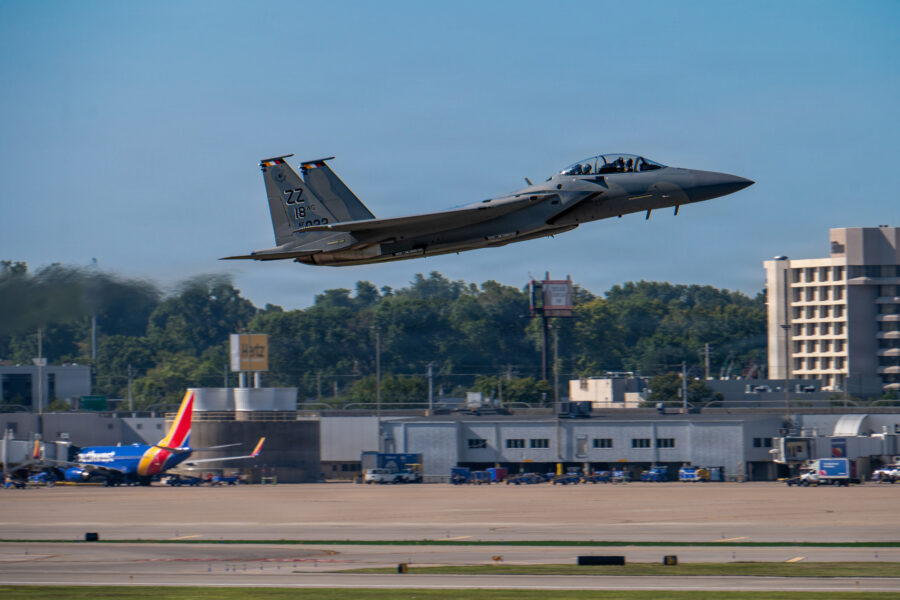
After months of delays from a factory strike, the first F-15EX fighter jet the U.S. Air Force will permanently base overseas left Boeing’s facilities in St. Louis on Aug. 28. Eventually, the aircraft will fly to Kadena Air Base in Japan and join the 18th Wing there, but for now it is going to Portland, Ore.
“This is an important next step toward bringing the F-15EX home to Kadena,” Brig. Gen. John Gallemore, 18th Wing commander, said in a release. “Our team is ready to welcome the F-15EX, and this is another milestone that brings us closer to putting this capability in the hands of the Airmen who will fly, maintain and employ it from Japan.”
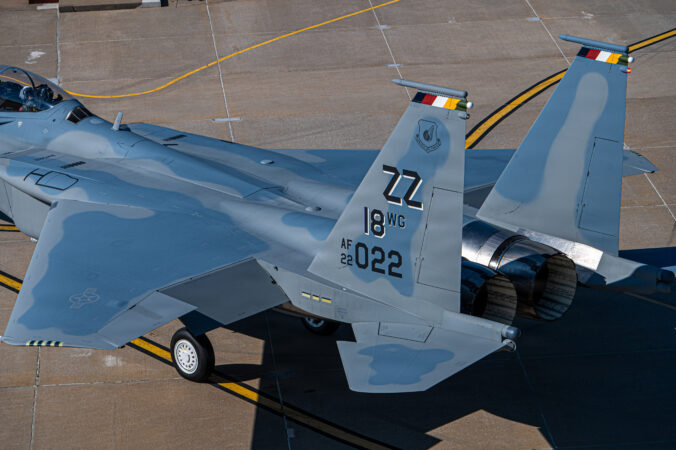
The F-15EX is the first Eagle II jet to feature the 18th Wing’s historic, distinctive “ZZ” tail flash and will actually arrive at Kadena sometime in fiscal 2027, which begins Oct. 1.
Spokespeople for Headquartes Air Force, the 18th Wing, and the Air National Guard did not immediately respond to queries from Air & Space Forces Magazine on Sept. 8.
Boeing spokesman Josh Roth told Air & Space Forces Magazine that the F-15EX-22 “was delivered with the baseline mission computing, communications, and sensor capabilities that provide the foundation for manned-unmanned teaming and future Collaborative Combat Aircraft integration.” He deferred additional questions to the Air Force.
This new jet is the first of 36 F-15EXs to be stationed at Kadena. The fighter, often described as halfway between fourth- and fifth-generation aircraft, will help usher in a new era in U.S. airpower within the first island chain surrounding China
The transition to the EX has been a long time coming for Kadena—the Air Force started retiring the base’s legacy F-15C/Ds in 2022 and confirmed plans to replace them with the F-15EX in 2024. The first jet was supposed to arrive in spring 2026, but a lengthy strike at the Boeing plant in St. Louis late last year slowed production until this Aug. 28 delivery.
The new F-15EX’s stopover in Oregon isn’t surprising—the Oregon Air National Guard was the first Air Force location with combat-coded F-15EXs at its Portland ANG Base. The base will conduct the final systems integration, add software updates, and other technical preparations before the aircraft can go to Okinawa.
In the interim, the Air Force has rotated F-16, F-15, F-22, and F-35 squadrons through Kadena to keep the tactical fighter presence steady at a key strategic base fewer than 400 miles from Taiwan.
Those rotational forces haven’t always matched the capabilities the F-15EX will bring. Air & Space Forces Magazine recently reported on the extended tour of aging F-16Cs out of the Colorado Air National Guard’s 120th Fighter Squadron, which ran from January through June. They brought a dozen fighters.
Both the squadron commander and the head of its parent wing, the 140th Wing, said in a call with the media on Sept. 3 that while the platform could keep up with fifth-gen fighters in the region, the pilots and maintenance crews were pushing the limits of the more than 30-year-old airframe
The permanent stationing of the F-15EX will “enhance Kadena’s ability to generate ready combat airpower while providing opportunities to train and integrate alongside the Japan Air Self-Defense Force and other allies and partners,” according to the release.
The 18th Wing trains alongside the Japan Air Self-Defense Force F-15s at Naha Air Base in bilateral exercises and other training, according to the release.
Pacific Air Forces has been slowly phasing out its oldest fighters and introducing more modern jets in recent years. In addition to Kadena’s F-15s, the Air Force has also recently withdrawn the A-10s at Osan Air Base, South Korea.
The 35th Fighter Wing at Misawa Air Base, Japan, meanwhile, is slated to get 48 fifth-gen F-35 Lightning IIs, but only a trickle had arrived as of April. The wing transferred its F-16s to Osan last year.
The Air Force publicly confirmed delays in getting the F-15EX to Kadena in February.
The Eagle II is the first of its kind to include digital fly-by-wire flight controls, a large-area display glass cockpit with a touchscreen interface, an APG-82 Active Electronically Scanned Array radar, a Joint Helmet Mounted Cueing System, and an Eagle Passive/Active Warning Survivability System.
The jet flies faster and farther, carries a heavier payload than its F-15 predecessors, and has two additional weapons stations.