


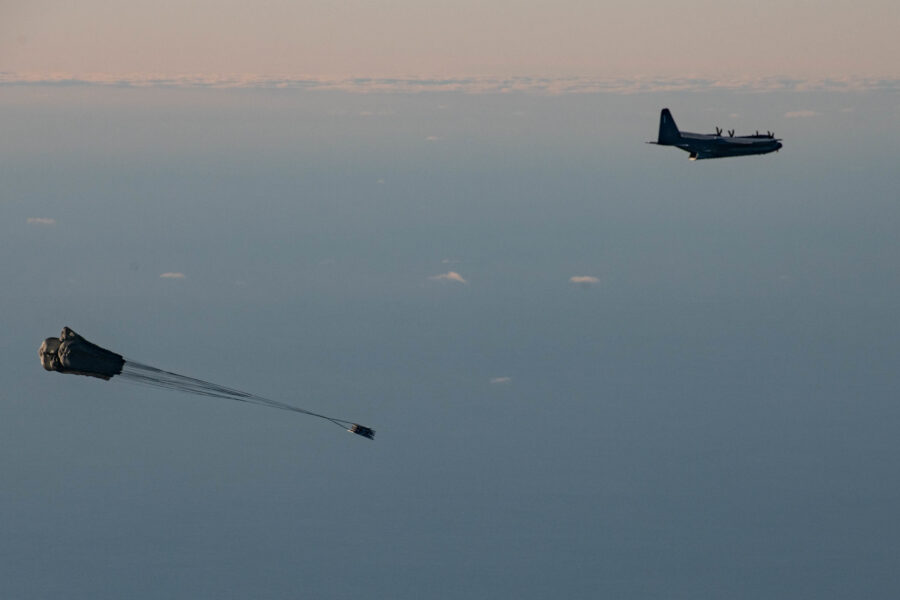
A yearslong effort to find an affordable way to turn cargo planes into strike platforms is now an official program with anticipated fielding in 2027.
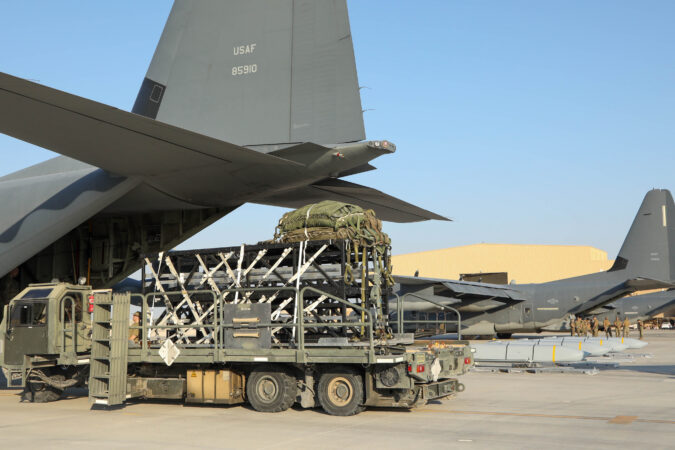
The Air Force Life Cycle Management Center recently announced the establishment of “Dragon Cart,” the program of record to arm mobility aircraft such as the C-17 and C-130 with so-called palletized munitions.
The palletized munitions concept involves putting a specialized container loaded with cruise missiles on a standard airdrop platform. The container is released like any other airdrop and deploys its parachute, then the weapons are deployed, ignite their engines, pull up, and proceed toward their target.
The Air Force Research Laboratory first developed the idea as part of its Rapid Dragon program. Now Dragon Cart will operationalize it.
“This program provides the operational ambiguity, adversary deterrence, and additional command options to maximize operational effects,” JiaJia Lee, the new Dragon Cart program manager, said in an AFLCMC release. “It gives us the option to transform mobility aircraft into powerful strike platforms, unlocking capabilities we wouldn’t normally have in how we employ our airlift fleet.
Air Force officials say the benefit of palletized munitions include saturating the airspace, complicating adversary targeting solutions, providing open access to targets, and depleting the opponent’s air defense stockpile.
Program officials expect to award prototype contracts for Dragon Cart in late May, with the goal of fielding in 2027, according to the AFLCMC release.
The release also noted that the program stands out in its focus on government control of technical requirements and data rights. That will provide flexibility as the Air Force matures the technology.
“Dragon Cart is literally the ‘born digital’ dream come true,” said Kent Mueller, the systems engineering program manager and program architect. “It is a system that was born inside Model-Based Systems Engineering models. Because we own the engineering, if a new payload needs a launch module that is slightly longer, we just model it, do the load path analysis, and send that model to our production vendors.”
A Cheaper Way
Dragon Cart is one of a host of efforts the Air Force is pursuing to find cheaper ways to put more missiles in their various quivers.
In 2026, the service announced its Family of Affordable Mass Munitions program. The program spans a range of missiles and bombs. One category is cruise missiles, which Dragon Cart will use.
Recent budget documents show the Air Force wants to spend $12 billion to buy nearly 28,000 cheap cruise missiles over the next five years.
Those are a mix of lugged missiles, those carried by planes, and palletized, those batched on pallets and released from mobility aircraft.
The Rapid Dragon program performed several tests on the C-130 and C-17, including a live-fire test at Eglin Air Force Base, Florida, in December 2021.
The program name comes from an ancient Chinese military-designed crossbow catapult that launched multiple crossbow bolts with the pull of a single trigger, raining destruction down on armies from tremendous ranges, according to an AFRL release. The weapons were called Ji Long Che—Rapid Dragon Carts.
Past missile experiments saw a six-weapon configuration on the C-130 and a nine-weapon configuration on the C-17. An Air Force Special Operations Command MC-130J Commando II dropped a four-cell pallet with a single cruise missile and three simulants.
Rapid Dragon, which debuted in 2019, eventually transitioned from AFRL to the Defense Innovation Unit as part of a program called Franklin, which sought to develop long-range fires at $100,000 per round.
A late-April AFLCMC notice to industry sought information on an affordable cruise missile capable of flying more than 1,200 miles, called the FAMM-Beyond Adversary Reach.
The future FAMM-BAR must have the option to be either lugged or palletized, according to the notice. Current FAMM efforts are in the 250- to 500-mile range.