


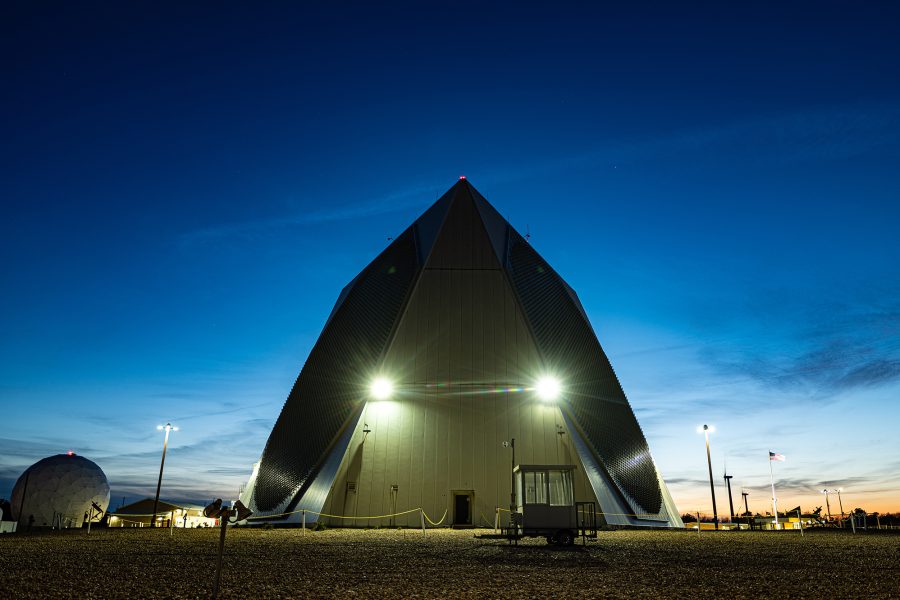
The Space Force plans to overhaul eight legacy missile warning and space surveillance radars located around the world, taking them from analog to digital operations, according to a May 7 notice.
Under the Ground Based Radar Digitization project, or GBRD, the service will install new hardware and software on the radars, upgrading everything from front-end antennas to back-end data processors. The systems, some of which have been in operation since the 1970s, include:
- Five Upgraded Early Warning Radars, located at Pituffik Space Base in Greenland; Royal Air Force Fylingdales in the United Kingdom; Clear Space Force Station, Alaska; Beale Air Force Base, Calif.; and Cape Cod Space Force Station, Mass.
- The Perimeter Acquisition Radar Attack Characterization, or PARCs radar, at Cavalier Space Force Station, N.D.
- The Cobra Dane radar at Eareckson Air Station, Alaska
- The C-6 radar at Eglin Air Force Base, Fla.
“These aging systems face critical obsolescence and sustainment challenges and require a comprehensive technological upgrade to meet evolving threats,” according to the notice. “GBRD will modernize the entirety of these systems.”
The Space Force relies on a mix of satellites and ground-based systems to monitor objects and activity in space and to detect and warn of potential missile threats—both key missions for the service and U.S. Space Command. Space domain awareness, in particular, is foundational to the U.S. military’s ability to move freely in space and to perform other core missions like space control. Likewise, missile defense is a top priority for the Trump administration, which launched a $185 billion program last year called Golden Dome aimed at scaling up key homeland defense capabilities.
USSF is fielding new and upgraded radars to build out its ground-based architecture, like the Deep-Space Advanced Radar Capability in Australia, which was approved for limited early use last September. It’s also integrating commercial radars into that network. Still, the service sees a continuing role for these legacy systems, especially when it comes to early warning capabilities and general space domain awareness.
That’s in part because of their strategic locations. For example, Cobra Dane is situated in the Aleutian Islands, a chain that extends from the southwestern coast of Alaska toward Russia. The L-band phased-array radar provides critical intelligence and surveillance of foreign missile test ranges.

The sites also provide unique contributions to the Space Surveillance Network, which tracks spacecraft and debris orbiting Earth. The C-6 radar at Eglin was the Space Force’s first dedicated space surveillance radar and, due to its large transmit and receive apertures—which serve as the radar’s mouth and ears—is still one of the most powerful radars in operation today, tracking thousands of objects daily.
As such, the service is moving quickly to field the GBRD upgrades that will keep these systems operating into the future. Maj. Gen. Stephen Purdy, senior adviser to the Secretary of the Air Force for space acquisition, said last month that the Space Force approved its GBRD strategy in November, designating it a “middle tier acquisition” effort. That authority, bestowed by Congress in 2015, allows the service to fast-track certain development and procurement programs. In its solicitation this week, Space Systems Command said it expects to choose a pool of vendors for GBRD in June.
The Space Force’s fiscal 2027 budget request includes $128 million for the program and projects its budget will include $654 million between fiscal 2028 and ‘31. The service expects to complete a preliminary design review for the upgrade in 2027 and begin developing software and hardware. The initial rapid prototyping phase will include up to four of the eight radar sites, likely three of the UEWR systems, budget documents indicate. The remaining four sites will begin the rapid fielding phase in fiscal 2030.