
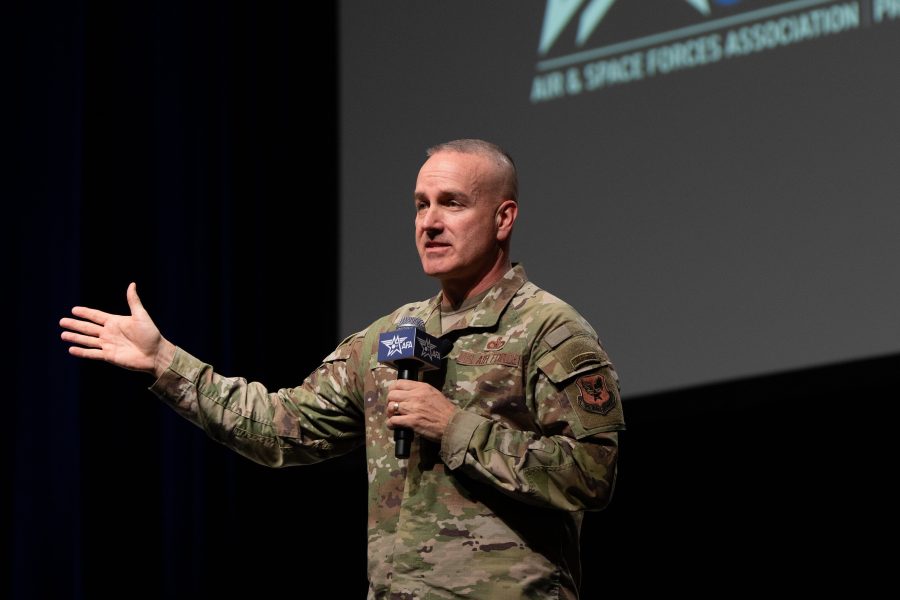
Chief Master Sergeant of the Air Force David R. Wolfe said May 8 that the service is working on a new training program to ensure that every Airman is educated to use AI in their everyday job.
Just weeks after the service released its artificial intelligence strategy, Wolfe said on a Military Officers Association of America webinar that the service must create a level of “AI literacy” throughout the force to take advantage of the new technology.
“We have got an opportunity here with AI that we are going all in on,” Wolfe said. “We are getting ready to roll out what I know will be some meaningful training for our folks to get everybody to a baseline of AI literacy so we can use it for all of its intended purposes, and for things that we haven’t really figured out yet that it can do.”
It’s not yet clear when the service intends to start this new AI training effort for Airmen.
Wolfe, who equated the technological leap of AI to the creation of desktop computers and email addresses, is confident it will make the Air Force more efficient and effective.
Wolfe’s comments also follow the service’s April 28 announcement that it plans to “aggressively recruit, train, and retain top-tier artificial intelligence professionals” to operationalize AI throughout the force. To attract new talent, the service plans to streamline its hiring and accessions processes, “remove bottlenecks, and expedite hiring for essential AI positions,” the announcement states.
The Air Force said it plans to offer competitive financial incentives to attract top AI professionals, but the service has not announced what those incentives might be worth.
“We plan to consider special hiring and compensation authorities, such as those used for the acquisition workforce,” Susan Davenport, chief data and artificial intelligence officer for the Air Force, told Air & Space Forces Magazine. “The goal is to compete with the private sector where AI professionals may seek employment, as we also want a workforce with top AI skills.”
Part of the plan involves developing training courses to ensure that the Air Force grows a “universally informed and responsibly engaged workforce prepared for an AI-integrated future,” according to the announcement.
Following on the Pentagon priorities for AI technology, the Air Force wants to use AI to “shorten sensor-to-shooter timelines” and enhance decision-making with “superior situational awareness and predictive insights,” according to the service’s strategy.
But to Wolfe, AI can be useful for simplifying the time-consuming processes that go into promotions and military awards.
“We are doing experiments looking at how we have done promotions boards in the past and how we have picked people for awards” he said.
Wolfe did stress that AI would not be used to selection Airmen for promotions or awards but in “automating the process, so that when the human looks it, it’s easy to see, easy to discern and gives us a really good chance of making a really good decision.”
“What we think is in the realm of the possible is we take our already awesome people … and make them even more capable than they already are by automating processes that they don’t have to put a bunch of time into.”
The Air Force announced last May that it was standing up a new center for artificial intelligence development to build on existing partnerships with MIT, Stanford University, and Microsoft.
“AI has a broad continuum,” former Air Force Chief Information Officer Venice Goodwine said at the time. “Yes, I can use AI for summarizing briefs in the legal world, or I can use AI for productivity, but I also can use AI for AI-enabled autonomy. So, when you have a continuum that broad, how do you make sure that the use cases or the tools that you use or the investments that you’re making enable the [service’s] strategic objectives? The AI Center of Excellence in the Air Force is going to do that.”