
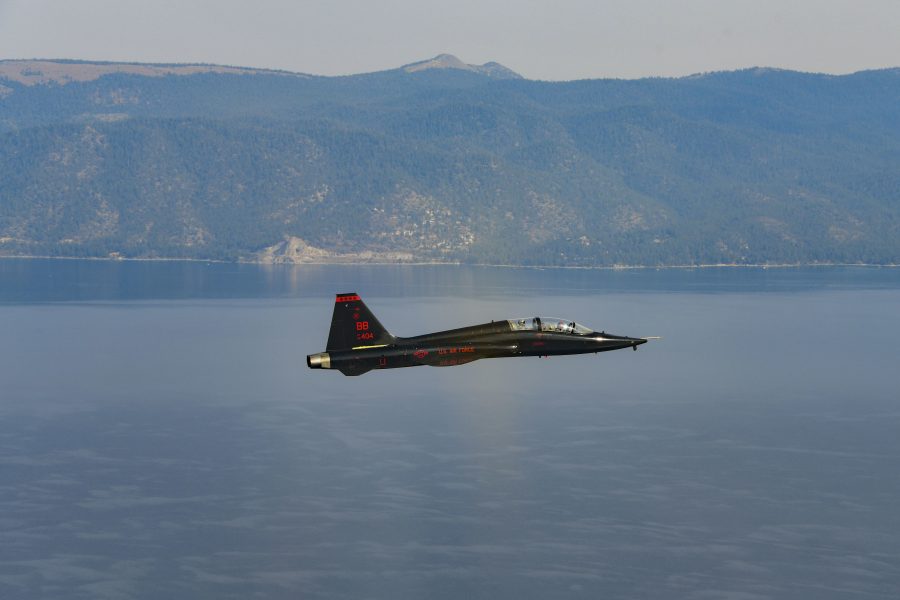
The T-38 was the first supersonic trainer aircraft and primarily serves AETC’s advanced JSUPT fighter/bomber tracks and Introduction to Fighter Fundamentals. The aircraft is used to teach supersonic techniques, aerobatics, formation, night and instrument flying, and cross-country/low-level navigation.
The T-38 is also used by the USAF Test Pilot School to train test pilots and flight-test engineers and by ACC and AFGSC as a companion trainer to maintain pilot proficiency. ACC uses regenerated T-38s as dedicated Aggressor aircraft for F-22 training and companion trainers for the B-2 and U-2 programs.
T-38Bs are equipped with a gunsight and centerline station for mounting external stores including ECM pod/practice bomb dispensers. Aircraft were redesignated T-38Cs after avionics modernization that added a glass cockpit and HUD, color MFDs, mission computer, integrated INS/GPS, and reshaped engine inlets. T-38s were designed for 7,000 flying hours but many have surpassed 20,000 hours, requiring life-extension to bridge the gap to replacement by the T-7A.
Pacer Classic III is the type’s third structural renewal effort and the most intensive in its history, replacing major longerons, bulkheads/formers, intakes, internal skins, and structural floors on 180 high-risk T-38Cs. The concurrent Talon Repair Inspection and Maintenance (TRIM) program addresses similar issues across the T-38A and T-38B fleets as well as T-38Cs lacking Pacer Classic III mods through 2029. Pacer Classic III redelivered the first of the 180 upgraded aircraft in 2015 and is slated for completion in FY26. TRIM launched in 2023 will redeliver 22 aircraft this year.
Future upgrades focus on cockpit modernization, including the Terminal Avionics Replacement Program (TARP) and Low-cost Avionics Modification Program (LAMP). TARP replaces obsolete HUD components and cockpit displays, while LAMP modernizes inertial navigation and instrument landing systems to prevent spatial disorientation. Avionics upgrades in FY26 are limited to modernized Video Data Transfer Unit to enhance aircrew debriefing capabilities.
Delays to the T-7A program have strained the fleet, which suffers a shortage of overhauled engines due to obsolescence, dragging mission capable rates as low as 58 percent and continuing to delay pilot training. USAF plans to divest 17 nonrepairable T-38s in FY26.
T-38 Talon Technical Data
Contractors: Northrop Grumman; Boeing (sustainment); CPI Aerostructures (Pacer Classic III kits).
First Flight: April 1959 (T-38A); July 8, 1998 (T-38C).
Delivered: 1961-72 (T-38A); 2002-07 (T-38C).
IOC: March 1961.
Production: 1,187.
Inventory: 52 (T-38A); six (AT-38B); 437 (T-38C) (Current as of FY24).
Operator: ACC, AETC, AFGSC, AFMC.
Aircraft Location: Beale AFB and Edwards AFB, Calif.; Columbus AFB, Miss.; Holloman AFB, N.M.; JB Langley-Eustis, Va.; JBSA-Randolph and Sheppard AFB, Texas; Vance AFB, Okla.; Whiteman AFB, Mo.
Active Variants: •T-38A. Upgraded version with Pacer Classic I and II mods. •AT-38B. Armed weapons training version. •T-38C. Modernized airframes incorporating glass cockpits and upgraded engines.
Dimensions: Span 25.3 ft, length 46.3 ft, height 12.8 ft.
Weight: Max T-O 12,093 lb.
Power Plant: Two General Electric J85-GE-5 augmented turbojets, each 2,900 lb thrust.
Performance: Speed 812 mph, range 1,093 miles.
Ceiling: 55,000 ft+.
Accommodation: Two pilots on Martin Baker US16T zero/zero ejection seats.