


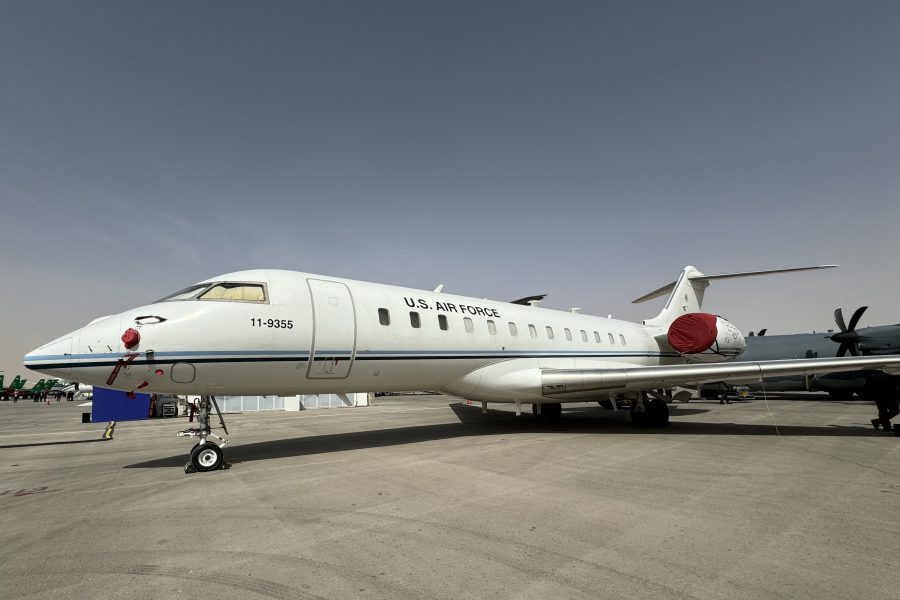
The Air Force’s BACN may be cooked—the service plans to retire its entire E-11A Battlefield Airborne Communications Node fleet in fiscal 2028 and equip aircraft to use satellite communications instead.
Department of the Air Force senior leaders disclosed the move in joint written testimony to Congress last week.
There are seven E-11s currently in the fleet. The Air Force has flown the aircraft since 2008, and the BACN (pronounced “bacon”) earned the moniker “Wi-Fi in the sky” during operations in the Middle East by extending communications links deep into mountainous terrain.
Its mission goes beyond just extending basic connectivity, though. The E-11 also serves as a relay or translator of sorts for data and information flowing between different aircraft and platforms that might not be able to communicate otherwise.
In their written testimony, presented to the House Appropriations defense subcommittee April 30, Air Force Secretary Troy E. Meink, Air Force Chief of Staff Gen. Kenneth S. Wilsbach, and Chief of Space Operations Gen. B. Chance Saltzman said that mission will continue with the “Hybrid SATCOM Terminal program providing a near-term bridge in capability.” They did not specify a long-term replacement.
The Hybrid SATCOM Terminal program is an ongoing effort to build a communications terminal with multiple antennas that can connect to different satellite constellations, depending on the needs of the user or the strength of the signal.
The Air Force Research Laboratory has been working on this challenge since 2018 under its Global Lightning program. The Space Force has helped fund the effort to the tune of more than $300 million in development and prototyping efforts, according to budget documents.
The plan for 2026 is to complete “development of prototypes for the Hybrid SATCOM Terminals that can be integrated on air and ground platforms,” the budget documents state, then start transitioning the effort to the Air Force’s Program Acquisition Executive for command, control, communications, and battle management in 2027.
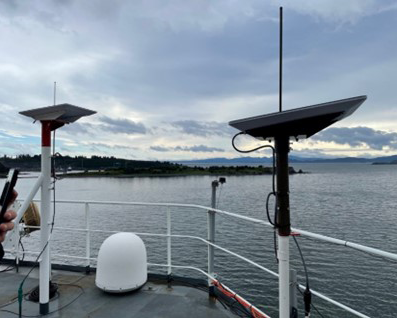
Budget documents also show the Air Force wants to move quickly to field the capability, starting procurement efforts for the new terminals in 2027 to put on B-1, B-2, and B-52 bombers and F-15 fighters, followed by F-22 fighters, KC-135 and KC-46 tankers, and other types in the next few years after that. By being able to tap into the same satellite networks, the aircraft will be able to better relay data to each other.
Both Northrop Grumman and L3Harris have conducted successful experiments with terminals as part of AFRL’s Global Lightning program, suggesting the technology is relatively mature.
Notably, AFRL has said the terminals will be able to connect with both government and commercial satellite constellations. The Space Force is currently working on what it calls the Space Data Network—a vast data transport and communications network that includes both military and industry satellites to provide both secure tactical connections and high-speed, high-throughput ones. Terminals that can tap into more networks could ease the technical challenge of fusing different agencies’ and companies’ systems into one.
The E-11A is not the only Air Force platform tapped to have its mission transferred to space. The Pentagon has also said it wants to forgo the E-7 Wedgetail program and transfer the moving target indication mission to satellites. The Air Force and Congress are currently debating the future of that plan.