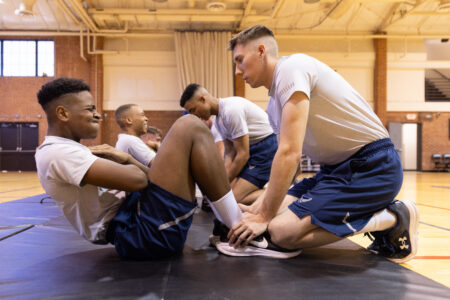
JOINT BASE ANACOSTIA-BOLLING, Washington—Airman 1st Class Rickey Newton’s muscles began to shake at the four-minute mark of his forearm plank exercise during the new Physical Fitness Readiness Assessment, or PFRA, on May 5. He had already held the position 30 seconds past the 3:30 he needed for the maximum score, but his fellow Airmen cheered for him to continue.
At 4:50, Master Sgt. Craig Harrison kneeled next to him, shouting “Ten more seconds! Ten more seconds!
“Yes! Five minutes! Five minutes!” Harrison shouted. Newton pushed through his pain for another 18 seconds before collapsing onto the mat. The 33-year-old Airman, and 10 other members of the Air Force Honor Guard, practiced the service’s new fitness test here during the three-month diagnostic test period before it starts counting for real in July.
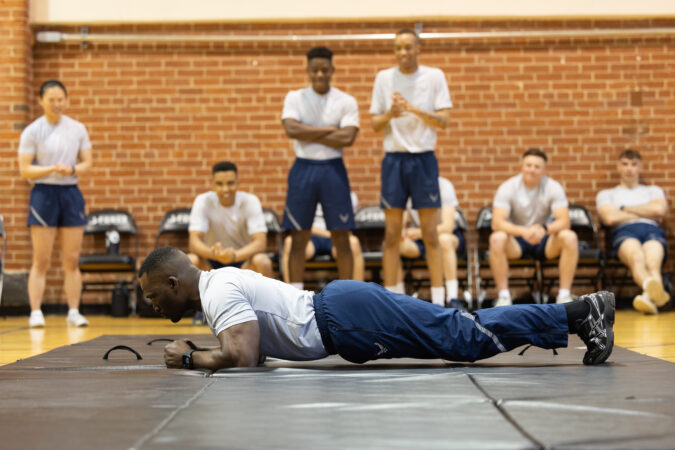
Photo by Jud McCrehin, Air & Space Forces Association
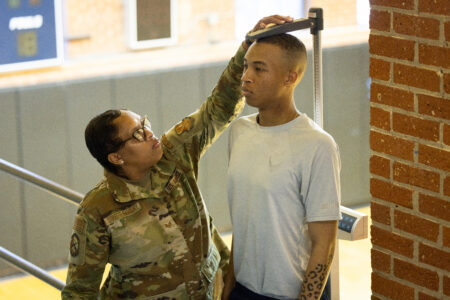
The Air Force first announced changes to its fitness test last fall requiring Airmen to take the assessment twice a year. For the new version, Airman can choose between a two-mile run—instead of the current 1.5 miles—or a 20-meter High Aerobic Multi-Shuttle run. The fitness test also includes a body composition measurement and different exercise options for measuring muscular strength and core endurance.
The Air Force released new scoring charts in September “to give the field a heads up as to what was coming,” Air Force Chief Exercise Physiologist Jason Ham told Air & Space Forces Magazine in an emailed statement. After more feedback and input from data analytics and fitness experts, the service updated its scoring charts in March to “better calibrate” them, Ham said.
As an example, the updated scoring for the HAMR is “better aligned” with the average VO2 max by testing demographic. VO2 max measures how much oxygen a person’s body consumes while exercising.
A diagnostic test period also started in March to give Airmen time to practice taking the new assessment and adjust to the new scoring standards, Ham said.
“It gives Airmen a chance to take the test under the new, more rigorous standards,” said Ham, who added that the diagnostic period also “gives policy makers a chance to understand areas that could use a little refinement in a major change such as this one.”
It’s still too early in the diagnostic period to tell if the scoring charts will have to be adjusted again, Ham added.
The Air Force Honor Guard requires all of its members score a minimum of 85 percent on fitness tests, which is 10 percent higher than the service-wide minimum. The 10 males and one female taking the May 5 diagnostic all scored 90 percent or higher, with a few achieving the top score of 100 percent. But several members said they are still learning which exercises play to their individual strengths.
The forearm plank might be better than the traditional situps for people who don’t have as much lower abdominal endurance, Newton said; the plank allows Airmen to “use their quads more and brace with their arms.”
Newton said he normally does situps and maxes out his score but decided to try the plank for the diagnostic. He admits, however, that next time he may not hold it beyond the 3:30 necessary for the max score. He didn’t earn any additional points for exceeding the max, and the strength he exerted on the plank hurt his staying power in the 20-meter High Aerobic Multi-Shuttle Run, or HAMR, event, which immediately followed.
“There was no rest time; I was still trying to recover from the plank,” Newton said, adding that he believes he can beat his overall score of 91 when he takes the PFRA for an official recorded score after July 1.
“You’ve kind of got to figure out where your strengths and weaknesses are within your body,” he said. “I’m just trying to gauge which one is best for me.”
The new PFRA’s main difference from past fitness assessments is it requires Airmen to choose between a two-mile run and the HAMR, which requires participants to dash between lines 20 meters apart at a progressively faster pace. Both the run and the HAMR count for 50 percent of the total score.
The Air Force initially planned on making the two-mile run mandatory for everyone, but in January, the service announced that Airmen will have continue to have a choice.
“The goal is to test physical fitness and cardiovascular fitness—both the two-mile run and the 20-meter HAMR do that equally,” an Air Force official said in January.
For the May 5 event, six Airmen in the group opted for the HAMR, while the other five did the run.
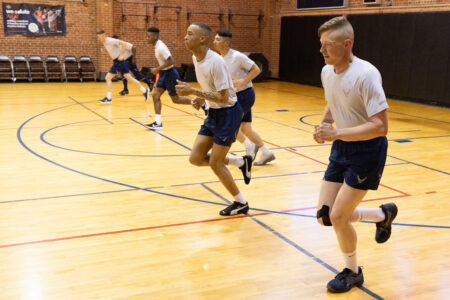
On the first level of the HAMR, Airmen start off at a slow jog and gradually increase their pace to match a pre-recorded series of beeps that takes Airmen through a specific number of repetitions for each level.
“By the time you get to like level 7, that’s when you see the real runners,” Harrison said.
Only three were still running by level 9-4. Midway through level 10, only one Airman remained—Airmen 1st Class Zachery Chance.
“Yes sir! That’s right, push, push, push it, Chance!” Harrison cheered. Chance reached his limit at level 11-3—95 repetitions—which is six more than the 87 repetitions needed for the max score in his age group. The 18-year-old Airmen, who scored a 99 out of 100 on the PFRA, chose the HAMR because he is a natural sprinter.
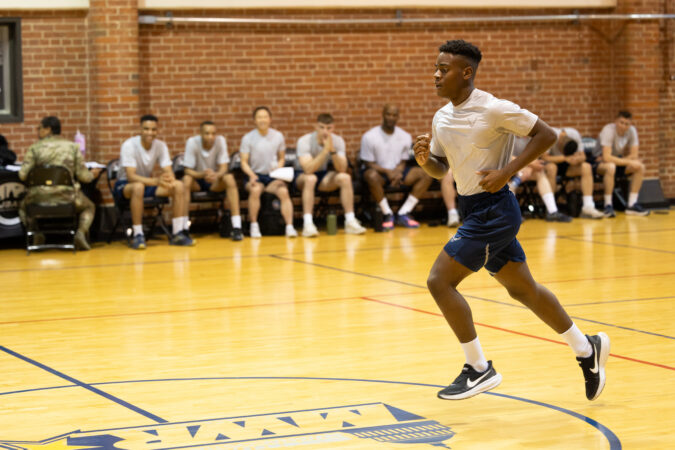
Photo by Jud McCrehin, Air & Space Forces Association
“I used to run track in high school; my thing is short distances,” he said. “Long distance was something that always tripped me up.”
For Airmen that choose to do the HAMR, Chance advises its all about learning when to increase the pace. He has noticed that a lot of people start out running too fast.
“They burn out because they run faster than they have to,” Chance said. “From level one to about level five or six, you can just keep a casual pace. You have to gauge how fast you have to run.”
Airmen 1st Class Jordan De Guzman, 19, got to level 10-1, or 82 repetitions, on the HAMR.
“For me, what helped a lot was the Stairmaster machine,” he said. “We had a Mount Everest challenge at the gym, and I did it for a week. I went from like an hour, and by the end of the week, I was doing about two hours on the Stairmaster.”
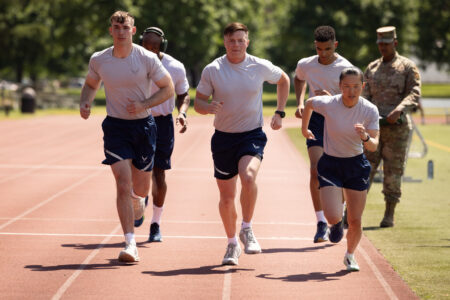
The Airmen that chose the two-mile run said that the extra half mile didn’t make a difference to them.
“I would consider myself a pretty big runner; I run three times a week, mainly distance, so for me, I’m more endurance-based,” said 34-year-old Staff Sgt. Ryne Montgomery, who ran the two miles in 11:58. He also aced the traditional pushup and situp events for a score of 100.
Montgomery said the increase from 1.5 to two miles “is certainly more challenging for people who aren’t accustomed to running.” Building a foundational base of cardio endurance is the only way to get better scores on the two-mile run, he said.
“Just gradually increase your mileage, week-by-week,” Montgomery said. “So, I’ll do an eight-mile run on Tuesdays, and then on Thursdays I’ll usually do a track workout to get some speed work in. And then, on Saturday I’ll do a long run, like 13 to 15 miles.”
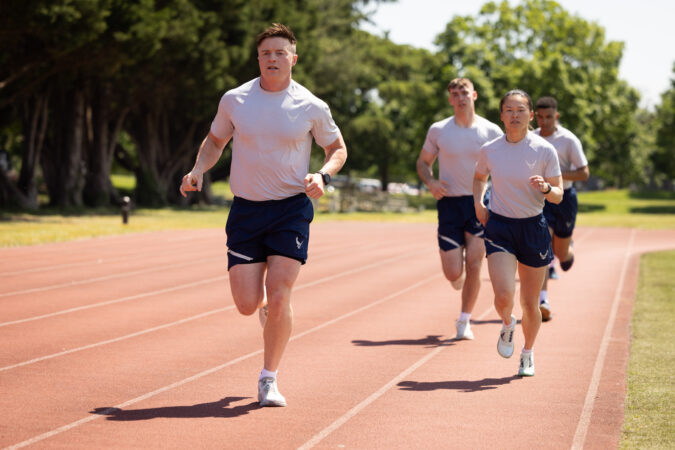
Photo by Jud McCrehin, Air & Space Forces Association
While those longer distances aren’t for everyone, experienced Airmen recommended running three times a week.
Capt. Rachel Smith, a 28-year-old flight commander in the Honor Guard, also did the two-mile run. For her, mixing three-to-five mile runs three times per week and performing calisthenic workouts in between was the key to earning her 100 score on the overall PFRA.
Tech. Sgt. Devonte Hentley, 37, scored a 96 on the test. Each week, he does a three-to-four-mile run, then a fast-paced two-to-2.5 mile run and ends the week with a four-to-five mile run at a pace where he can comfortably carry on a conversation.
“But you don’t have to run every day,” Hentley added, noting that recovery in between running days is also important.
Currently, most Airmen serving in the Honor Guard manage their own workout routines since varying work schedules make unit PT more challenging.
“They’re on an individual level right now, however, if we have a discrepancy or some type of leniency in the numbers, then we would talk to our commander and say ‘hey, we probably need to do some squadron PT,’” said Harrison, who serves as the lead unit fitness program manager for the unit. “Luckily, we haven’t had that; everybody’s fit and doing pretty well.”
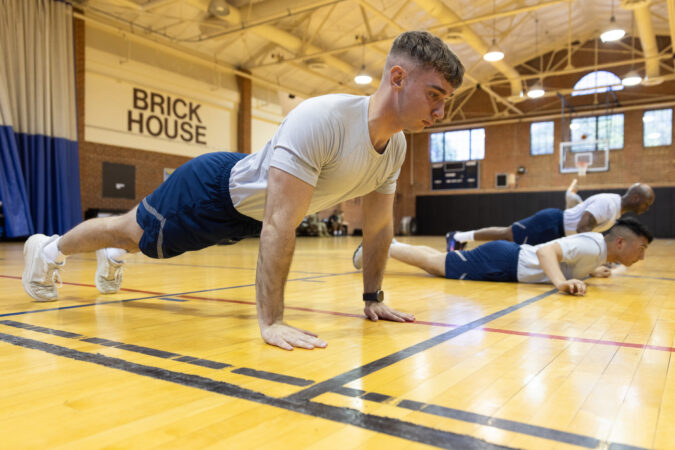
Photo by Jud McCrehin, Air & Space Forces Association
Harrison, 38, scored a 95.5 on an earlier diagnostic test and plans to submit that as his recorded score after July 1.
Harrison said he was training for the two-mile run during that diagnostic but changed his mind after the Air Force decided against making it mandatory.
“I can do long-distance running; I don’t mind it. However, I’m more of a sprinter type, so doing the shuttles back and forth is more comfortable for me,” Harrison said, adding that he was pleasantly surprised when the Air Force announced that Airmen would have a choice.
“A lot of people aren’t necessarily long-distance runners. I think some people perform better at shorter sprints, so for them having an option is good.”
Harrison said plans to do the two-mile run on a future PFRA. “I’ve timed myself around the 15:30 mark, so it’s not bad—could do with some improvement—but I am going to attempt the two-mile, just to see where I’m at.”