
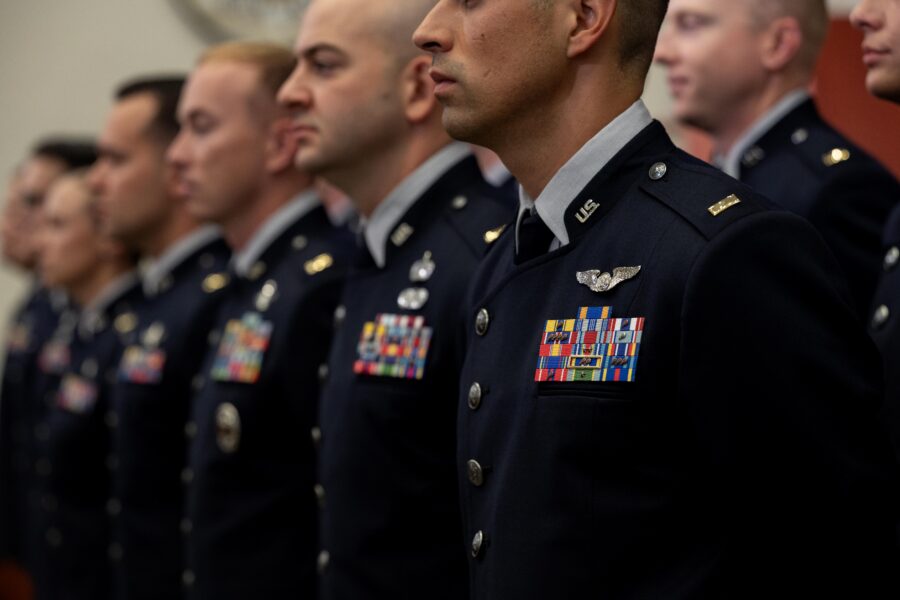
Guardian officers looking to advance their careers must master their job specialty but also have a strong all-around understanding of the service and the joint force, the Space Force detailed in a new officer career path document.
The Officer Career Development Path, released May 8, lays out a 20-year “career delta” path showing how newly commissioned officers can chart their way to success regardless of their chosen specialty.
“First and foremost, Guardian officers are leaders and planners,” Chief of Space Operations Gen. B. Chance Saltzman said in a release accompanying the new development path. “Prevailing in the contested space domain requires officers to have experience across space disciplines, mission command, and joint planning.”
Guardians have flexibility in how they climb the ranks; the release stresses that instead of a “rigid sequence,” USSF officers will progress according to performance and experience, according to the document.
The holistic approach to career development follows on the work the service has done with its new officer training course, which saw its first 84 graduates in August 2025. The service has now graduated a total of 300 officers from OTC, held at Peterson Space Force Base, Colorado, a Space Force spokesman said.
Saltzman told Air & Space Forces Magazine at the time that the service took “ownership” of its officer training with a fresh approach, not based on other military branches, which can focus tightly on a job specialty.
“We designed the training course the way the Space Force needs it to be done to meet Space Force needs,” Saltzman said then. “We’re too small to really specialize and gain the benefits. … We don’t have the same scale; our officers have to do a lot more.”
The Space Force had 9,985 total Guardians in fiscal 2025. Nearly half, or 4,649, were officers.
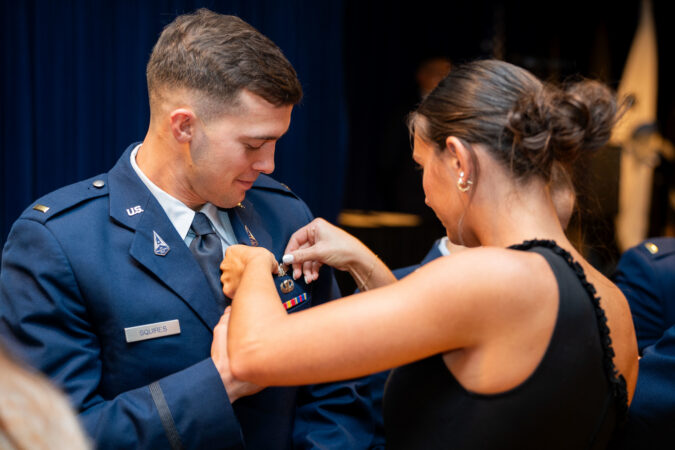
The yearlong course starts with fundamentals training, including joint doctrine, Space Force doctrine, leadership, and planning skills. That’s followed by stints immersing Guardians in each of the service’s major career fields: cyber, intelligence, space operations, and acquisition.
The goal, Saltzman and other leaders say, is to develop “Guardians first, specialists second.”
The new officer career path doubles down on that push by calling career-broadening assignments, such as instructor, recruiting ,or talent management, “essential” to develop the force.
“Officers will be expected to seek opportunities to broaden their understanding of the Space Force by applying for career broadening/special duty positions that align to the skills and experiences gained at that point in their career,” according to the document.
Retired Space Force Col. Charles Galbreath, now with the Mitchell Institute Spacepower Advantage Center of Excellence, said that including career broadening as part of the foundational development of the service’s officers is a “step toward normalizing the Space Force officer progression with those of the other services.”
Most Guardians in the early days of Space Force were working overtime to stand the service up and get it moving. There wasn’t much time or manpower for work outside their main duties.
That meant few Guardians were available to serve on career-broadening assignments, such as joint billets, which can be crucial for a military branch to gain exposure and for its members to be included in multiservice operations.
Joint billets give officers a “better sense of how space integrates with other services into joint operations,” Galbreath said.
As the service continues to grow, more of those joint jobs will be available for Guardians, Galbreath said. There are already signs that it is improving. Galbreath pointed out that Lt. Gen. Steven P. Whitney now serves as the director of force structure, resources, and assessment on the Joint Staff in the Pentagon.
While not exhaustive, the career-broadening opportunities extend beyond joint billets, and the list is long.
Career Broadening Opportunities
- Officer Instructor & Recruiter Special Duty
- Education with Industry
- Space Test Course
- Weapons Instructor Course
- Regional Space Advisor
- Intermediate Level Education; Senior Level Education
- Acquisition Exchange Program
- Deployments
- Special Experience Exchange Program
- Joint Assignments
- Junior Officer Cryptologic Career Program
- Junior Officer Geospatial Program
- Legislative Liaison
- Advanced Studies Groups
- Computer Network Operations Developmental Program
- Expeditionary Warfare School
- Space Intelligence Intern Program
- Advanced Academic Degree
The broadening work aims to give the Space Force “well-rounded leadership,” though the document reminds officers to prioritize operational depth in their careers.
Leader Development
For Guardians who choose to pursue a career in force modernization, which includes acquisition and developmental engineering, the framework gives insight into how they can time their careers and assignments to be competitive for promotions.
The Space Force plans to hold an annual board to select Guardians for the force modernization track, which Guardians can learn about from their senior leadership and mentors, according to the document.
Another unique feature of the Space Force, Galbreath noted, is that roughly half of its officer billets are associated with acquisition due to the highly technical nature of the service’s mission.
Specific guidance in the framework spells out how time outside of an officer’s job specialty might impact their eligibility and future leadership opportunities, according to the release.
The document also notes that all officers will start their careers in full-time status, though they may have the option to work part-time, depending on what’s available and their qualifications.
The Space Force is unique among the services in that it does not have a Guard or Reserve, and full-time and part-time Guardians are all in one component. While other services allow individuals to enlist or be commissioned, complete their training, and immediately join the Guard or Reserve, at least for now, the USSF mandates that its officers start full-time.
The new officer career path complements work the Space Force has done on career development for the enlisted side. In April, USSF introduced its Core Enlisted Framework, a document to guide the service in developing enlisted leaders.
That document identified key skills to master—initiative, critical thinking and problem solving, outcome-focused approaches, team mindedness, and leadership. The aimpoint for the enlisted document is the service’s “World Class Master Sergeants” goal. Starting at the lower ranks, it seeks to develop subject-matter experts in their fields who can also teach, train, and mentor subordinates.
Both the enlisted and officer frameworks lay out expectations by rank throughout a Guardian’s career.