
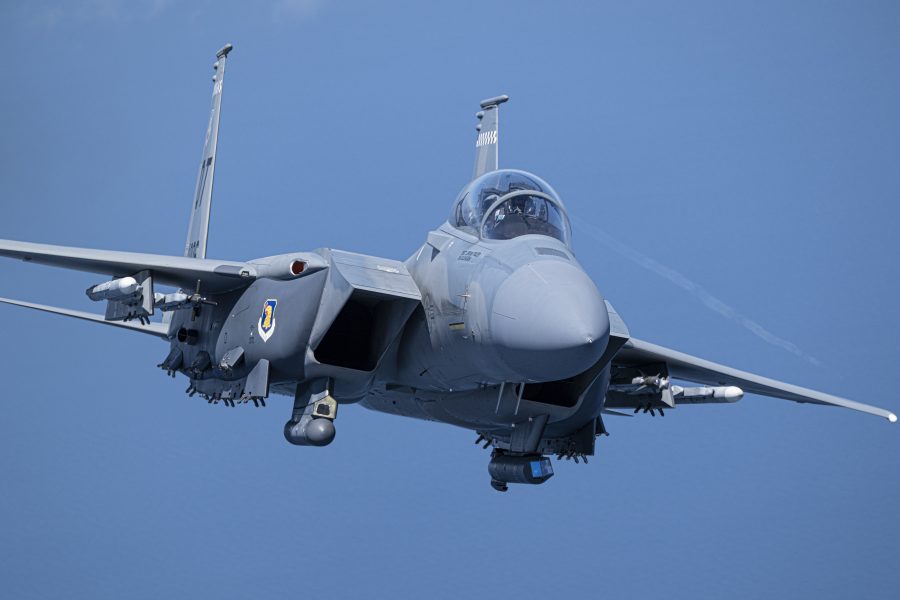
The first F-15EX Eagle IIs will arrive at Kadena Air Base in Okinawa, Japan, in 2027—a year later than originally planned—and the last of 36 planned fighters will likely get there in 2028, Air Force Secretary Troy Meink said May 21.
Testifying before the Senate Armed Services Committee, Meink also said the Air Force is working with F-15EX manufacturer Boeing on ways to ramp up production past two fighters per month, so Kadena and other bases can have enough of the new fourth-generation fighters.
Kadena is the closest U.S. air base to Taiwan, making it a strategically vital location should China ever launch an invasion. For that reason, the Air Force has long viewed maintaining a ready fighter force at Kadena as a linchpin of its Indo-Pacific posture.
For decades, the 18th Wing at Kadena flew F-15C/D Eagles, but the Air Force began retiring those aging jets in November 2022. Since then, the service has been rotating other fighters through on temporary deployments. Most recently, F-22s from Joint Base Elmendorf-Richardson, Alaska, and Joint Base Langley-Eustis, Va., arrived at Kadena in early May.
In 2024, the Air Force announced it would station 36 new F-15EXs at Kadena, which were originally supposed to start arriving in spring 2026. But in 2025, Boeing’s F-15EX factory in St. Louis, Mo., experienced a monthslong strike, which left production behind schedule.
As a result, multiple bases have not received their F-15EXs. The Air Force has already selected four other bases besides Kadena to receive the new fighter:
- Portland Air National Guard Base, Ore.
- Fresno Air National Guard Base, Calif.
- Naval Air Station Joint Reserve Base New Orleans, La.
- Selfridge Air National Guard Base, Mich.
More basing decisions are coming. In April, the Air Force announced plans to more than double its total buy of F-15EX jets from 129 to 267. And Sens. Ted Budd (R-N.C.) and Jeanne Shaheen (D-N.H.) have introduced legislation that would authorize the service to acquire up to 329.
Meink told lawmakers that the Air Force has not yet decided which units will be next to receive F-15EXs but said they will be divided between Active, Guard, and Reserve units. He said the Air Force plans to go through a strategic basing process to figure out where the newest EXs should be assigned.
Budd and Shaheen’s proposed legislation would also allow the Air Force to award multiyear procurement contracts for fighter programs. Meink said the F-15EX is an ideal example of how multiyear procurement authorities would help the Air Force procure critical new aircraft.
“Because [of] the instability in the [F-15EX] production rates and the unknown future, the contractor [Boeing] just couldn’t make the investments necessary to tool up and improve, and really modernizing how they’re doing production of that aircraft,” Meink said. “That long-term stability allows a contractor to do those things that eventually save the government money, and allow us to produce those aircraft quicker.”
Limiting contracts to a year-to-year basis is inefficient, Meink said, but multiyear contracts would make it easier for the Air Force to buy spare parts as well as aircraft or spacecraft.