


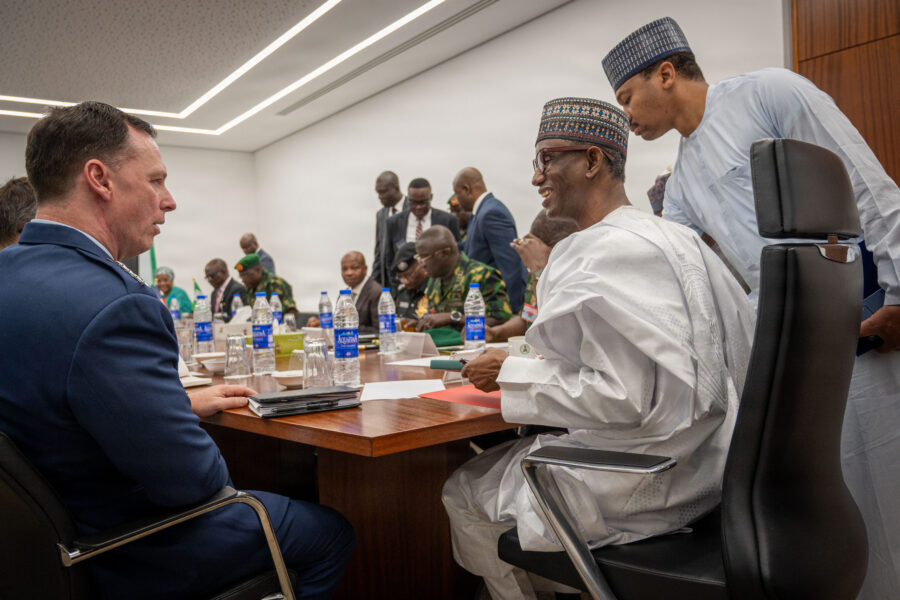
Strikes carried out by the U.S. military in coordination with Nigeria have killed scores of Islamic State fighters over the last several days, officials from both countries say, as the Trump administration has stepped up its counterterrorism campaign in Africa.
On May 16, the U.S. and Nigerian militaries carried out a joint operation that killed a senior ISIS leader, Abu-Bilal al-Minuki, and other top members of the militant group. Al-Minuki was ISIS’s second in command for global operations.
But the strike in northeast Nigeria was not a one-off engagement. The U.S. carried out “additional kinetic strikes” on May 17 and May 18 as well, according to U.S. Africa Command.
“These were significant strikes that set back the ISIS network significantly globally,” the head of U.S. Africa Command, Air Force Gen. Dagvin R. M. Anderson, told the House Armed Services Committee on May 19. A Nigerian military spokesperson said May 19 that the operations in recent days had killed some 175 ISIS fighters. Anderson described Al-Minuki as “the most active and impactful terrorist in the world.” Al-Minuki was killed in a U.S. airstrike during the operation, according to the U.S. military officials.
The flurry of attacks have occurred even as U.S. air and naval forces have been imposing a blockade on Iran and are preparing for a potential renewal of their military campaign against Tehran. The U.S. and Iran remain far apart on a deal to open the Strait of Hormuz and impose constraints on Iran’s nuclear program.
“AFRICOM remains committed to leveraging specialized U.S. capabilities in support of our partners to defeat shared security threats,” the command said in a statement on the most recently announced strikes.
AFRICOM also said that “complete assessments are ongoing” of its recent operations. Videos released by the command show what appear to be U.S. airstrikes, actions which American officials say were carried out in coordination with the Nigerian government.
The Islamic State’s self-declared caliphate in Iraq and Syria collapsed in 2019. Earlier this year, the U.S. turned over its bases in Syria to the Syrian government. It also transferred some 5,700 ISIS fighters from prison camps in Syria to Iraq, according to the head of U.S. Central Command Adm. Brad Cooper, who testified alongside Anderson. But the group has been attempting to make a comeback and its African affiliates have grown in recent years.
“Today, the epicenter of global terrorism is in Africa,” Anderson said. “ISIS leadership is African. Al Qaida’s economic engine is in Africa. Both groups share the will and intent to strike our homeland.”
Long-running strikes against the militant groups in Somalia have been ramped up during the second Trump administration. The U.S. military has conducted dozens of airstrikes against ISIS in Somalia and al-Shabab, which is affiliated with al-Qaida, throughout 2025 and 2026.
The U.S. campaign against militants in Nigeria is more recent. The U.S. conducted strikes with Tomahawk missiles in Nigeria on Christmas Day in 2025, after Trump said more needed to be done to stop attacks on Christians in the country. The two countries have stepped up cooperation since then.
“We have had an incredibly good partnership and cooperation with the Nigerians, including their intelligence sharing,” Anderson told lawmakers. “We are working with them as they address the strategy to address the greater drivers of this terrorism.”
Nigeria’s military indicated the strikes would continue.
“The joint strikes have resulted in the destruction of ISIS checkpoints, weapons caches, logistical hubs, military equipment, and financial networks used to sustain terrorist operations,” a Nigerian military spokesman said in a statement. “The joint operations will continue to hunt down and destroy those who threaten our nation and regional stability.”
U.S. counterterrorism efforts in Africa suffered a blow in 2024 when U.S. military forces were ousted from Niger following a military coup, which included the loss of access to a key base for U.S. drone operations in the Sahel region.
Anderson acknowledged that the U.S. inability to operate in Niger had hampered its counterterrorism efforts, as has the small U.S. presence on the continent. The U.S. maintains a base in Djibouti in East Africa, but it lacks other substantial installations to stage operations on the continent. U.S. partners such as France have also withdrawn forces from Africa in recent years.
“[With] a 75 percent reduction in our regional posture over the past decade, compounded by the drawdown of our allies, we struggle with an intelligence black hole,” Anderson said. “Without sufficient indicators and warnings, we risk being blind to the gathering dangers and threats of the region.
“AFRICOM’s lack of expeditionary capabilities and diminished force posture compromises our crisis response,” Anderson added. “In a crisis, we can surge assets, but you cannot surge trust. Our reduced presence on the continent also allows disruptive actors to drive the agenda and undercut American interests.”
The Trump administration has sought to move toward a more transactional relationship with African nations, a policy reiterated during the May 19 hearing by Undersecretary of Defense for International Security Daniel Zimmerman, who said the U.S. was pursuing a “trade and investment-focused relationship” with countries in the region.
Still, Anderson noted that ultimately, the U.S. military, despite its limited presence, remains the most capable force on the continent.
“AFRICOM is prioritizing willing and capable partners,” Anderson said. “We support partners with unique capabilities that only the U.S. can provide, such as ISR, targeting, and precision strike. This approach has taken ISIS leaders off the battlefield in Nigeria and driven their leadership in Somalia underground, putting pressure on the broader ISIS network in West Africa.”