
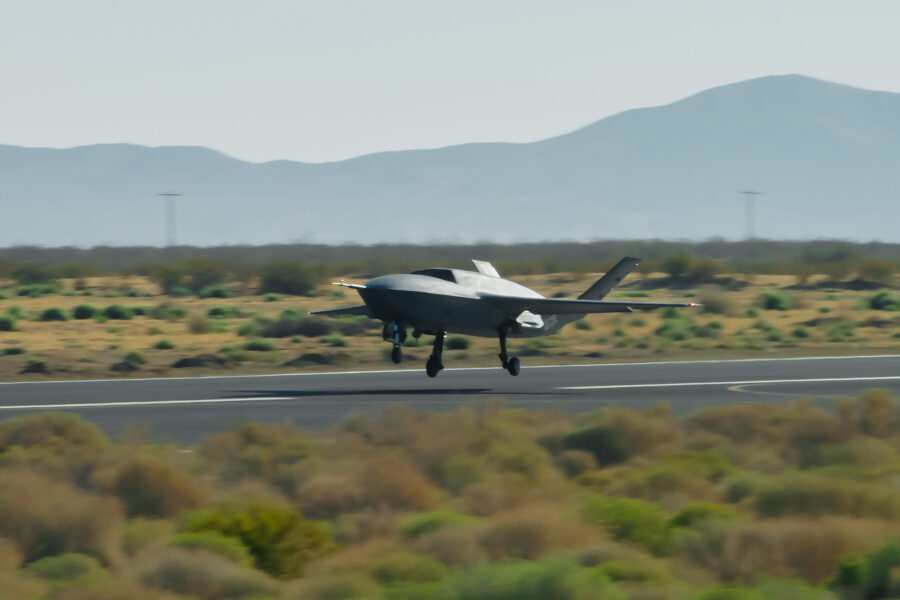
The YFQ-42A Collaborative Combat Aircraft has resumed flight testing after a six-week pause that began when one of the drones crashed in early April.
General Atomics Aeronautical Systems, which builds the YFQ-42A, announced the return to flight May 21 and said a safety review conducted by the Air Force and GA determined the crash was caused by an “autopilot miscalculation for the weight and center of gravity of the aircraft.”
The aircraft was destroyed in the crash near an airport in the California desert owned by General Atomics, though no one was hurt. Multiple YFQ-42As have been built as part of low-rate production.
The firm updated the drone’s software, and flights have resumed. During the safety pause, work on the program continued with ground testing and other activities, General Atomics said in its release.
The YFQ-42A’s autopilot software is separate from the mission autonomy software Shield AI and Collins Aerospace are developing for the CCA program. The autopilot is part of the flight autonomy software, which is responsible for the basics of flying the aircraft, while the mission autonomy software is the “AI pilot” that governs the flight software and executes specific maneuvers based on basic directions from a human operator
The Air Force envisions its CCA program as a fleet of semi-autonomous drones to fly alongside and take direction from a manned fighter and its pilot.
For the first “increment” of the program, the service is considering the YFQ-42A and the YFQ-44A, built by Anduril. Both are envisioned as strike platforms, though future increments could perform electronic warfare, intelligence, surveillance, and reconnaissance, or more.
The YFQ-42’s return to flight comes as the Air Force is closing in on a decision about which drone it will move into production—officials say they will make their choice in fiscal 2026, which ends Sept. 30.
“We’re excited to have YFQ-42A flying again,” GA Aeronautical Systems President David R. Alexander said in a statement. “It’s been said that you learn more from your setbacks than your successes. We are applying what we’ve learned to our growing fleet of CCAs, as we continue building the most dependable and cost-efficient unmanned fighters in the world.”
The Air Force released a statement that said it and General Atomics’ response to the YFQ-42A’s crash shows the strategy of accepting risk in the acquisition and testing phase, instead of in operations, is the right approach.
“The CCA program was and is set up to learn, even when the learning comes from ‘failing forward,'” said Col. Timothy Helfrich, portfolio acquisition executive for fighters and advanced aircraft. “We pushed the envelope, identified a risk, learned from the data, and have cleared the YFQ-42A to return to flight. Even when flight testing on the YFQ-42 was temporarily paused, the program was not.”
During GA’s flight pause, the Air Force conducted an experimental exercise with Anduril’s YFQ-44A. As part of that exercise, airmen from the Experimental Operations Unit—not engineers or test pilots—flew the drone from Edwards Air Force Base in California in multiple sorties. Those early April flights of the YFQ-44A were intended to help refine operational and logistical procedures for deploying and sustaining a CCA in a contested environment, the Air Force said at the time.
Helfrich pointed to the EOU exercise as an example of technology maturation and risk reduction activities on the CCA program that continued during the YFQ-42A’s pause.
“Because of this momentum and our resilient, multi-vendor approach, overall CCA progress never missed a beat as we drive toward delivering advanced capability to the fleet,” Helfrich said.