
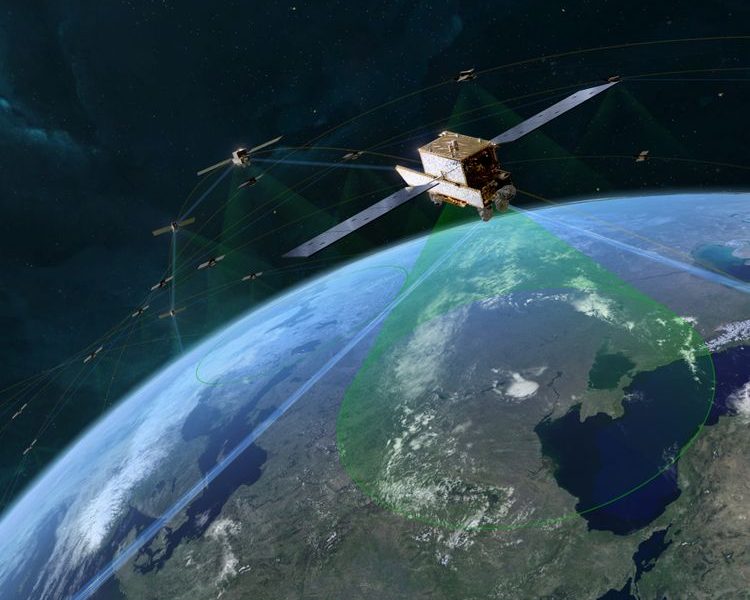
The Space Force plans to stand up a Mission Operations Center to manage the backbone of its hybrid commercial-government data transport constellation, the Space Data Network.
The center will be owned by the service but supported by contractors, serving as “the centralized hub that ‘brokers’ user services, mission plans, and resources,” the service said in an April 30 notice. “It will deliver enterprise-wide situational awareness and a common operational picture of all SDN ground and space assets.”
The Space Force’s vision for the SDN is to bring together commercial and military satellites that reside in multiple orbits to manage both tactical and enterprise communication needs, enabling faster decision-making for key missions like missile defense. The effort aims to combine both the secure, tactical communications that military users need as well as the high-throughput, low-latency satellites that can push large amounts of data to users with the goal of creating a more resilient and capable network.
The service wants $3 billion for the program in fiscal 2027, about half of which would go to buying SDN satellites for its proliferated low-Earth orbit constellation. The procurement budget indicates the service will buy 21 SDN space vehicles in fiscal ‘27, up from 13 in fiscal ‘26. The remaining funding is for research and development, including the integration of a commercial radio frequency payload onto communication relay satellites that will contribute to the Pentagon’s Golden Dome Space-Based Interceptor project.
Officials haven’t revealed the full scope of systems that will make up the SDN but have said it will include a communications backbone, previously known as MILNET, and will integrate the Space Development Agency’s Transport Layer, a constellation of tactical communication satellites. Today, SpaceX is the only provider for that backbone network, but the service plans to use fiscal ‘27 funding to expand that constellation to include more companies to provide satellites, ground architecture and network orchestration services.
The Mission Operations Center solicitation released this week is a key part of that expansion. In the document, the Space Force says it currently lacks a unified, enterprise system to manage a network of systems owned by multiple vendors and that operate across a variety of frequency bands and orbits. The MOC will help the service prioritize its most important missions, automate tasks like network monitoring and data correlation, and ensure that the broader network is interoperable.
The service says in its solicitation that it’s interested in a range of commercial capabilities to build out the MOC, including: commercial cloud management tools for SDN orchestration; AI and machine learning analytics; and interfaces that give operators a common picture to work from. Of note, officials say they won’t consider bespoke or government-unique MOC designs as part of the solicitation.
“The Space Force intends to obtain ‘innovative’ solutions or potential new capabilities that fulfill requirements, close capability gaps, or provide potential technology advancements,” according to the solicitation. “Solutions may include existing technologies or procedures that are not currently in use by units at various locations that would enhance or streamline their mission capabilities.”
