



The Space Force is proposing to cancel a $3.4 billion program intended to provide missile warning and tracking coverage of the northern polar region as part of its 2027 budget request.
Northrop Grumman is under contract to build two satellites for the Next-Generation Overhead Persistent Infrared Polar program. According to new budget documents released April 27, the service wants to cancel NGP and instead rely on new proliferated constellations it is building in other orbits, which it says will provide needed coverage of northern hemisphere missile threats.
“Due to projected polar coverage from the low-Earth orbit and medium-Earth orbit layers of the Resilient Missile Warning/Missile Tracking [program], a risk informed decision has been made to terminate the Next-Gen OPIR Polar program,” the Space Force said in budget justification documents. A service spokesperson did not immediately respond to a request for more details.
A Northrop Grumman spokesperson said the company’s “work on the Next-Gen OPIR Polar program continues, on-schedule and on-budget.”
“We continue to support the customer’s mission needs,” the company said.
NGP and its sister program in geosynchronous orbit, NGG, are part of the Space Force’s plan to replace its legacy Space-Based Infrared System satellites. Lockheed Martin received an initial contract worth $2.9 billion in 2018 to build three GEO satellites. The service selected Northrop to build the polar spacecraft in 2020, work that budget documents show cost a total of $3.4 billion through fiscal ’26.
Then in 2021, USSF announced a new approach to detecting and tracking missiles from space that shifted its focus away from large, bespoke spacecraft to smaller, cheaper, more proliferated satellite constellations. Initially, the Space Force said it would fund both approaches—NGP and NGG alongside the Space Development Agency’s LEO tracking layer and Space Systems Command’s MEO satellites. In its fiscal 2023 budget request, it asked Congress for $3.4 billion to begin its move to the new architecture while still maintaining the GEO and Polar satellites. Space Force leaders said at the time that such a “bridging strategy” was needed to reduce the risk inherent in making such a significant transition.
“I think it’d be fair to say that we don’t have the luxury of going out to the world and saying we’re going to turn off all of these capabilities and we’ll come back in a few years with a bunch of new capabilities,” then-Chief of Space Operations Gen. John Raymond said in April 2022. “You have to have a bridging strategy.”
The following year, the Space Force cut back the NGG constellation, reducing it from three satellites to two and arguing that a constellation of two polar and two GEO satellites was “sufficient” to avoid gaps in the missile warning mission. Congress did not block the move at the time, but lawmakers have generally shown support for maintaining a multi-orbit missile warning architecture. In fiscal ’26, congressional defense committees added $436 million in NGP funding, including for its classified Advanced Payload Suite-Alpha payload, which Northrop is developing.
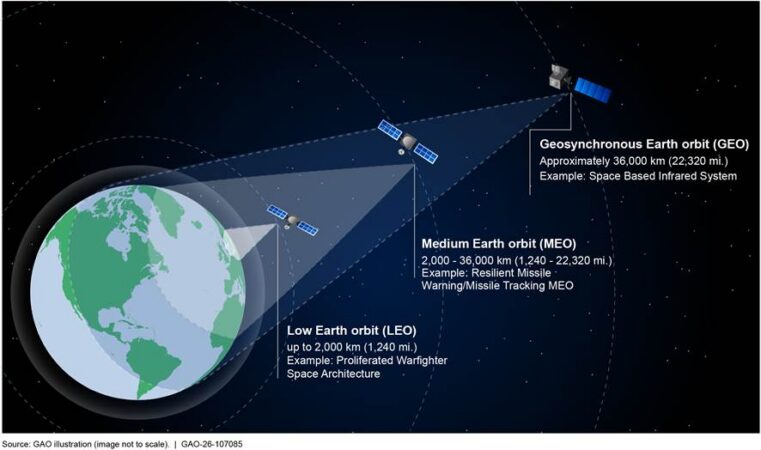
The Space Force’s decision to scale back its space-based missile warning and tracking architecture comes amid a push to bolster the Defense Department’s homeland missile defenses through a layered “shield” of ground and space-based systems known as Golden Dome. The ability to see and track missile threats is key to that approach, and the Space Force’s attempt to cancel NGP appears to be a show of confidence that the LEO and MEO Resilient Missile Warning/Missile Tracking satellites are a more viable alternative.
To date, SDA has launched eight missile warning tracking satellites as part of the demonstration layer of its constellation. It plans to start launching its first operational tracking satellites, built by Northrop and L3Harris, later this year, though that timeline is in flux as the agency works through some schedule delays caused by a mix of technical, supply chain, and launch vehicle issues. That Tranche 1 layer will include 28 spacecraft.
The Space Force’s fiscal ‘27 budget request includes $3.5 billion for SDA’s leg of the architecture—a nearly $2 billion increase over last year’s appropriation—to launch, test, and begin operating Tranche 1 satellites. That funding will also cover Tranche 2 satellite development and capability expansion and contracts for Tranche 3. The agency projects the program will cost nearly $12 billion between fiscal ‘28 and ‘31.
SSC, meanwhile, expects to launch the first of its medium-Earth orbit MW/MT satellites in 2027. Millennium Space Systems is on contract to build the first 12 of those spacecraft, known as Epoch 1, and BAE will build the next batch of 10 satellites, part of Epoch 2.
The budget proposes $1.4 billion for the MEO layer, more than doubling the program’s fiscal ‘26 funding, to support its first launch next year as well as a second launch in late 2028. That money will also fund additional continued development, integration, and test of BAE’s Epoch 2 satellites as well as contracts for more Epoch 2 spacecraft, which the service plans to award later this year. Between fiscal ‘28 and ‘31, SSC expects the MEO layer to cost nearly $7 billion.