
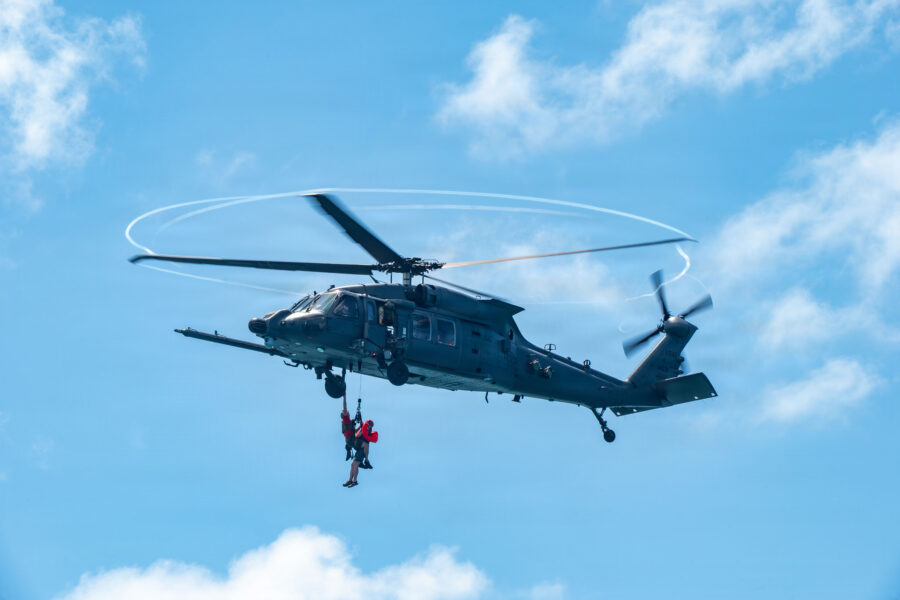
Members of the Air Force Reserve’s 920th Rescue Wing helped save 11 airplane crash survivors off the coast of Florida on May 12.
The Reserve Airmen were flying an HC-130J Combat King II and an HH-60W Jolly Green II on a routine training flight when a Coast Guard call diverted their mission.
A twin-engine turboprop aircraft signaled the Coast Guard with a potential distress call that morning May 12. The Coast Guard dispatched its own plane to search and called upon the 920th from Patrick Space Force Base, Fla.
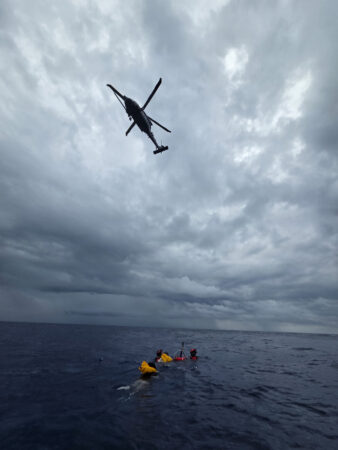
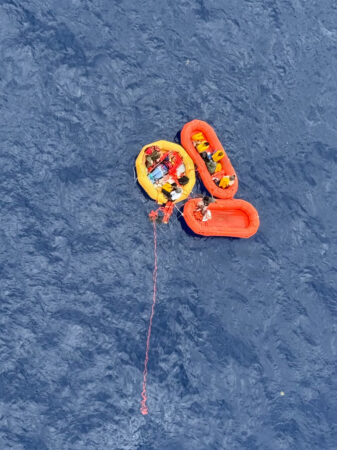
Eleven survivors from that twin-engine aircraft were huddled into a single life raft and had been rolling in 3- to 5-foot seas for nearly five hours. There were no fatalities reported from the crash.
After flying nearly 80 miles off the coast of Melbourne, Fla., the Combat King started the search using the last known position from the beacon’s signal. Once the crew spotted the life raft, they threw out a survival bundle, which has two rafts on each side, aircraft commander Maj. Elizabeth Piowaty said in a May 13 press conference on Patrick.
At the same time, the plane’s crew relayed the location to the Jolly Green, which headed to the scene.
Lt. Col. Matt Johnson, commander of the Whiskey, then hovered his helicopter about 10 feet overhead and Capt. Rory Whipple, a combat rescue officer, got to work.
“Once the basket was in the water we started working,” Whipple said. “One PJ was working the hoist, hoisting the patients up to the cabin. The other PJ was assessing people and treating any people that had possible injuries.”
The PJs conducted about nine hoists to raise the 11 survivors onto the helicopter, Whipple said.
All the while, the Jolly Green was fast approaching “bingo time,” when an aircraft has just enough fuel to get back to base without refueling, Whipple said.
They’d been told to expect six to eight survivors when they launched the mission. So, Johnson and his crew had to calculate the new weight, flight time and whether they’d need to dump fuel to get back safely, Johnson said.
Luckily, they didn’t.
The helicopter crew transported the survivors to Melbourne International Airport.
“This rescue highlights the readiness, professionalism, and interoperability our Airmen train for every day,” said Col. Chadd Bloomstine, 920th Operations Group commander. “We are proud to have played a role in bringing 11 people home safely.”
Having all individuals aboard the aircraft survive a crash into the ocean was nothing short of “miraculous,” said Piowaty, commander of the HC-130J’s seven-Airman crew with the 39th Rescue Squadron.
“As a fixed-wing pilot, we train to that, but I’ve not known anyone to survive a ditching in the ocean,” she said.
The civilian aircraft had left Marsh Harbor, Bahamas, and was flying to Freeport, Fla., about a 30-minute flight. The incident will be investigated by Bahamian officials.
A Coast Guard Air Station Clearwater C-27 Spartan assisted in conducting the search.
“The outstanding support from Patrick Space Force Base and the seamless coordination among all responding agencies directly contributed to the successful rescue of 11 survivors from the downed aircraft,” said Master Chief Petty Officer Omar Colon, a command duty officer with the Southeast Coast Guard District.
Jolly Green II
The 920th is the Reserve’s only combat search and rescue unit that flies the Jolly Green, and was the first unit to conduct an Air Force Reserve rescue. In January 1957, the wing saved Airmen who survived the collision of two B-47 bombers off the coast of Cuba during a mass refueling mission.
The wing received its first HH-60W in February 2024. There are five Jolly Greens assigned to the 301st Rescue Squadron at Patrick.
The HH-60W is one of the Air Force’s newest helicopters, replacing the legacy HH-60G Pave Hawk, which has been in service since the 1980s.
“It was cool to use those systems and maybe bring something back for debrief for new tactics, techniques, and procedures as far as how we can be even better next time when this call comes,” Johnson said.
In 2024, the wing’s rescue force airlifted a critically ill passenger off a cruise ship 350 miles off the U.S. coast in 2024 over eight hours that utilized two Pave Hawks, two Combat Kings, and took three air-to-air refuelings to cover more than 1,000 miles.
The Jolly Green also featured prominently recently in the early April rescue of downed U.S. pilots during Operation Epic Fury in Iran.
The HH-60W is a Lockheed Martin/Sikorsky-built aircraft that’s based on the Black Hawk.
Air Force efforts to procure the HH-60W have changed since it reached initial operational capability in 2022. The service’s original plans were for 113 Whiskeys, but that figure dropped to 85 in 2023.
Later funding changes bumped procurement back up to 102. The fiscal 2026 enacted budget shows two more remaining to procure. There are no funds dedicated to procuring additional aircraft in the 2027 budget. But there are some modifications and improvements left to be made.
The Air Force is seeking $100 million in its 2027 budget request to upgrade the Whiskey for both counter-rocket lasers in its combat role and to make modifications for VIP transport around the Washington D.C. area.