
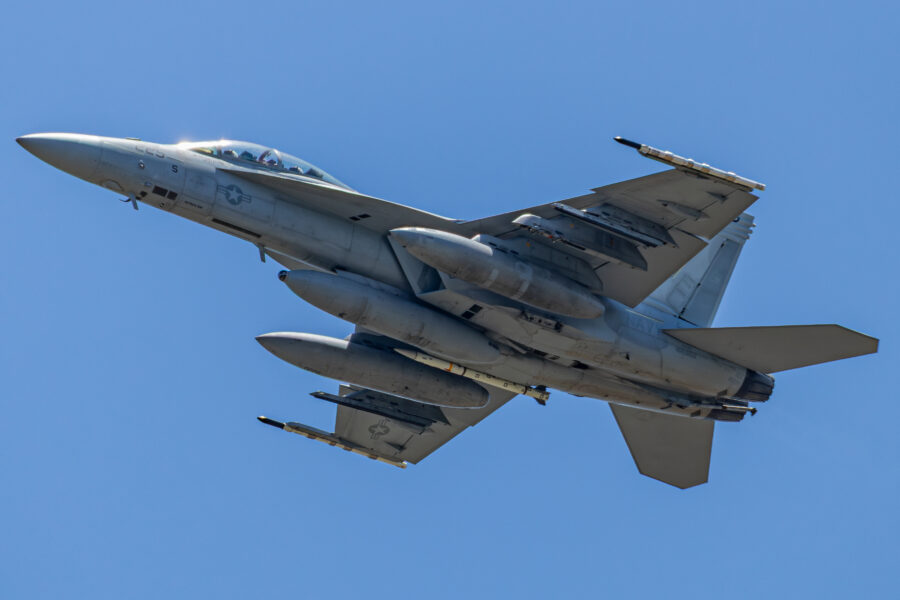
The military’s secretive new air-to-air missile appears to have been publicly photographed for the first time during testing.
A missile matching previously released information and renders of the AIM-260 Joint Advanced Tactical Missile, or JATM, was photographed being carried by an F/A-18F Super Hornet on May 13, shortly after taking off from Eglin Air Force Base in Florida. Jonathan Tweedy, a Florida-based aviation photographer who posts on Instagram at @flightline_visuals and took the pictures, told Air & Space Forces Magazine he also photographed a second Super Hornet with an inert version of the JATM among the five planes that flew that day.
JATM, which is being built by Lockheed Martin and has been in development since 2018, is intended to be the successor to the AIM-120 AMRAAM, which is now the main radar-guided air-to-air missile used by the Air Force and Navy. Details on the new missile are classified, but JATM reportedly will be able to fly farther than the AMRAAM and can fit on existing missile rails and in the internal weapons bays of fighters. Testing has been ongoing at Eglin.
On May 13, an EA-18 Growler from VX-9, the Navy’s air test and evaluation squadron nicknamed the Vampires, took off first, Tweedy told Air & Space Forces Magazine in a series of messages. It was followed by the Super Hornet with the live JATM and another with an inert JATM, both from VX-31, the Dust Devils test squadron. The were followed by another pair of Super Hornets, one from VX-9 and another from VX-31, he said.
Tweedy snapped a series of photos during their departure, shortly after 11 a.m. Central time and said at first he didn’t realize what he had captured.
“I was more excited at the fact that I had caught VX-31 and VX-9 together,” Tweedy said. “It wasn’t until after I reviewed my photos that I noticed the [JATM] missile.”
Tweedy said checked his photos afterward and noticed one seemed to have a live missile, indicated by yellow bands. He wasn’t sure what he had photographed, but judging by its size and the lack of fins on the missile’s midsection, he knew it wasn’t an AMRAAM. He sent the picture to an friend, who is very knowledgeable on military technology, who quickly identified it as a JATM.
Tweedy monitored air traffic control during the test flight, and said he heard chatter indicating the fighters released their JATMs over the Gulf of Mexico.
The Air Force plans to spend $1.47 billion on R&D for JATM over the next five years, according to budget documents released in April. It also is spending nearly $369 million on procurement for JATM in fiscal 2026, as well as another $8.8 billion between fiscal 2027 and fiscal 2031.