
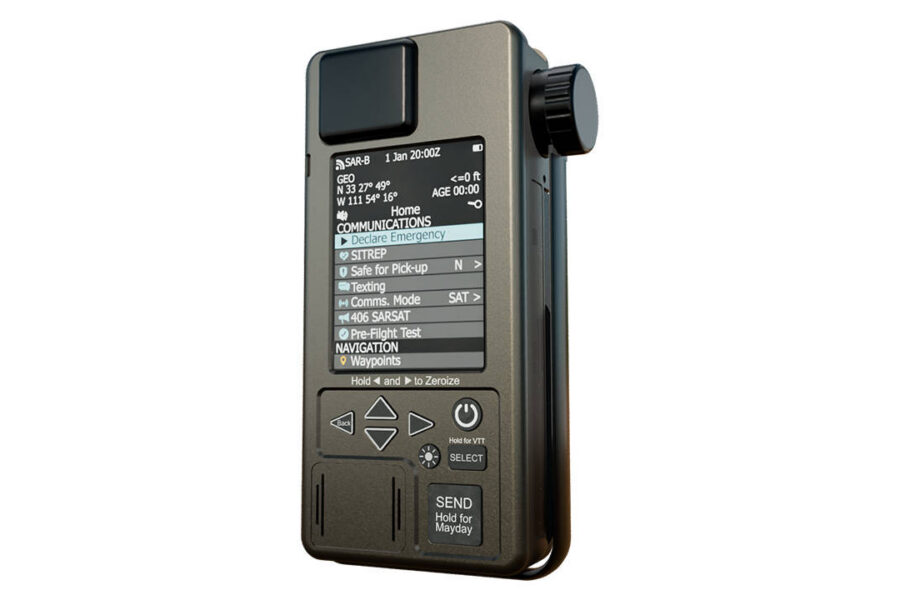
The Air Force plans to start buying thousands of advanced new handheld radios in 2027 for downed aircrew to communicate with search-and-rescue forces, a capability spotlighted earlier this year during the recovery of two aviators shot down in Iran.
The Next-Generation Survivor Radio will replace the current Combat Survivor Evader Locator radio, which has been in service since 2006. Development of the NGSR kicked off with a small investment in 2025 and picked up with $51.7 million in R&D funding in the 2026 budget.
The Air Force is requesting $96 million for the program in 2027, $80 million of which would buy 6,868 radios, spares, and associated support equipment. While the Air Force is taking the lead on the program, the radios will also go to aviators in the Army, Navy, and Marine Corps.
According to budget documents, NGSR will replace the existing radio’s “legacy satellite communication and encryption methods.” It will have “secure, over-the-horizon, two-way data communications and precise geo-positioning information” and be approved by the National Reconnaissance Office as having a low probability of being detected or intercepted. It will also have “modern encryption technology” certified by the National Security Agency.
“NGSR is one node of an overall personnel recovery network which includes multiple on-orbit satellite constellations, geographically dispersed satellite ground stations, joint service CSAR communication devices, and a Joint Personnel Recovery Center cloud-based web application,” the budget documents state.
In 2026, the Air Force is working on testing and integrating the new radio within that personnel recovery network. In 2027, it wants to transition to rapid fielding.
General Dynamics is building the NGSR and says it will be lighter, smaller, and more power efficient than the current radio, while touting its “cell phone-like form factor.” It is roughly similar in size to an iPhone 17 Pro Max, albeit much thicker at 1.5 inches.
The radio is software-defined, meaning it can be reprogrammed and upgraded to work with future waveforms, and it can send both voice and text messages. It also works with the more advanced, secure M-code GPS signal.
The existing CSEL radio has been upgraded over time and provides secure voice and data transmissions over a variety of different frequencies and satellite constellations.
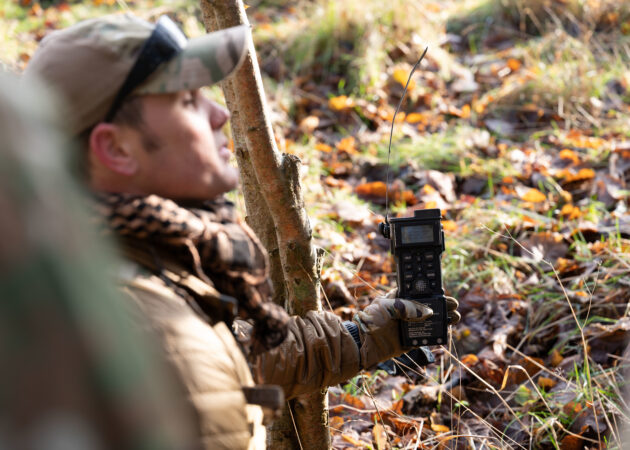
That radio proved crucial in the early April rescue operation for the downed F-15E pilot and weapon systems officer known by the call sign “DUDE 44.” President Donald Trump confirmed April 6 that one of the aviators used his radio to transmit his location.
“They have a very sophisticated beeper-type apparatus that is on them at all times,” Trump said. “When they go out on these missions, they make sure they have lots of battery space and they’re in good shape, and this one worked really well, amazingly, saved his life.”
An Air Force official confirmed to Bloomberg at the time that Trump was referring to the CSEL.
Boeing has built more than 50,000 CSELs for the U.S. The Air Force’s budget documents do not say how many NGSRs the service plans to buy over time, and projected procurement funding drops in 2028, but the service noted that it will certify its spending plans in a future budget, suggesting more money may be added in the years to come.
