
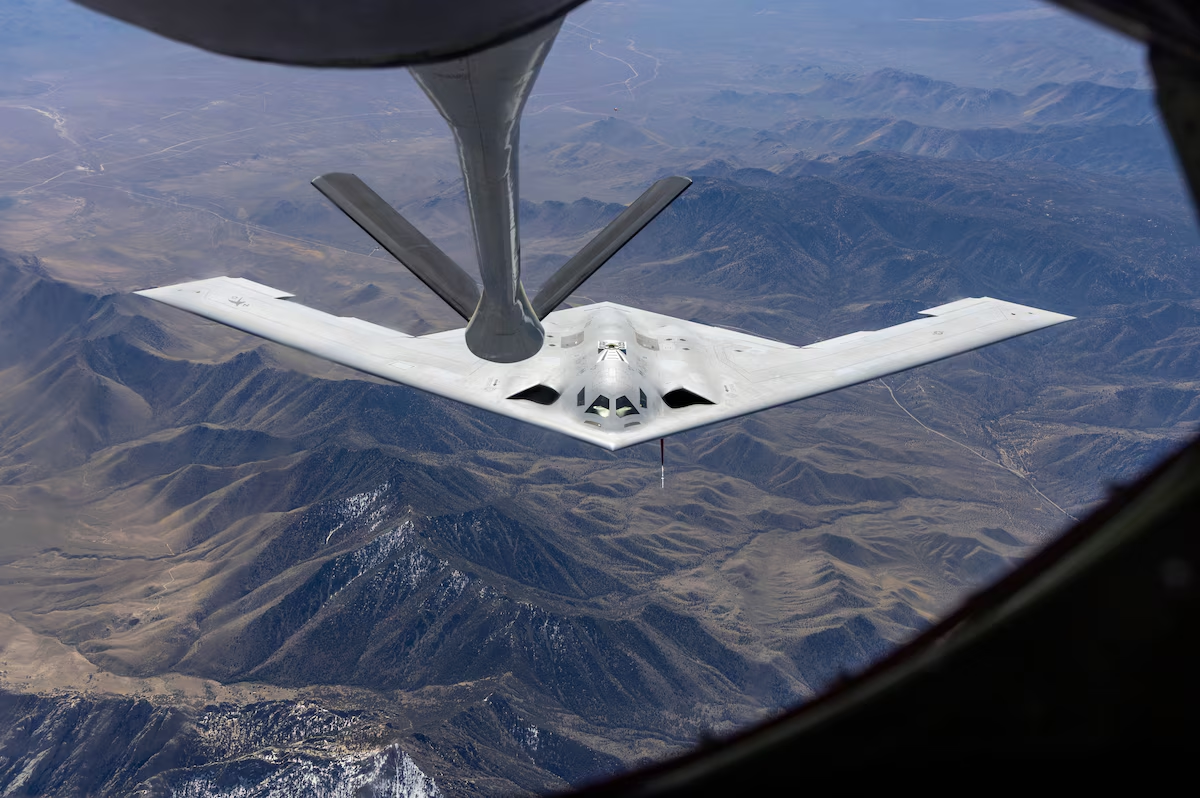
There’s a growing consensus among experts, lawmakers, and Pentagon leaders that the Air Force should buy more than the planned minimum of 100 B-21 stealth bombers. Exactly how many more is a question USAF will likely answer in its 2028 budget request, the service’s top planner said May 13.
That budget submission is expected in spring 2027.
Calls to increase B-21 production have been around for several years now, but the idea has gained momentum amid high-profile bomber missions against Iran and growing defense budgets. The last two heads of U.S. Strategic Command have endorsed a fleet size of 145 sixth-generation Raiders, and Defense Secretary Pete Hegseth told lawmakers April 30 that the U.S. will need “a lot more” than 100 aircraft.
Testifying before the House Armed Services subcommittee on seapower and projection forces two weeks after Hegseth, Air Force Deputy Chief of Staff for Plans and Programs Lt. Gen. David H. Tabor said he agreed more than 100 B-21s will be needed.
Acknowledging that there have been calls to drastically increase the fleet to 200 or more B-21s, Tabor said a new goal number is still in the works.
“We’re in the process of sharpening our pencils, really getting down to exactly what that [revised program of record] is,” Tabor said. “I think here in the next year, by the time we get to the ’28 budget, we’ll be able to give you a better answer, much more precise answer, and show you our homework.”
Tabor’s remarks are the closest an Air Force leader has gotten to confirming that the service will go beyond the official program of record, which only calls for “a minimum” of 100 aircraft.
That program goal was set years ago, noted Rep. Rob Wittman (R-Va.), who questioned Tabor as to whether the changing threat environment—particularly from advancing Chinese capabilities—warranted a boost to the Raider fleet.
Wittman also expressed confidence in the B-21’s progress. Early in the program, he said, he visited Northrop Grumman’s facility in Palmdale, Calif., and was struck by their plans to move to a digital design process.
Wittman said he was “skeptical” at the time and was concerned the highly digital approach wouldn’t work, but now concedes he was “100 percent wrong” to doubt it.
“That was a great success story, and how to execute one of the most complex aircraft ever manufactured in human history,” Wittman said.
Hanging over the debate over the potential size of the B-21 fleet is the Air Force’s experience with the B-2 Spirit more than three decades ago. The Air Force originally wanted to buy 132 B-2 stealth bombers, but in 1990 that plan was cut to 75.
Two years later, after the collapse of the Soviet Union, the B-2 program was cut even further to 20, although another was added back later, putting the final number of Spirits to 21. The repeated cuts meant the cost of the B-2 program was spread out over fewer aircraft, bringing the price of an individual Spirit up to more than $2 billion.
One B-2 was later destroyed in a crash, meaning the Air Force today has just 20 operational stealth bombers in its inventory. And with the bomber having a mission-capable rate of 55 percent in fiscal 2024, the last year for which statistics were available, that means just 10 or 11 B-2s are typically available to carry out operations at any given time.
Recent missions such as Operation Midnight Hammer and Operation Epic Fury, which targeted Iranian nuclear and military sites, relied heavily on the B-2’s stealth and penetrating strike capabilities. And in a potential conflict with a larger and more advanced adversary like China, the Air Force would need even more aircraft—such as the B-21—with the ability to slip into enemy airspace undetected and deliver large amounts of firepower on enemy targets to open up more opportunities for other aircraft to strike.
