
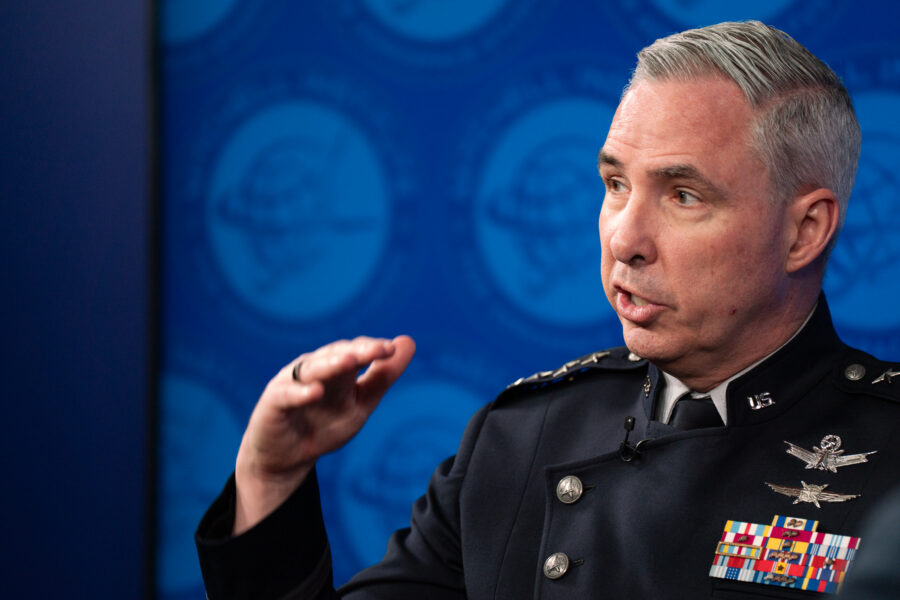
U.S. Space Command is working with close allies to define a joint plan for how to protect and defend space assets from threats in orbit, according to Commander Gen. Stephen Whiting.
The concept of operations, which Whiting said should be completed by the end of this year, builds on work the countries have been doing through the multinational Operation Olympic Defender. That partnership was formed in 2013 under U.S. Strategic Command and expanded in 2024. Today, it includes the U.S., United Kingdom, Australia, Canada, Germany, France, and New Zealand.
“We’ve collectively decided, and we are in the process of building, a defense of orbital assets [concept of operations,]” Whiting said during a May 12 event with AFA’s Mitchell Institute for Aerospace Studies. “How do we leverage all of these capabilities that these nations will be bringing with our capabilities to deconflict them? We really want to be able to integrate them and synchronize them and synergize them.”
Whiting didn’t discuss in detail what capabilities the U.S. and its allies would use in this concept of operations, but he did say it will consider orbital warfare operations as well as rendezvous and proximity operations—precise orbital maneuvers to approach, inspect, or dock with another spacecraft. The Olympic Defender team has conducted three such demonstrations in the last 18 months, Whiting said.
The most recent of those exercises, dubbed Operation Selene, was led by Canada and focused on maintaining custody of a “high-interest target” by taking advantage of all seven nations’ space domain awareness capabilities. Whiting said the demonstration was so successful that it will now be a regular fixture for the partners.
“We’re going to make that a permanent operational now where we work together to identify what are those targets that are most concerning to us,” he said.
Operation Selene followed two RPO missions the U.S. conducted with France last year and in 2024 as well as an operation with the United Kingdom last September—all with the goal of demonstrating joint maneuvers in orbit. U.S. Space Command and the Space Force have in recent years emphasized the need for satellites that can perform for regular maneuvers without being constrained by the amount of fuel they carry, a concept they call dynamic space operations. SPACECOM recently announced a series of exercises called the “Apollo Maneuvers” meant to test space maneuver concepts and inform future concepts of operations, like those being developed by Operation Olympic Defender.
In recent testimony to the Senate Armed Services Committee, Whiting said one of Operation Olympic Defender’s focuses in fiscal 2026 is testing and refining concepts for how the allies will work together as a combined force—and determining how to “challenge the posture” of would-be adversaries that they view as threatening the peaceful use of space.
“We must also challenge the posture of our competitors in key regions, for example, as we partner with allies and other [combatant commands,] to look at reducing potential adversaries’ space enabling infrastructure and influence in the Western Hemisphere and around the world,” he said in March 26 written testimony.
In fiscal ’27, he said, the allies aim to integrate their operations with NATO exercises, which Whiting described as “a positive step toward expanding the effects provided by this critical multinational body.”
The countries involved in Operation Olympic Defender announced last year they achieved initial operational capability after meeting five criteria:
- Establishing collective concepts for space domain awareness
- Agreeing to a combined operational framework
- Determining a defined scope of national space input to the organization
- Crafting a plan to synchronize communication between partner nations
- Approving an initial campaign plan in April
Asked during the Mitchell Institute event whether Operation Olympic Defender would expand in the near future to include other spacefaring allies, Whiting said the coalition, for now, is focused on refining its own operational concepts before adding additional countries to the mix. However, once it achieves “full operational capability,” he expects there will be an opportunity to introduce more partners.
“We have had a discussion with some of those additional countries that we know are interested,” Whiting said. “We’re not looking to expand, but I expect that in the not-too-distant future.”
