
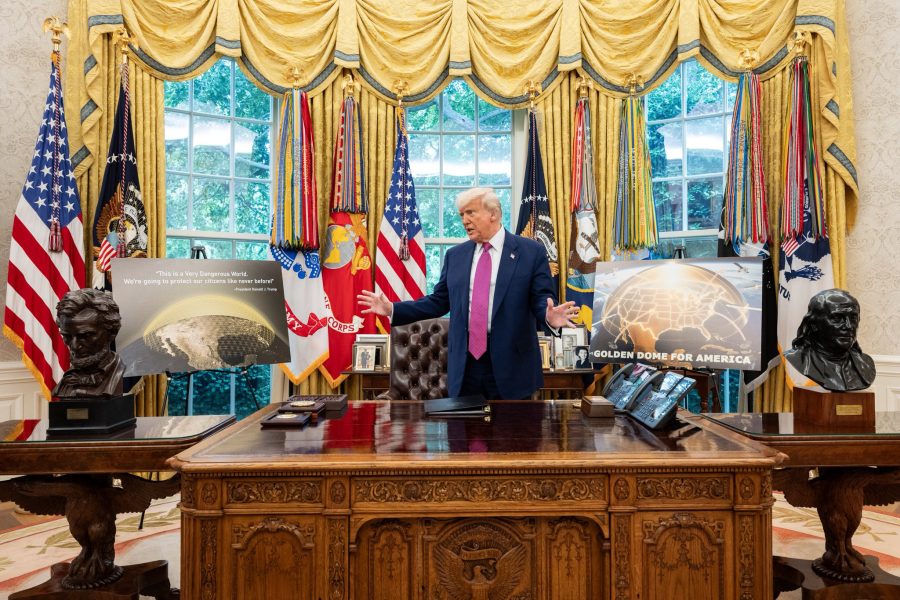
The Space Force has awarded 20 contracts worth up to $3.2 billion to 12 companies since last year to develop space-based interceptor capabilities, the service’s main acquisition arm announced April 24, providing new details on the firms involved and the scope of their work.
The development of on-orbit missile interceptors is one of the bigger technical lifts of the Golden Dome program, an initiative announced by President Donald Trump last year that aims to stitch together a sprawling, layered “shield” to protect the U.S. from both traditional and advanced missile threats. According to Space Systems Command’s announcement, the service expects to integrate the space-based interceptors into the Golden Dome architecture by 2028 and to ultimately launch a proliferated SBI constellation in low-Earth orbit.
“Proven and formidable U.S. missile defense systems, combined with next-generation space-based tracking and advanced interceptors must be integrated with Artificial Intelligence to counter the speed, maneuverability, and lethality of the threats,” SSC said. “The [interceptor] program is addressing this gap by developing a proliferated Low Earth Orbit (pLEO) constellation of interceptors capable of boost, midcourse, and glide phase engagements.”
The service last year issued two solicitations calling for industry prototypes for systems that can destroy a missile during the boost and midcourse phases of flight. Golden Dome Director Gen. Michael Guetlein announced in December that it had awarded 18 other transaction agreement contracts, but did not disclose details about the value of those deals or the firms that received them. According to SSC, the following companies are on tap for the effort:
- Anduril Industries
- Booz Allen Hamilton
- General Dynamics Mission Systems
- GITAI USA
- Lockheed Martin
- Northrop Grumman
- Quindar
- Raytheon
- Sci-Tec
- SpaceX
- True Anomaly
- Turion Space
The program’s goal of demonstrating SBIs by 2028 means SSC will need to move quickly, Program Executive Officer for Space Power Col. Bryon McClain said in a statement.
“Adversary capabilities are advancing rapidly, and our acquisition strategies must move even faster to counter the growing speed and maneuverability of modern missile threats,” McClain said. “Utilizing Other Transaction Authority agreements, we attracted both traditional and nontraditional vendors, while harnessing American innovation, and ensuring continuous competition. With the commitment and collaboration of these industry partners, the Space Force will demonstrate an initial capability in 2028.”
While validating the technical viability of a near-term SBI system is central to this effort, so too is affordability. Speaking at an April 15 hearing, Guetlein told lawmakers that cost will be a determining factor when it comes to scaling the boost-phase capability in particular.
“If boost-phase intercept from space is not affordable and scalable, we will not produce it because we have other options to get after it,” he said.
The overall Golden Dome program is expected to cost $185 billion, and experts say a large SBI fleet could drive that cost much higher. The American Enterprise Institute, a Washington think tank, estimated in a September report the 20-year cost could range anywhere from $252 billion to $3.6 trillion with that variation depending largely on the number of space-based interceptors.
The program hasn’t discussed how many space-based interceptors it expects to need, and SSC’s release did not provide further details. Guetlein has been critical of outside estimates that have projected much higher costs than what the Pentagon itself has identified.
“I would say the biggest difference between what they are estimating and what we are building is they’re not estimating what I’m building,” he said in March at the annual McAleese Defense Programs Conference in Washington. “They’re estimating a very large, complex capability, fully integrated, using technologies that we currently use to fight the away game.”
The department requested nearly $400 million for Golden Dome in fiscal 2027 as part of its base budget, and proposed that more than $17 billion be included in a separate budget reconciliation bill—$4.5 billion for space-related efforts. Congressional Republicans approved $150 billion in reconciliation funding for defense last year—which included $25 billion for Golden Dome. A repeat attempt in fiscal ‘27 will likely face political headwinds due to the uncertainty of midterm elections and the possibility that the GOP may lose its majority in Congress.
