


The Pentagon’s Golden Dome project could cost about $1.2 trillion over the next two decades, and it still may not be able to fend off a major missile attack from Russia or China, according to a new estimate from the Congressional Budget Office.
That estimate, released May 12, is about seven times the Pentagon’s near-term projection for the program, which puts Golden Dome’s price tag at around $185 billion over the next 10 years. The nonpartisan CBO based its projection on a January 2025 executive order from President Donald Trump, which called on the Defense Department to build an advanced, layered missile defense shield to protect the U.S. from a range of missile threats, including hypersonic weapons.
The Pentagon has said Golden Dome for America, or GDA, will be a network of command-and-control systems, sensors, and interceptors, but hasn’t provided details on what platforms—or how many of them—will make up the architecture. In light of this, CBO’s estimate attempts to fill in those gaps based on the notional capacity it expects would be needed to achieve the president’s vision.
“In the absence of specific plans for GDA’s objective architecture, CBO has estimated the cost of a notional [national missile defense, or NMD] architecture based on the defensive systems and capabilities that are called for in the executive order,” the report states.
The architecture laid out in CBO’s report assumes four interceptor layers designed to target multiple missile types and to operate either independently or in concert with an associated command-and-control network:
- A space-based constellation of 7,800 satellites designed to take out up to 10 intercontinental ballistic missiles launched near simultaneously as well as hypersonic glide vehicle threats
- An upper wide-area surface layer comprised of three Ground-Based Midcourse Defense sites, each with 60 Next-Generation Interceptors or Ground-Based Interceptors focused on engaging ICBM threats
- A lower wide-area surface layer with four U.S.-based sites, each equipped with 48 SM-3 Block IIA interceptors to defeat ICBMs or hypersonic glide vehicles
- A “regional sector” layer with 35 interceptor and radar sites loaded with THAAD, SM-6 Block IB, and Patriot interceptors that can target ICBMs, glide vehicles, and cruise missiles
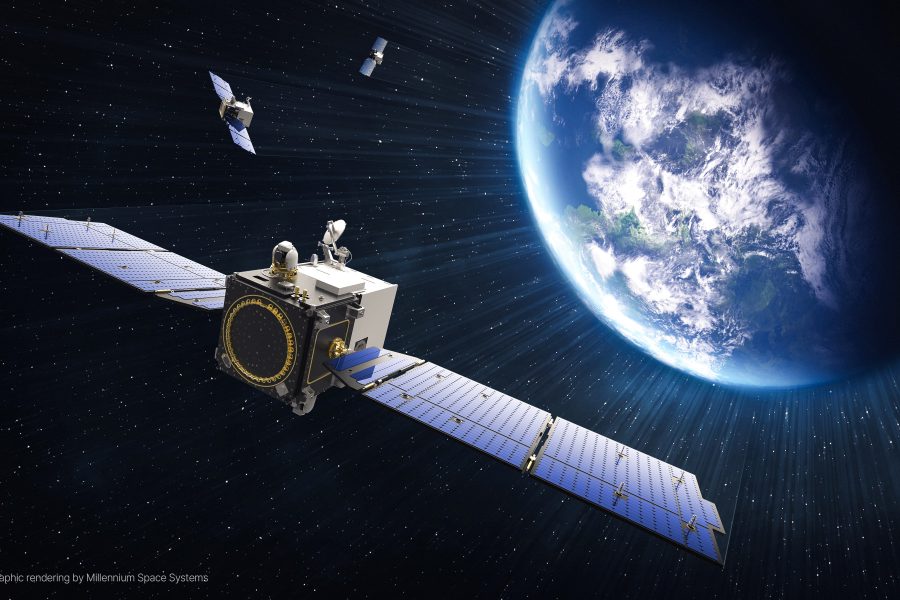
The space-based interceptor constellation would be the most expensive element of this architecture by far, costing $743 billion over 20 years, or 60 percent of the total cost. The report, which calls its architecture a “middle ground” between more limited and high-end alternatives, estimates each SBI-equipped satellite would cost $22 million and have a five-year service life. The Space Force last month awarded 20 contracts worth up to $3.2 billion to 12 companies since last year to develop space-based interceptor capabilities, which it expects to start integrating with Golden Dome in 2028.
CBO’s report also includes the cost of a satellite sensing layer—which it projects would require about $90 billion to develop, field, and maintain—as well as the battle management and communication systems needed to coordinate the broader architecture. The sensing layer would include satellites such as the Hypersonic and Ballistic Tracking Space Sensor, which the Space Development Agency is fielding as part of its low Earth orbit missile-tracking constellation, and space-based air-moving target-indication satellites, which the Space Force is currently developing.
CBO’s assumed architecture would be designed to “fully engage” an attack from a regional adversary such as North Korea or a small-scale threat from Russia or China, but “would be overwhelmed by a full-scale attack mounted by a peer or near-peer adversary,” according to the report. Because a major attack could potentially penetrate the system’s defenses, CBO says, it’s possible Golden Dome could encourage adversaries to launch such attacks, even if it is able to deter smaller raids.
“Although the notional NMD system analyzed by CBO would be far more capable than defenses the United States fields today, it would not be an impenetrable shield or be able to fully counter a large attack of the sort that Russia or China might be able to launch,” the report states. “As a result, the strategic consequences of deploying an NMD system with the capacity considered here are unclear because they hinge on an adversary’s perception of the defense’s capability and how that adversary chose to respond.”
CBO’s estimate is in line with other independent Golden Dome cost assessments. Todd Harrison from the American Enterprise Institute has projected costs ranging anywhere from $250 billion to $2.4 trillion, with space-based interceptors being the primary cost-driving variable.
The Pentagon is requesting about $17 billion for Golden Dome in its fiscal 2027 mandatory spending, or reconciliation, request, which is separate from its base budget proposal of about $400 million. That follows about $25 billion the program received through reconciliation in fiscal ‘26.
The Pentagon’s cost estimate for Golden Dome—which has grown by $10 billion since the program began—may not include the same systems or scope as its own or may be supplemented by other funding sources, CBO notes. That could explain why the department’s public projections are so much lower.
“That difference suggests either that GDA’s objective architecture is more limited than CBO’s notional NMD system or that DoD expects significant funding from other accounts to contribute to GDA (or both),” CBO writes. “For example, procurement of interceptors might be funded directly through the services’ missile procurement accounts instead of the GDA fund.”
Meanwhile, Golden Dome Director Gen. Michael Guetlein has criticized outside estimates, saying they’re built on inaccurate assumptions about the program’s largely classified architecture. Speaking in March at a conference in Arlington, Va., he said he’s focused on keeping costs within the program’s baseline estimate by leveraging existing communications nodes and other infrastructure. But to really drive down costs, he said, the Defense Department will need to rely on “next-generation technology” like directed energy, artificial intelligence, and advanced data processing.
“We’re working really closely with the national labs and with the Director of Research and Engineering to bring to bear some of that next-generation tech to drive down that cost per kill and drive up the magazine,” Guetlein said.