


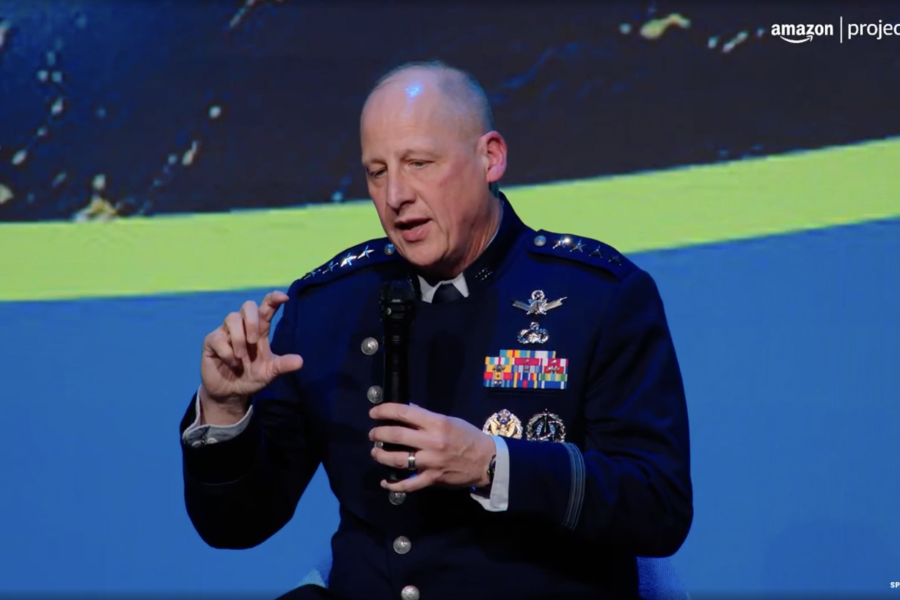
A Congressional Budget Office estimate that pegs the 20-year cost of the Pentagon’s Golden Dome program at $1.2 trillion dollars is based on inaccurate assumptions about the advanced missile shield’s architecture, according to the general in charge of the project.
“They’re not estimating what we’re building,” Golden Dome Director Gen. Michael Guetlein said during an event hosted by defense technology and space publications Tectonic and Payload. “It’s as simple as that.”
According to Guetlein, the report’s assumptions are based on technology envisioned in the early 2000s “for a different fight”—one focused on point defense, or defense of a limited area, rather than the regional, homeland defense mission that underpins Golden Dome.
“That is not what we need for the homeland,” he said. “In a regional defense, there’s a different architecture. And you can’t just take what we’ve done in the past and multiply it forward or you’re going to get large numbers like CBO got.”
CBO released its cost estimate May 12, building its projections around an executive order issued in January 2025 by President Donald Trump that birthed the Golden Dome program, calling on the Pentagon to build an advanced, layered missile defense shield to protect the U.S. from a range of missile threats, including hypersonic weapons. The nonpartisan budget analysis office acknowledged that it had few details on the systems that will make up Golden Dome due to a lack of public information on the program and referred to the systems required to fulfill Trump’s order as a “notional national missile defense” architecture.
Guetlein agreed that there is a dearth of public detail on the program due to concerns about security and classification, which he said likely explains why CBO’s estimate is seven times the Defense Department’s own $185 billion, 10-year projection. However, according to Guetlein, CBO didn’t consult the program office before releasing its report.
The architecture laid out in CBO’s report assumes four interceptor layers designed to target multiple missile types and to operate either independently or in concert with an associated command-and-control network:
- A space-based constellation of 7,800 satellites designed to take out up to 10 intercontinental ballistic missiles launched near simultaneously as well as hypersonic glide vehicle threats
- An upper wide-area surface layer comprised of three Ground-Based Midcourse Defense sites, each with 60 Next-Generation Interceptors or Ground-Based Interceptors focused on engaging ICBM threats
- A lower wide-area surface layer with four U.S.-based sites, each equipped with 48 SM-3 Block IIA interceptors to defeat ICBMs or hypersonic glide vehicles
- A “regional sector” layer with 35 interceptor and radar sites loaded with THAAD, SM-6 Block IB, and Patriot interceptors that can target ICBMs, glide vehicles, and cruise missiles
The space-based interceptor constellation would be the most expensive element of CBO’s notional architecture by far, costing $743 billion over 20 years, or 60 percent of the total cost. The report, which calls its architecture a “middle ground” between more limited and high-end alternatives, estimates each SBI-equipped satellite would cost $22 million and have a five-year service life.
Guetlein has said in recent congressional testimony that SBIs aren’t guaranteed to be part of Golden Dome’s architecture, and if the technology is not both affordable and scalable, the Pentagon won’t pursue it. The program hasn’t detailed its cost targets for SBIs, but he said during the event that the estimate CBO presented doesn’t meet the program’s affordability targets, and said he’s pushing industry to offer innovative interceptors at lower price points.
“That’s a signal to industry that says you need to simplify the solution,” he said. “You need to think innovatively about the requirements.”
The space industry is responding to that challenge, Guetlein said. Last month, the Space Force last month awarded 20 contracts worth up to $3.2 billion to 12 companies since last year to develop space-based interceptor capabilities, which it expects to start integrating with Golden Dome in 2028.
“I believe that our industrial base can scale this all,” he said. “And I believe the innovation that I’m seeing coming out of AI, advanced processing, advanced manufacturing, 3D manufacturing, etc.—I think they’re going to figure out how to do it.”