


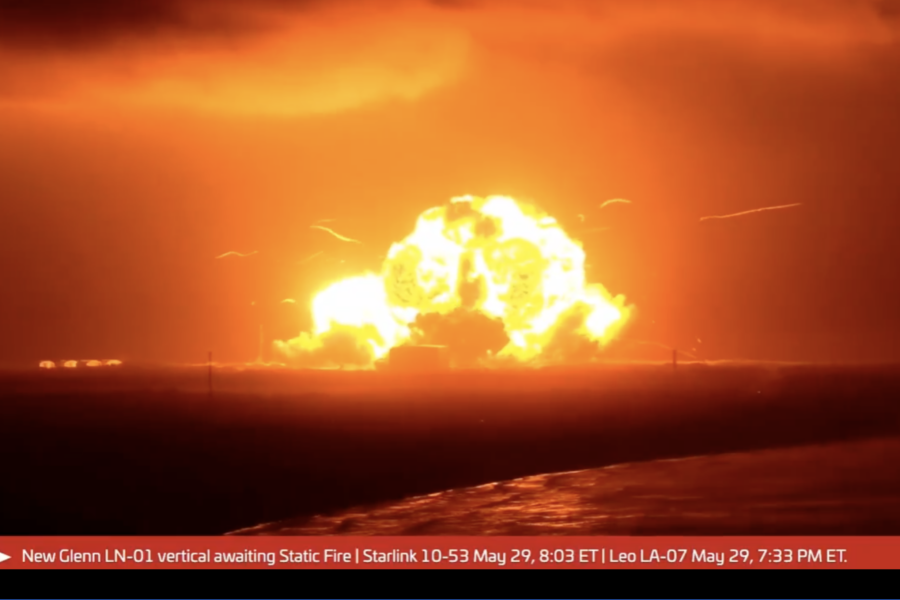
Officials at Cape Canaveral Space Force Station, Fla., said the range is “fully mission capable” to support launches following a major May 28 mishap involving Blue Origin’s New Glenn rocket.
The rocket exploded on a launch pad at Cape Canaveral during a routine prelaunch test around 9 p.m. The explosion caused a large fireball that appeared to consume a large portion of Space Launch Complex 36-A, the company’s sole New Glenn launch pad.
In a statement on the social media site X, Blue Origin described the event as an “anomaly,” adding that “all personnel have been accounted for.” Founder Jeff Bezos added in a separate post: “It’s too early to know the root cause but we’re already working to find it. Very rough day, but we’ll rebuild whatever needs rebuilding and get back to flying.”
Space Launch Delta 45 manages the range, which flies both commercial and government launch missions. In a May 29 statement, officials said the range was up and running and was able to support a separate SpaceX launch just 12 hours after the New Glenn anomaly.
“Despite the unexpected emergency response efforts overnight, the Eastern Range remains fully mission capable for National Security Space Launch and continues to support operations at all other launch complexes,” the Space Force said in a statement. “Operating the Eastern Range requires a posture that anticipates contingencies without halting the broader mission. Space Launch Delta 45 is committed to remaining responsive, resilient, and ready to sustain the launch mission regardless of operational disruptions.”
An SLD 45 spokesperson did not confirm whether any other range infrastructure had been damaged in the explosion.
New Glenn, a reusable heavy-lift rocket that debuted in January 2025, has been seen as a promising competitor in a U.S. government and commercial launch market dominated by SpaceX and, to a lesser extent, United Launch Alliance.
The company is in the thick of the Space Force’s new entrant certification process and prior to the anomaly had completed three of the four launches required under its individualized certification plan. Following an anomaly during its third mission involving New Glenn’s upper-stage, Blue Origin had just been cleared for flight by the Federal Aviation Administration on May 22. The rocket was slated to launch its fourth mission June 4, carrying communication satellites for Amazon, also owned by Bezos.
It’s not clear how long it will take Blue Origin to recover. Although it has more rockets on hand, the anomaly investigation will slow its return to flight, as will the damaged facilities. SLC-36A is the sole launch pad capable of supporting New Glenn, though the company is in the process of building a second complex for the rocket at the Cape. The firm also won a lease agreement to build a pad at Vandenberg Space Force Base, Calif., but the Space Force has said it could take at least two years to complete that facility.
Caleb Henry, director of research at Quilty Space, said that while there are many unknown factors that could impact New Glenn’s return to flight, a standard launch failure typically results in about three to six months of down time. Add to that a spaceport failure and it could be a year, depending on the severity of the damage.
While Bezos’ massive wealth means he could inject capital to speed up the repairs at SLC-36A or construction at the second pad, Henry noted that spaceport construction is notoriously difficult, and money can only go so far in overcoming the challenges of repairing a damaged pad. He pointed to SpaceX’s 2016 Falcon 9 explosion, which destroyed its launch pad at SLC-40. It took about 15 months to repair the complex.
“If you have a failure of a rocket and you clear the pad, you can figure out what went wrong and get back to launching quickly,” he said. “If you destroy the pad, that requires a lot more downtime and incurs a lot more cost.”
That’s a major setback not just for Blue Origin, but for the commercial and government customers waiting for another heavy launch provider to enter the mix. ULA has had its challenges with slower-than-expected development of its new Vulcan rocket, and other U.S. firms developing medium and heavy-class vehicles like Rocket Lab, Firefly, and Relativity have taken longer than expected to debut their systems. Globally, companies like Arianespace and Mitsubishi are launching at a lower cadence, which leaves SpaceX as essentially the only option, Henry said.
While Blue Origin hasn’t received any contracts for Space Force missions, its emphasis on New Glenn’s reusability and its plans to quickly increase the rocket’s launch cadence positioned it as a viable contender to meet demand for heavy lift services in the near future. The service did not immediately respond to a request for details on how the mishap might affect its launch manifest.
New Glenn is also a key player in NASA’s plans to return astronauts to the surface of the moon; the agency announced May 26 it had selected the rocket to launch two lunar rovers in 2028. And the company’s lunar lander, Blue Moon Mark 1, was slated to fly on New Glenn as soon as this fall.
“As soon as there is a second launch provider that can hit a steady cadence of launching every one to two months, the industry will be very eager to have that. But right now, it doesn’t, and this exacerbates that issue,” Henry said. “The market is ready to crown king whoever is second place here. . . . There is a strong desire for alternatives to SpaceX. The problem is, no one is there yet.”