
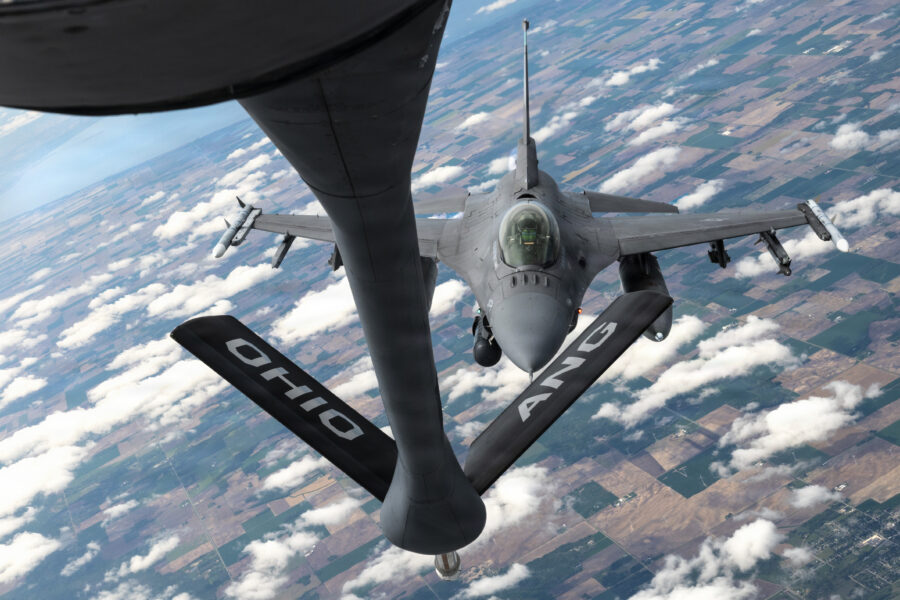
The Pentagon established an Aviation Mishap Task Force earlier this year “to address concerning trends” in safety and help produce an action plan, officials say.
The task force was set up Jan. 15, a Pentagon spokesperson said. Accidents declined in 2025, but the impetus for review was that they hit a six-year high in fiscal 2024. The formation of the task force was not previously publicized.
Secretary of Defense Pete Hegseth disclosed the the new task force’s existence in a brief mention among his written testimony submitted to Congress in April, citing Congress’ reliance on continuing resolutions in lieu of passing budgets on time for impacting safety by holding funding increases hostage, including line items for flying hours and maintenance.
Undersecretary of Defense for Personnel and Readiness Anthony J. Tata’s written testimony submitted May 20 expanded on the task force’s purpose.
“A ready, lethal force requires a culture of safety and accountability,” Tata wrote. “To address concerning trends in aviation, we established the Aviation Mishap Task Force, integrating the Joint Safety Council and the Military Departments to identify joint and systemic risk factors, including the readiness degradation associated with repeated Continuing Resolutions, and deliver actionable policy recommendations. These recommendations will help to ensure that our warfighters have the predictable training, maintenance, and equipment needed to operate safely, effectively, and with lethal proficiency.”
Assistant Secretary of Defense for Readiness Maurice L. Todd wrote in separate testimony that the task force’s purpose is “reinforcing maintenance discipline, strengthening aircrew training, and tightening operational risk controls across the fleet.”
The Pentagon spokesperson said the task force’s work “will inform an Aviation Safety Plan of Action that identifies priorities and areas for improvement, including materiel solutions, training adjustments, and resource decisions, and will guide future safety policy, underscoring and reinforcing the importance of safety at every level of the joint force.”
The exact roles and responsibilities of those serving on the task force is unclear; the Pentagon spokesperson said each military departments will provide “essential safety and operational data, ensuring a comprehensive Total Force perspective” but declined to comment further.”
The Air Force declined to comment, referring questions to the Pentagon.
Early this year, about the same time the new task force was established, the Air Force Safety Center rolled out a Unit Risk Forecasting dashboard intended to help commanders understand and manage factors that historically raise mishap risks.
What the Data Shows
In November 2025, Sen. Elizabeth Warren (D-Mass.) shared DOD accident rates for Class A mishaps for every 100,000 flight hours across the Pentagon had generally increased from 2020 to 2024, though her data did not include the final two months of fiscal ’24. Class A mishaps are those that result in any deaths, permanent total disabilities, $2.5 million in costs, or destruction of an aircraft.
Updated data released by the services and compiled by Air & Space Forces Magazine show there were 54 Class A flight and ground aviation mishaps across the military in 2024, the most since 2018. The Air Force and Army in particular had more Class A mishaps in ’24 than they had had in years.
The Air Force and Army’s rate of flight mishaps per 100,000 was also their most in a decade. Complete data for the Navy and Marine Corps was not immediately available.
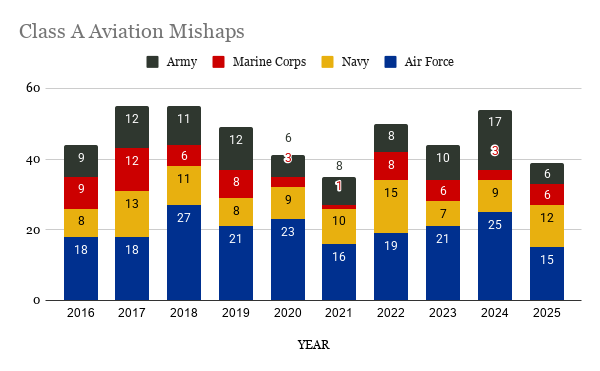
Yet 2025 showed signs of improvement. The Air Force recorded its fewest Class A mishaps in a decade, and the Army tied its 10-year low. The 39 total mishaps across the military were the fewest since 2021.
Preliminary Air Force data for 2026, current as of late May, show a continuing decline in accidents; 11 total so far, making for the lowest rate per 100,000 flight hours this decade.
The war in Iran has taken its toll, with 14 USAF aircraft destroyed so far in 2026, already above the decade’s yearly average. Generally speaking, though, the number and rate of USAF aircraft destroyed has declined from a high of 24 in 2016.
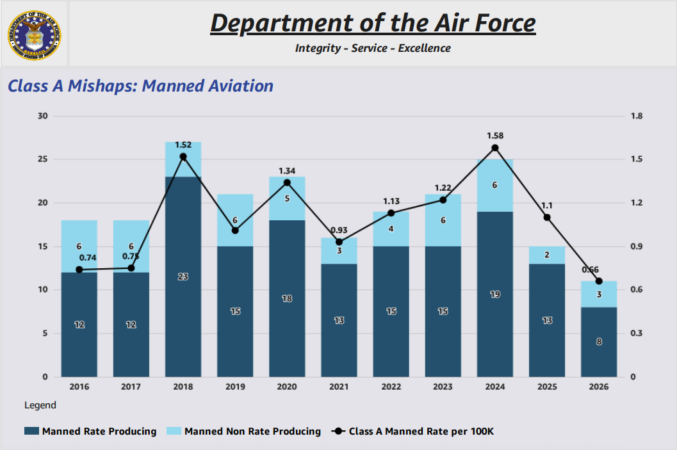
Key: Rate-producing = in-flight mishaps | Non-rate producing = aviation mishaps on the ground
