
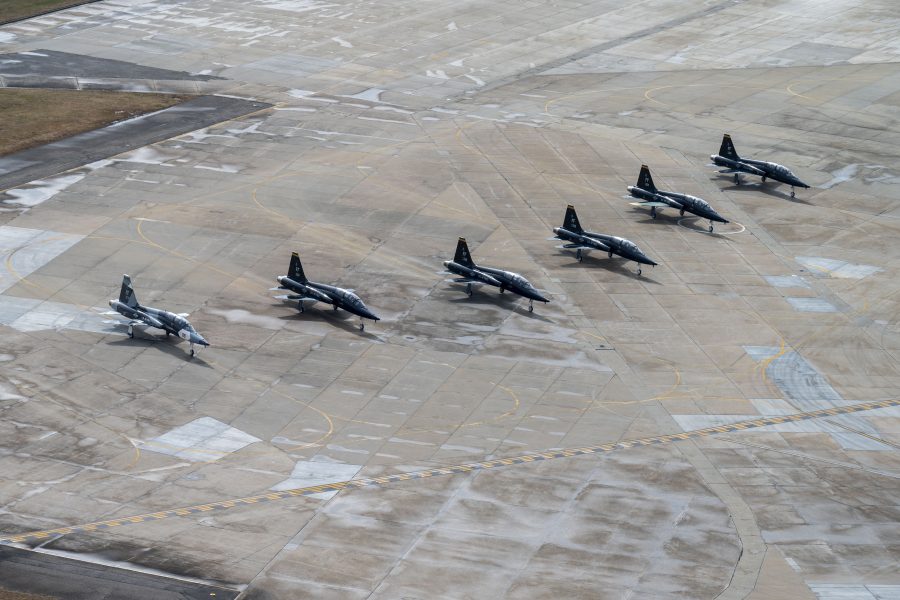
The Air Force has begun inspecting T-38 Talons as it works to get its fleet of trainer jets back in the air. The first aircraft could be flying again within days.
The service announced May 19 it had stopped all T-38 flights as the result of a May 12 crash in Alabama. Both pilots in that T-38, who were flying what the Air Force called a routine training mission, safely ejected.
The service said at the time that it imposed an “operational pause” on the entire T-38 fleet “out of an abundance of caution,” and said grounded T-38s would return to flight status after they were inspected and any required maintenance was finished.
The move affected aircraft at Air Education and Training Command, Air Combat Command, Air Force Materiel Command, and Air Force Global Strike Command.
In a May 29 statement, the Air Force said it had lifted the operational pause a day earlier.
Engineering and maintenance teams across the service have now finished setting up the inspection process needed to “ensure a safe and thorough return to flight” for T-38s, the service said.
“The Air Force continues making progress toward safely returning the fleet to service and anticipates inspected aircraft will begin returning to flying status within the next few days,” the Air Force’s statement said.
Affected commands have been taking steps to mitigate the negative effects of the flight pause on operations, training, and readiness, including by making the most use of simulator training to keep pilots current.
It is not yet clear what the Air Force is looking for in its T-38 inspection processes. AETC said in a statement to Air & Space Forces Magazine that the safety inspection board investigating the May 12 crash is still ongoing and a cause has not yet been determined.
Air Force pilots have been learning to fly in the two-seat, supersonic T-38 for about six decades, and roughly 475 are still in service.
But the T-38 is aging and growing harder to maintain. It was also originally introduced in the 1960s to teach pilots how to fly third-generation jets that are no longer in service, and it has a limited ability to prepare pilots for advanced fifth-generation aircraft like the F-22 Raptor and F-35 Joint Strike Fighter. That challenge has led the Air Force to start buying a new fleet of modernized, Boeing-made T-7 Red Hawk trainers.
