
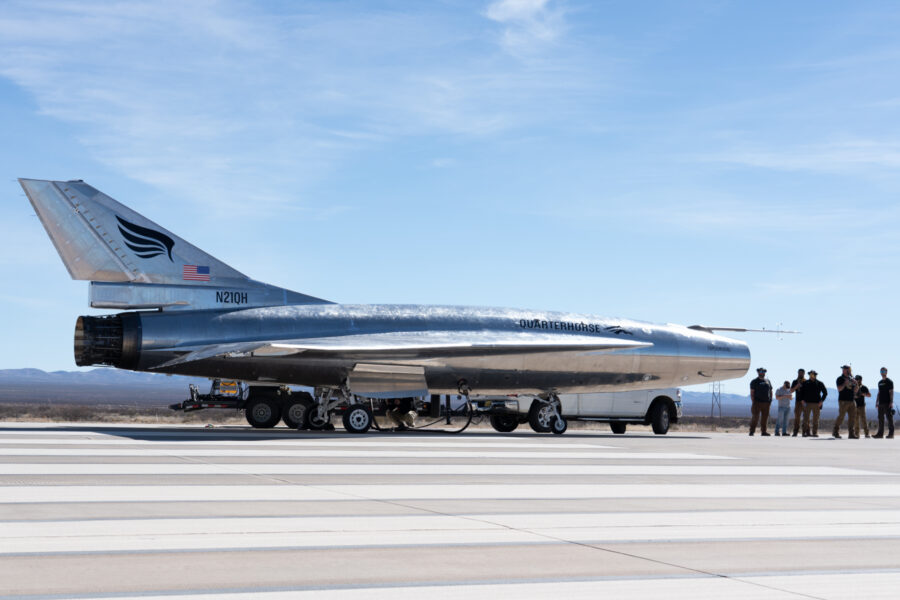
Venture capital-backed aircraft startup Hermeus announced May 28 its Quarterhorse unmanned aircraft will conduct a series of flight tests with the Defense Innovation Unit over the next few years.
Under the $159 million contract, the company will provide flight data from upcoming Quarterhorse flights to DIU, the Air Force, and the Navy to inform future concepts for high-speed military aircraft.
Just this month, Quarterhorse hit a top speed of Mach 1.21, but Hermeus President and incoming CEO Zachary Shore said the firm is expanding the aircraft’s flight envelope with a goal of hitting Mach 3 speeds in 2027.
“This really gets us into the envelope expansion for these three vehicles, getting these higher-speed conditions and demonstrating stable, reusable, high-Mach unmanned aircraft,” Shore told Air & Space Forces Magazine. “For us and the DIU team, getting through those technical milestones to demonstrate the viability of the platform unlocks that there’s a strategically impactful technology.”
Hermeus was founded in 2018 with a strategy to develop hypersonic aircraft for both military and commercial customers through a rapid, iterative prototyping approach. The first Quarterhorse vehicle, Mk 1, debuted in 2025 with a flight at Edwards Air Force Base, Calif., and its second, Mk 2.1, flew for the first time in March. Earlier this month, Mk 2.1 became the first privately funded unmanned aircraft to reach supersonic speeds, hitting Mach 1.21 in a flight over White Sands Missile Range in New Mexico.
Supersonic refers to all speeds above the speed of sound, Mach 1. Hypersonic refers to speed at Mach 5 and above.
The Defense Department has provided some seed funding for Hermeus’ hypersonic ambitions. In 2020, the Air Force’s innovation arm, AFWERX, awarded the company a $1.5 million contract to study options for a future hypersonic Presidential Airlift Fleet. The next year, AFWERX awarded it a $60 million follow-on contract.
In 2023, DIU chose Quarterhorse for its Hypersonic and High-Cadence Airborne Testing Capabilities program, or HyCAT, which is trying to funnel commercial technology into the hypersonic testing space. At the time, Hermeus received $23 million to demonstrate propulsion systems, thermal management, power generation, and mission system capabilities that could be folded into future Pentagon programs.
Shore said that although it took Hermeus seven years to get an aircraft off the ground, its recent test successes posture the company for fast progress. During this next phase of HyCAT work, Hermeus will conduct a series of flights this year and next, testing two more prototypes. Shore said he expects the next vehicle, Mk 2.2, to hit Mach 1.6 this summer, and Mk 2.3 to reach Mach 3 in 2027.
While hypersonic flight is the company’s long-term goal, Shore said the firm is in some early conversations with the Air Force and Navy about potential opportunities for a supersonic Quarterhorse, which Hermeus plans to offer as a standalone product. Shore said he’s hopeful that contracts could materialize once it hits the Mach 3 milestone.
The aircraft is about the size of an unmanned F-16, with 30,000 pounds of thrust, a payload capacity of up 20,000 pounds, and 20 kilowatts of power, Shore said it could perform a number of missions. He highlighted it as a potential fit for programs like the Air Force’s Collaborative Combat Aircraft or as another standalone strike or electronic attack platform. Without specifying its cost, he said Quarterhorse is competitive and its price tag could be adjusted up or down depending on its configuration.
Maj. Gen. Joseph Kunkel, DIU’s military deputy and the former deputy chief of staff for Air Force Futures, said a platform like Quarterhorse could potentially address several challenges the department expects to face in the future—especially when it comes to factors like time and distance.
“If we can mass produce this, then it becomes a game-changing warfighting capability, where we use it as a weapon instead of a test platform, and I think we found a significant number of use cases where it can be used as a weapon,” Kunkel said in a statement.
Hermeus is also in discussion with some combatant commands about opportunities for Quarterhorse to support DOD exercises and experimentation campaigns. Right now, the company is somewhat limited by vehicle availability due to other test commitments, but Shore said they should have enough aircraft on hand by the end of next year.
The Pentagon has said the development of high-speed weapons and air vehicles is a major priority, naming “scaled hypersonics” as one of its six critical technology imperatives last year. In parallel to major weapons development programs, like the Air Force’s Air-Launched Rapid Response Weapon and Hypersonic Attack Cruise Missile, the department has also invested in startups like Hermeus who are maturing key technology that could be leveraged as part of future programs or used to help test capabilities for existing efforts.
Still, despite years of targeted investment, DOD has yet to field a hypersonic platform. Lawmakers have cited concern about this lack of progress, most recently in the House Armed Services Committee’s draft of fiscal 2027 defense policy legislation.
“The committee notes that the Department of Defense has not yet completed transition of hypersonic weapon technologies from science and technology, prototyping, and middle-tier acquisition efforts into major acquisition capabilities,” the bill states, calling for the department to craft a plan to transition hypersonic technologies into major acquisition programs and deliver that strategy by March 2027.