
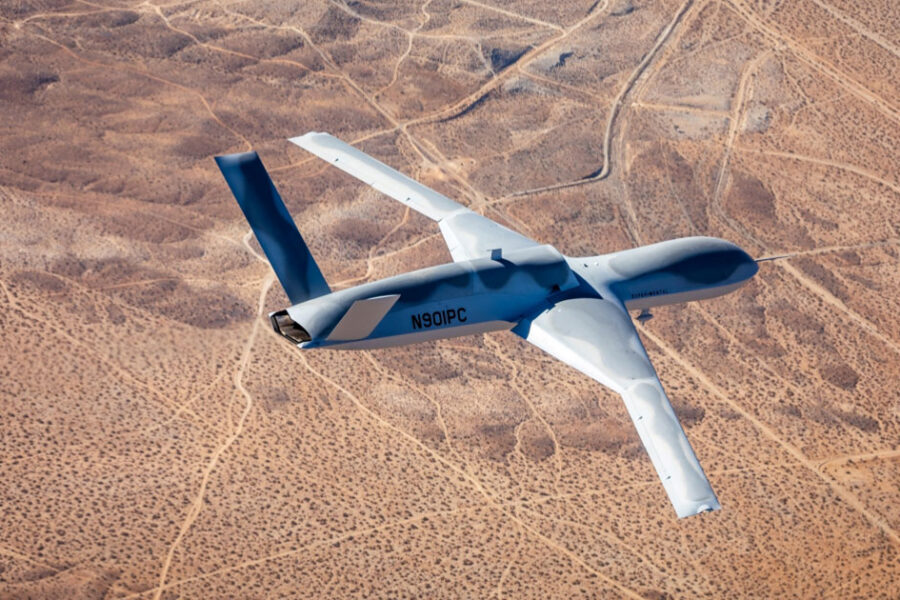
An F-35 Joint Strike Fighter teamed up with a General Atomics MQ-20 Avenger drone in a recent test to refine the Air Force’s Collaborative Combat Aircraft concept, the company said in a May 27 statement.
General Atomics worked with Lockheed Martin, the F-35 Joint Program Office, and several Air Force units to demonstrate the Avenger’s ability to conduct advanced manned-unmanned teaming. This concept is core to Collaborative Combat Aircraft, which will be semi-autonomous drones that pair up with crewed aircraft to extend the Air Force’s reach and ability to carry out missions.
The F-35 remained on the ground and connected with the airborne Avenger drone using beyond-line-of-sight communications. The pilot in the F-35’s cockpit sent tactical autonomy commands to the Avenger drone using a tablet, General Atomics said.
The commands—including orders to carry out tactical maneuvers and adjust its coordinates—were relayed to the MQ-20 via a data link through a satellite in low-Earth orbit, General Atomics said, and the drone sent back critical responses and location, altitude, and velocity data to the F-35 pilot. The Avenger was equipped with General Atomics’ Tactical Autonomy Ecosystem software, which is based on the government’s latest autonomous software standard.
For more than five years, the Air Force has also used the MQ-20 Avenger as a test aircraft and “surrogate” CCA to help develop and refine the concept. General Atomics’ contender for the CCA program is the YFQ-42A.
“This significant warfighter integration milestone is the beginning of operational readiness for the Collaborative Combat Aircraft and demonstrates the near-term opportunities for force integration,” Michael Atwood, vice president of advanced programs for General Atomics Aeronautical Systems, said in a statement. “Events like these drive home [GA’s] continued commitment to adoption of next-generation data links, mission autonomy, and unmanned air combat operations.”
General Atomics claimed the demonstration showed the Avenger’s hardware, software, networks and other systems are capable of carrying out CCA missions. The flight test also included autonomy firm Autonodyne and the Air Force’s 309th Software Engineering Group, 461st Flight Test Squadron, and 370th Flight Test Squadron.
The demo builds on an October 2025 event in which an Air Force F-22 pilot controlled an MQ-20 at the Nevada Test and Training Range, followed by another F-22/MQ-20 flight in February at Edwards Air Force Base.
The Air Force has made the CCA program one of its top priorities and is racing to buy its first drones in fiscal 2027. The service sees the “loyal wingmen” as a way to increase its capacity to carry out strike missions, electronic warfare attacks, reconnaissance, or other operations, at a lower cost and risk.
Congress is strongly supportive of the CCA initiative, not only for the Air Force but also the Navy and Marine Corps, and the House Armed Services Committee included several related provisions in its proposed National Defense Authorization bill released May 26.
The HASC subcommittee on tactical air and land forces, in its markup of the bill, proposed ordering the secretaries of the Air Force and Navy to submit a report to lawmakers on cost impacts while settling on the requirements for their CCA programs. This report, which would be due Jan. 15, 2027, would determine how efforts to minimize costs could affect the attributes of CCAs, and overall operational costs across the fleet.
This report could also detail how CCAs plan to integrate technology, including commercial and modified off-the-shelf tech, that could help bring costs down.
In language accompanying the draft bill, lawmakers said the Air Force and Navy may have to develop CCAs that have enough range, speed, and power to deploy themselves from the continental United States and carry out a variety of missions for geographic combatant commanders—particularly in a potential conflict with China.
Chinese long-range weapons are likely to make it risky to launch CCAs from the string of archipelagos in the Pacific theater known as the “first island chain,” committee members wrote.
“Sufficiently bolstering forward deployed combat airpower, while keeping fleet life-cycle costs low, will require aircraft capable of reliably carrying out an array of missions over extended ranges, all while minimizing attrition,” the committee wrote.
The committee also wrote that it “commends the effective collaboration between the Air Force and industry” on the first increment, or phase, of the CCA program. The subcommittee highlighted how General Atomics and Anduril, manufacturers of the first two CCA variants, were able to conduct successful flight demonstrations in 18 months, “faster than any other major tactical fighter-like aircraft program in recent history,” while continuing tests to refine the capability.
Lawmakers said they support the Air Force’s plan to rapidly transition the first CCA increment to production—and urged the Navy to follow in the Air Force’s footsteps on its own CCA program.
“The Navy and Marine Corps should leverage the mature and innovative technologies and processes developed through USAF Increment 1 and the model of collaboration between the Air Force and industry to accelerate development, improve capability delivered, and reduce risks in both cost and schedule,” the air and land forces subcommittee wrote.
The NDAA draft would require the Navy secretary to brief HASC by Dec. 15 on that department’s CCA acquisition strategy, and spell out how it will use development strategies and technologies pioneered by the Air Force CCA program.