


Anticipating significant demand in the coming years for reconnaissance and surveillance satellites, the Space Force is increasing the ceiling value of its recently awarded Andromeda contract from $1.8 billion to more than $6.2 billion.
The service announced the initial Andromeda awards in early April, choosing 14 companies to compete to build reconnaissance satellites under a program called RG-XX. In a May 4 notice, it indicated that an urgent need for more visibility in orbit drove more funding toward space-based domain awareness programs in the fiscal 2027 budget request. As a result, the Space Force increased Andromeda’s ceiling by more than $4 billion. It also indicated it will eventually use the larger Andromeda indefinite-delivery, indefinite-quantity contract vehicle to buy both reconnaissance satellites for RG-XX as well as surveillance spacecraft for a separate effort called SG-XX.
“Shortly before the award decision, the space reconnaissance and surveillance budget for Fiscal Year 2027 was significantly increased to address the escalating threat environment projected for [calendar year] 2030+,” the Space Force said in the notice. “The revised budget results in increased demand for the same requirements already encompassed within the Andromeda [Multi-Award Contract] IDIQ.”
A Space Systems Command spokesperson told Air & Space Forces Magazine the ceiling increase will support both RG-XX and SG-XX, though the solicitation for the surveillance satellites is not expected until this fall. The spokesperson said the vendors chosen to compete last month are not specific to RG-XX, but may respond to solicitations for either effort.
The increase also provides some margin for the service to accommodate “unknown future U.S. and Foreign Military Sales requirements,” the notice states.
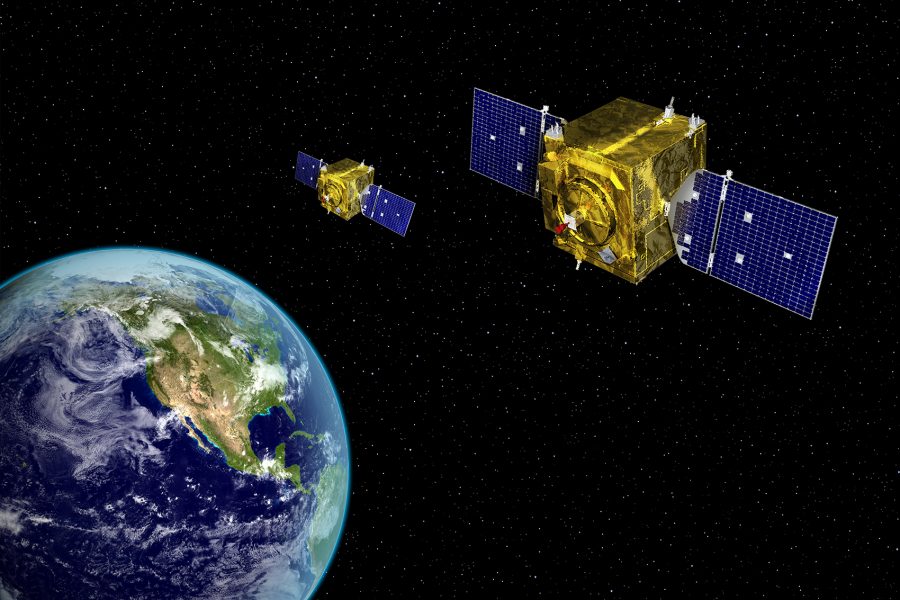
The Space Force’s plan for both RG-XX and SG-XX is to field constellations of small, low-cost, commercial-based satellites to augment and eventually replace existing capabilities. For RG-XX, the focus is on maneuverable satellites that can observe and track activity in geosynchronous orbit. Today, that mission is performed by Geosynchronous Space Situational Awareness Program, or GSSAP, spacecraft.
The service has yet to solicit bids or award contracts for SG-XX, but officials told reporters last December they envision a fleet of wide-field-of-view satellites to surveil GEO. Those satellites will form the follow-on to a joint Space Force-National Reconnaissance Office program called Silent Barker, which complement GSSAP. The satellites coordinate target tracking and data sharing amongst themselves using complementary sensors. Both programs have, thus far, been developed and fielded largely in secret.
Space domain awareness is a top priority for the Space Force and U.S. Space Command. Officials want the ability to better track threats and gain more insight into potential adversaries’ on-orbit operations. Along with space-based sensors, the service has a network of ground radars that track activity in orbit as well as launches.
Surveillance is focused on more general, prolonged monitoring—which wide-field-of-view sensors can provide—while reconnaissance is focused on specific objects and targets on tighter timelines. Maneuverable satellites would be particularly useful for reconnaissance; proliferation, however, could benefit both missions.
The Space Force’s fiscal ‘27 budget request includes $355 million for RG-XX to fund satellite design and manufacturing as well as additional contract awards and experimentation. The service plans to field the satellites in increments, with the first batch launching in 2029 and the second in 2030. The budget also funds ground system development. Future-year projections show the service spending nearly $2.8 billion on the program between fiscal ‘27 and ‘31, hitting a peak of about $1 billion in fiscal ‘29.
For SG-XX, the Space Force wants $370 million in fiscal ‘27 to continue funding satellite development and to prepare for the launch of the first increment in 2030. The budget also would fund a two-satellite prototype demonstration called YSG-XX, which is slated to launch in 2028. The service’s five-year projection calls for $1.7 billion between fiscal ‘27 and fiscal ‘31.
Editors note: This story has been updated to include additional information from Space Systems Command about the Andromeda solicitation and the ceiling increase.