


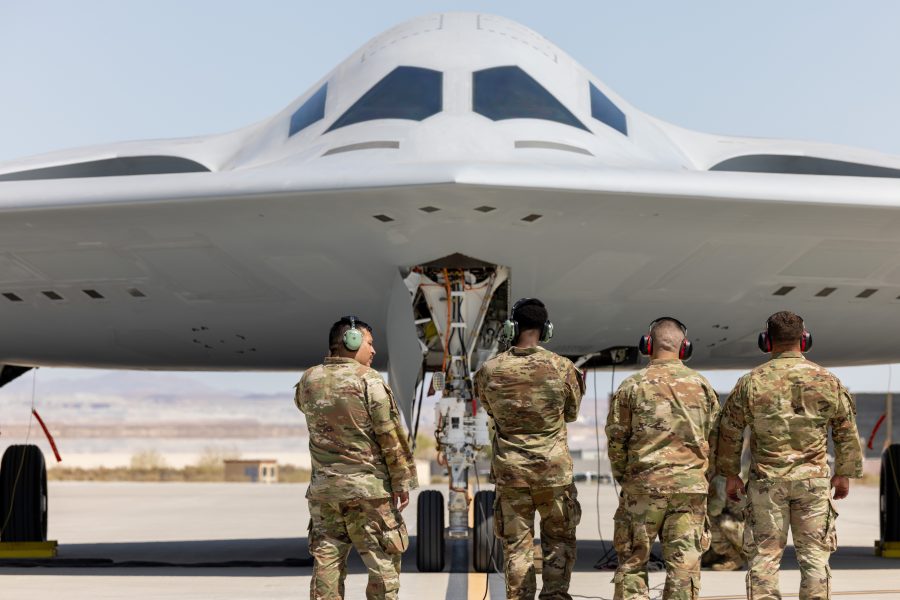
Northrop Grumman hopes its efforts to make more B-21 Raiders faster will encourage the Air Force to expand the final fleet size of the advanced stealth bomber.
Kathy Warden, Northrop’s chief executive, said during a May 28 discussion at the Bernstein Strategic Decisions Conference that the company is taking steps—at times, on its own dime—to expand its production capacity for the B-21.
If the Air Force is confident that Northrop will be able to handle increased B-21 orders, Warden said, they may feel more comfortable buying more than 100, the minimum number the service has committed to at this point
“As we move through the completion of the test program and into production, we look forward to the opportunity to build these faster—and that’s the agreement that we have now come to with the Air Force—which also opens up the opportunity for [the Air Force] to potentially buy even more,” Warden said.
“That increased rate allows [the Air Force] to consider how they meet mission requirements, and how many aircraft they would want to build to do that,” Warden continued. “They are undertaking that analysis now, and certainly our ability to build faster is a positive factor in those evaluations.”
Warden’s comments came at a time when the Air Force is expressing more openness to boosting the B-21 fleet beyond its official stated goal of “at least 100”—and as the service is facing pressure to do so.
Secretary of Defense Pete Hegseth in April told lawmakers that the Air Force will need “a lot more” than 100 B-21s in the future, the strongest signal yet that Pentagon leadership wants to expand the Raider fleet. The Air Force’s top planner, Lt. Gen. David H. Tabor, told lawmakers May 13 that the Air Force will likely spell out its revised B-21 fleet numbers in spring 2027, as part of the fiscal 2028 budget proposal.
Congress may want to know even sooner than that. A draft of the National Defense Authorization Act for fiscal 2027 released May 26 by the House Armed Services Committee would require the Pentagon to submit a report by December 2026 that determines how many B-21s would be needed to carry out both nuclear and conventional missions, and if more than 100 are needed, how long it would take to buy those additional bombers.
Committee members wrote that they were “concerned” that the current plan to buy 100 B-21s “may be insufficient to meet the requirements of the National Defense Strategy.”
That goal of 100 has remained unchanged since it was first set in 2015, the committee wrote, even though the security environment has changed considerably since then, and top national security leaders such as the last two heads of U.S. Strategic Command have called for buying more B-21s.
Most recently, STRATCOM Commander Adm. Richard Correll told lawmakers in March that the Air Force needs 145 B-21s and said opening up a second production line to reach that goal is being considered.
The B-21 is a sixth-generation bomber that will be able to carry both conventional and nuclear weapons. It has advanced stealth, data-sharing capabilities, and open systems architecture, and the Air Force plans to use it to carry out penetrating strike missions deep in enemy territory.
It is expected to replace the aging B-1B Lancer and B-2A Spirit bomber fleets sometime in the 2030s. The Air Force is now flight testing two B-21s at Edwards Air Force Base in California, and the first operational Raider is expected to arrive at Ellsworth Air Force Base in South Dakota in 2027.
Northrop Grumman is building B-21s at its facility at Air Force Plant 42 in Palmdale, California.
The Air Force and Northrop have been looking for ways to boost production. In February, the Air Force announced it and Northrop had agreed on a plan to increase B-21 production capacity by 25 percent, using $4.5 billion from the massive reconciliation bill passed in 2025 nicknamed the “One Big Beautiful Bill.”
Warden said in an April earnings call with investors that Northrop Grumman is also investing $2.5 billion of its own money in bolstering B-21 production. Most of that money will be spent on building new facilities, Warden said, and will be phased in over several years.
Northrop Grumman also reported a $477 million loss on the B-21 in the first quarter of 2025, and at the time said much of that resulted from changes to its production process intended to allow the company to build Raiders at a higher rate.
During her talk at the May 28 Bernstein conference, Warden said the company learned something about its manufacturing process that led to the 2025 loss.
“No program is going to be perfect, and so we had that ‘learning,’” Warden said. “It resulted in some rework, and we took that charge.”
Warden expressed confidence in Northrop’s ability to continue building B-21s efficiently while lowering the risk faced by the program.
“For a program of this size, complexity, and duration, this program is performing exceptionally well,” Warden said. “But any program of this size does carry with it risk, especially as you move into production for the first time. But we are retiring those risks with each passing day. As the aircraft tests well, and we get through build processes, we are feeling very positive about our ability to continue to deliver on our estimates.”