


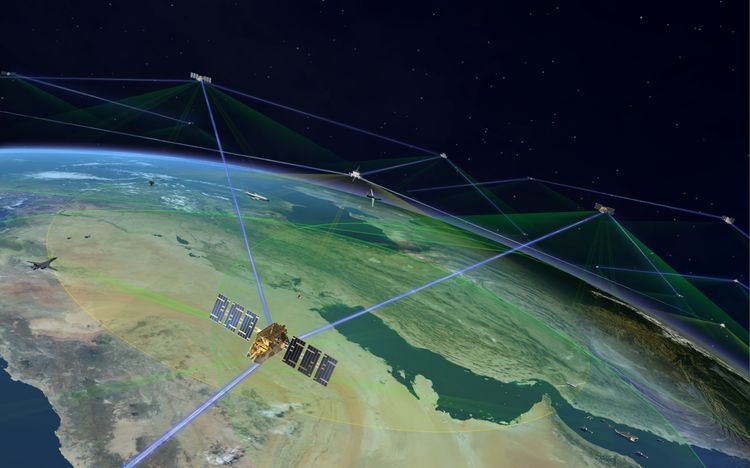
The Space Force plans to expand the scope of its data transport constellation in the next few years, kick-starting a competition to bring on new commercial capabilities and procuring nine launches in fiscal 2027 to support the hybrid satellite communications network.
The effort, called the Space Data Network, will bring together both military and commercial satellites to manage both tactical and enterprise communication needs, enabling sensor-to-shooter data transport for missile defense and other missions. The fiscal ‘27 budget includes $1.5 billion for SDN research and development and a separate $1.5 billion procurement account proposes funding to continue to build out the low Earth orbit constellation. The request also reflects the service’s proposal to move the Space Development Agency’s Transport Layer and a joint Space Force-National Reconnaissance Office effort called MILNET under the SDN umbrella.
Space Force officials have offered few details on what programs will fall under SDN and how they will be woven together and orchestrated. In an April 21 budget rollout briefing, Deputy Assistant Secretary of the Air Force for Budget Maj. Gen. Frank Verdugo described the network as “a resilient joint network architecture providing high capacity and low latency transport.”
Air Force Secretary Troy Meink said April 15 that part of the reason for the lack of a clear message on the program is that the service is still refining what the SDN architecture will look like.
“We probably need to improve how we tell that story, and we’re working on it,” Meink told reporters during the annual Space Symposium in Colorado Springs, Colo. “One of the challenges is there’s just so many different user sets that we’re supporting, and some of these users have different requirements … and we have to meet them all. So, that’s the architecture we’re refining now. This is an area where the technology is moving so fast. Things we thought five, six years ago were impossible are very possible and actually more affordable than we would have thought.”
Detailed budget documents released April 27 offer insight into some elements of the architecture and how the Space Force would spend near-term funding, if appropriated by Congress. Most of the program’s research and development budget would fund an effort to integrate a commercially derived radio frequency payload onto “multiple planes” of communication relay satellites that will support Golden Dome’s Space-Based Interceptor program. The procurement budget indicates the Space Force will buy 21 SDN space vehicles in fiscal ‘27, up from 13 in fiscal ’26.
The service also plans to expand its provider base for SDN’s communications backbone, previously known as MILNET. Currently, SpaceX is the sole provider for the effort, but a Space Force spokesperson told Air & Space Forces Magazine the service wants to “galvanize the U.S. industrial base to meet Space Force proliferation needs,” and that identifying a second contractor to build SDN satellites—as well as other elements of the architecture—is part of that.
“The SDN Backbone is being expanded to include additional vendors across all architectural elements,” the spokesperson said. “The first delivery order for operational capability is currently going through a competitive award process and therefore vehicle quantities and vendor details cannot be provided.”
Other technology development efforts proposed in fiscal ‘27 include $50 million to integrate the Space Development Agency’s Transport Layer into the SDN and $20 million to “synchronize” space-to-space command and control needs across various agencies and capabilities. That funding will help enhance a DARPA program to develop low-cost, reconfigurable intersatellite optical communication terminals called the Space-Based Adaptive Communications Node. And it will support development of a communications testbed as well as an Air Force Research Laboratory effort to develop the networking systems that will manage the SDN.
Finally, the Space Force’s budget proposal includes $40 million for SDN prototyping and experimentation. Last year, it began an effort to assess the performance and resilience of proposed SDN systems, work that will continue through fiscal ‘28. The service also has an ongoing prototype integration and test campaign and plans to start operational experimentation in fiscal ‘26.