


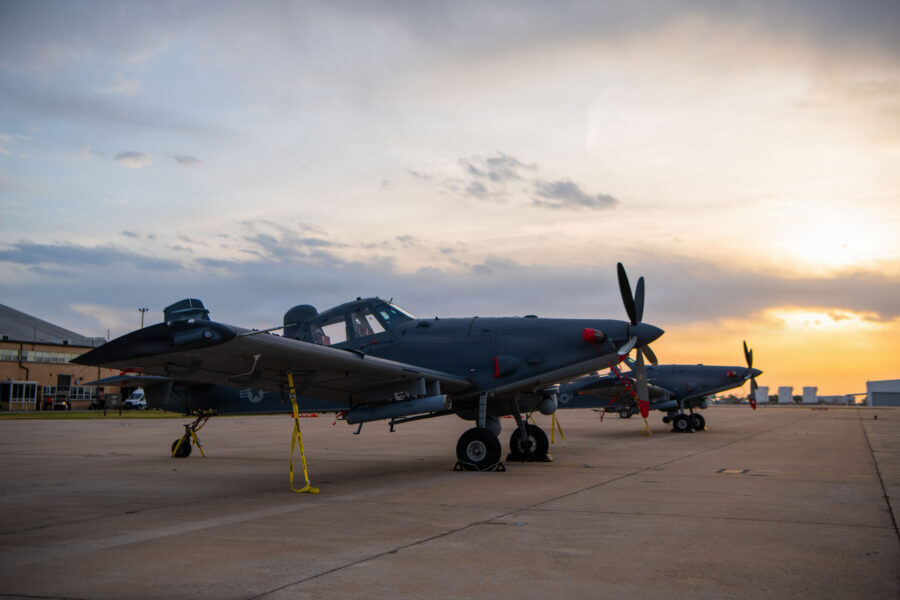
With a shrinking fleet and growing operational demand, Air Force Special Operations Command sees the new OA-1K combat scout aircraft as key to a “new era,” officials say.
Even as budget constraints threaten to limit the number of aircraft built, AFSOC is charging forward on the program, also known as Armed Overwatch. The command recently received its 18th airframe from contractor L3Harris, commander Lt. Gen. Michael Conley told lawmakers last week. And ahead of the annual SOF Week conference that started May 18, a command official said the OA-1K will start operational testing later this year, then likely fly in large-scale exercises in 2027.
“We’re kind of transitioning and pivoting—the program has matured to the point where we can actually start to demonstrate capability, so it’s really reaching an exciting point in the program where we can actually start to see the benefits and the fruits of the labor up to this point,” Lt. Col. Robert Wilson, AFSOC’s Armed Overwatch requirements branch chief, told reporters May 15.
Combat deployments are coming in the next few years, Wilson said, though he declined to offer a definitive timeline.
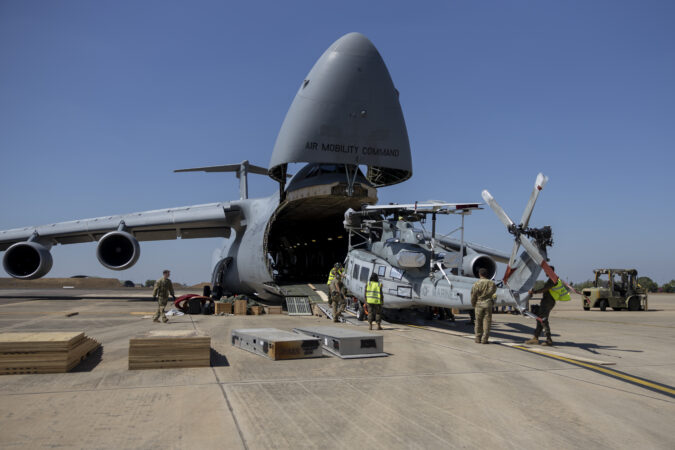
Both Conley and Wilson made the case that the OA-1K, dubbed the Skyraider II, can be a “Swiss Army knife” for the joint force—not only capable of conducting multiple missions, but easily transportable. Crews will be able to break down the modified crop duster and put it on a transport aircraft for quick deployments.
“With rapid disassembly and reassembly, OA-1K can be loaded into mobility aircraft like a C-5 or C-17 for rapid worldwide deployment, supporting missions around the world at a moment’s notice,” Wilson said. “And importantly, we’re talking a matter of hours, instead of the days or weeks that it would have otherwise required to fly around the world.”
Wilson said AFSOC has tested the capability in a hangar and plans to load a Skyraider into a cargo aircraft later this year as part of operational testing. He said the process requires a “handful of maintainers” and described it as taking “hours,” but did not provide exact details on how many personnel are needed and how long it takes.
After reassembly, the plane’s two crew members are trained to conduct “functional check flights” before flying missions, Wilson said.
In a release, AFSOC said “several” OA-1Ks can fit on a larger transport aircraft. Wilson said the command has done preliminary work to see how many but said the final determination will come through operational testing.
Air Force airlifters can already transport helicopters for all the services, but for fixed-wing aircraft, “this really is a unique capability,” Wilson said.
It’s an important one, because the OA-1K maxes out at about 250 miles per hour with a range of 1,500 miles, so it cannot cover long distances at quick speeds in a contingency. Even with those limitations, AFSOC says the Skyraider can be useful in scenarios beyond the counterinsurgency fight for which it was originally envisioned.
“OA-1K represents a new era for AFSOC, with the flexibility to support not only counterterrorism-like missions, but also crisis and contingency response, competition with more advanced adversaries, and even aspects of full-on conflict,” Wilson said.
Conley has made the case before that special operators will find “novel” ways to use the OA-1K once it is in the fleet, and both he and Wilson said the platform is modular enough to employ future payloads and weapons. L3Harris has already pitched its low-cost cruise missile as a possibility for the aircraft, and Conley indicated AFSOC is interested.
“It could do exquisite [signals intelligence], collect intel, and also be armed with up to 6,000 pounds of payload, whether that’s Hellfires, rockets, maybe some small cruise missiles that we’re working on,” he told members of the Senate Armed Services Committee.
The Air Force has made a point of moving away from aircraft that cannot survive in contested airspace. While the OA-1K is far from stealthy, Wilson argued it can hold its own.
“We have a built-in certain survivability capability for the platform. The contractor that’s working on it has built-in cockpit and engine armor, for example, to ensure that it’s survivable, and it does have defensive systems,” he said. “So I would say it does have a baseline level of defensibility and survivability equipped, and then we are certainly working on, with funding, ensuring that it is modernized and equipped, not only for survivability, but for really any other capability for the platform as well, to ensure that it remains relevant for the future.”
Funding is a major issue, though. U.S. Special Operations Command, which is procuring the OA-1K, has trimmed its planned purchase from 75 down to 53 airframes, citing resource constraints. AFSOC, as the “capability sponsor,” is still pushing for the stated requirement of 75, Wilson said.
Before Congress, Conley made the case that AFSOC’s fleet cannot afford any more cuts after years of divestments and deferred modernization.
“We’ve now reached an inflection point. More than one third of our fleet has been reduced while demand continues to rise,” he warned. “Further divestments will directly translate into missions we cannot execute.”
The OA-1K is the only new manned aircraft in production for AFSOC. The command may get replacements for its two MC-130Js destroyed during a search-and-rescue operation in Iran in April, but Conley said that will “take time.”