
Editor’s Note: This story was updated April 29 to include comments from U.S. Special Operations Command.
U.S. Special Operations Command is shifting its aviation plans to favor more drone swarms and fewer militarized crop-dusters, according to its fiscal 2027 budget request.
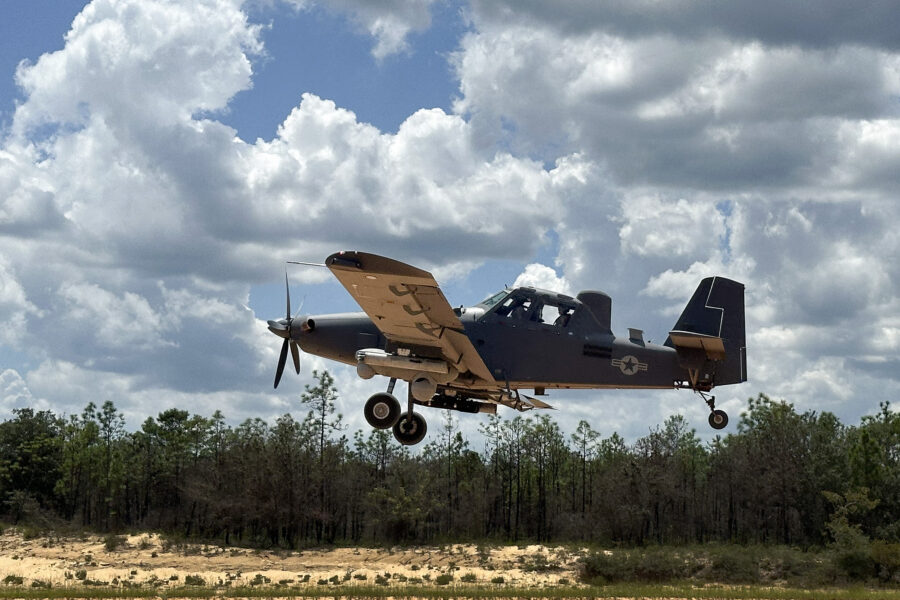
According to budget documents released this month, the combatant command is once more scaling back its planned purchases of the OA-1K Skyraider II to just 53 aircraft in total. That’s down from the 62 aircraft previously budgeted and the 75 aircraft originally envisioned for SOCOM’s Armed Overwatch program.
For 2027 in particular, SOCOM is proposing to buy just two OA-1Ks, down from six in 2026 and 12 in 2025.
The idea behind Armed Overwatch was to buy a rugged aircraft that could perform the light attack, close air support, and intelligence, surveillance, and reconnaissance missions previously fulfilled by several different aircraft types, particularly for counterinsurgency operations. In 2022, SOCOM selected L3Harris’ AT-802U Sky Warden as the program’s winner—the aircraft is a converted Air Tractor AT-802 crop-duster, with a single engine, turboprop, and a tailwheel.
While SOCOM is buying the OA-1K, the planes will be in the Air Force’s inventory. The original contract with L3Harris was worth up to $3 billion for the full fleet of 75 aircraft.
Critics have questioned the need for that many OA-1Ks, given the U.S. military’s shift to prioritize operations in the Indo-Pacific, where airspace is expected to be far more contested. The Government Accountability Office in particular suggested in late 2023 that SOCOM might need a “substantially smaller” fleet based on its requirements.
Air Force Special Operations Command boss Lt. Gen. Michael E. Conley has defended the OA-1K, though, arguing that special ops forces will “figure out novel ways that it will be relevant in the future fight as well as the current one” and that the counterinsurgency mission isn’t going away anytime soon. And SOCOM has been careful to note in its budget requests that it is reducing the budgeted fleet size, not the “program of record”—the official requirement for the fleet size.
The 2027 budget request notes that the latest cut to 53 aircraft “reflects the strategic reallocation of resources to support [SOCOM] evolving priorities,” but a command spokesperson confirmed that the program requirement remains 75 aircraft.
Budget documents now show plans to reach just $1.35 billion in procurement spending, ending with four aircraft purchased in 2028 and two in 2029.
MQ-9 Motherships
While SOCOM is scaling back its plans for the OA-1K, the command is surging its efforts to turn the MQ-9 Reaper into a drone “mothership” surrounded by smaller unmanned systems.
Air Force Special Operations Command has been exploring the idea through an effort it calls the Adaptive Airborne Enterprise, or A2E. The goal is to transition the MQ-9 from its traditional strike and intelligence, surveillance, and reconnaissance missions to become a mobile control center for a network of small drones which can form an “expansive sensing grid” to find targets or create communications pathways for special operators deep in the battlespace.
That effort is poised to kick into high gear in 2027; SOCOM is requesting $75.8 million for the MQ-9, more than triple the $24.9 million it got for 2026. Almost all of that increase is going toward A2E, with plans to spend nearly $48 million on:
- 93 “Group 2” drones
- 10 “Group 3” drones
- 16 swarm carrier pods
- Five ground system interfaces for human-machine teaming
Group 2 drones weigh no more than 55 pounds and operate 3,500 feet above ground level. Group 3 drones weigh up to 1,320 pounds and can operate up to 18,000 feet. Both fly at less than 250 knots.
Budget documents note that the Group 2 drones will be “air-launched effects” used for intelligence, surveillance, and reconnaissance. The Air Force awarded a $50 million contract last year for one such system in Anduril Industries’ ALTIUS 600, but other options could be on the table.
The Group 3 drones, meanwhile, will be “signature managed,” meaning they have been designed to reduce their electromagnetic footprint. Last year, the Air Force conducted market research on such drones to see if they could serve as command-and-control or data relay nodes for drone swarms.
It’s unclear exactly how many Group 2 or 3 drones the Air Force or SOCOM want to pair with each MQ-9, but the 2027 plan represents a major increase over the 2026 budget, when the combatant command said it wanted to buy 29 Group 2 drones.
“sUAS units and Swarm Carrier pods are a continuation of efforts to provide capabilities to project air-launched effects to meet AFSOC requirements,” the SOCOM spokesperson said.
And looking further down the road, it appears SOCOM is preparing for a steady stream of such spending, with projections showing more than $50 million for the MQ-9 program every year from fiscal 2028 to 2031.
