


The Air Force wants to rapidly replace about two dozen MQ-9A Reaper drones lost during Operation Epic Fury against Iran, top service officials told lawmakers May 12.
“We are concerned about how they’ve attrited,” said Lt. Gen. David Tabor, Air Force deputy chief of staff for plans and programs, while testifying before the Senate Armed Services air-land subcommittee.
Tabor suggested the Air Force wants to move quickly.
“We’re looking at options to buy back as many of the MQ-9As as we possibly can right now, so there’s a bit of a short-term effort to buy back things immediately, in this fiscal year,” Tabor said.
The Air Force is working with Pentagon leadership on how to do that.
The MQ-9A model now flown by the Air Force is no longer in production. General Atomics shut down that production line in 2025 after the Air Force confirmed it would not buy more.
But that was before the Reapers proved uniquely valuable in operations over Iran in the opening weeks of Operation Epic Fury, both to gather intelligence and to execute strikes on Iranian forces. The Reapers can remain on station for up to 24 hours without putting pilots at risk. But the aircraft are comparatively slow and have proven vulnerable to Iranian anti-aircraft weapons.
The Air Force ended fiscal 2025 with 158 MQ-9s in the Active force and 24 more in the Air National Guard. But over the course of the past 18 months, numerous MQ-9s have been lost to anti-aircraft fire and drone strikes that crippled some Reapers on the ground. In addition, Houthi militants operating in Yemen destroyed at least a dozen MQ-9s in earlier operations.
Tabor told the committee that that the USAF MQ-9 fleet now numbers about 135, yet has been able to fulfill all combat requirements assigned to Reaper units.
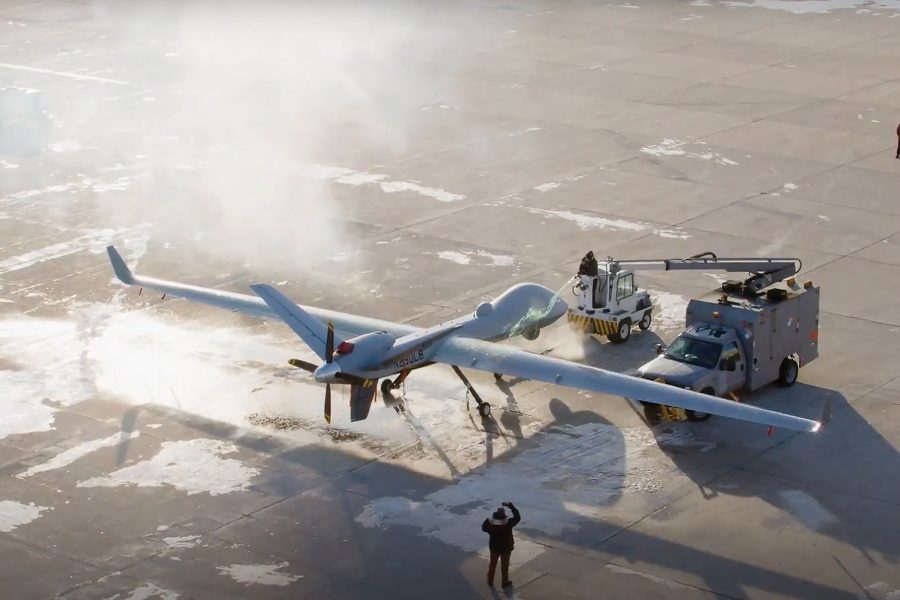
Tabor did not detail what the options for short-term replacement of the lost MQ-9s might be now that the MQ-9A production line has been shuttered. But perhaps the likeliest option would be General Atomics’ MQ-9B, sometimes referred to as SkyGuardian, the successor aircraft to the original model.
General Atomics is “offering the U.S. Air Force modular options for MQ-9B, at a price that reflects the [Department of War’s] requirements and can be delivered today,” company spokesman C. Mark Brinkley said in a statement to Air & Space Forces Magazine.
With its 79-foot wingspan and 38-foot length, the MQ-9B is substantially larger than the Reaper’s 66-foot wingspan and 36-foot length. That larger airframe means the MQ-9B can carry about 28 percent more than the A model: 800 pounds internally, plus 4,000 pounds externally. Its range is far greater too: the MQ-9B can fly 6,000 nautical miles, more than four times the Reaper’s 1,400-nautical miles range.
A fully equipped MQ-9B would cost about $30 million apiece, Brinkley said, but costs could be pared by reducing capabilities.
Alternatively, Brinkley said General Atomics has fewer than 10 Reapers that could be provided, if necessary, to the Air Force from its remaining inventory, including about five that could be built from stores of parts now on hand. Some older, decommissioned Reapers could be returned to service from the Boneyard, he said.
Longer Term Options
Beyond adding to the MQ-9 fleet in the short term, Tabor said the Air Force is examining the “medium-term problem” of how Reaper requirements might be filled by other types of aircraft.
Maj. Gen. Christopher Niemi, military deputy for the deputy chief of staff of Air Force Futures, said the Air Force wants to follow a similar approach in developing an MQ-9 successor as it has used in developing the Collaborative Combat Aircraft program.
“We were very successful with the CCA program in communicating to industry the types of attributes that we wanted, canvassing for a number of companies, [and] ultimately down-selecting,” Niemi said. “We’d like to do a similar thing with the platform that will follow MQ-9.”
Lt. Gen. Luke Cropsey, military deputy to the Assistant Secretary of the Air Force for Acquisition, Technology and Logistics, said this week that the Air Force had received over 50 responses to a recent request for information about a potential MQ-9 successor.
“There is a burgeoning interest across the broader defense industrial base on what comes next,” Cropsey said.
Niemi said the ideal MQ-9 successor should make greater use of modular open architecture technologies and be more adaptable and easier to mass produce than the Reaper.
This could make it more affordable and attritable than the current MQ-9 fleet, which Niemi told Senators could cost up to $50 million, depending on how exquisite its sensors would be.
“By getting something that’s more modular, we think we could take advantage of an opportunity, if you knew that aircraft was going to operate in a high-threat environment, of taking off those packages that drive that cost, to a much lower price point,” Niemi said.